
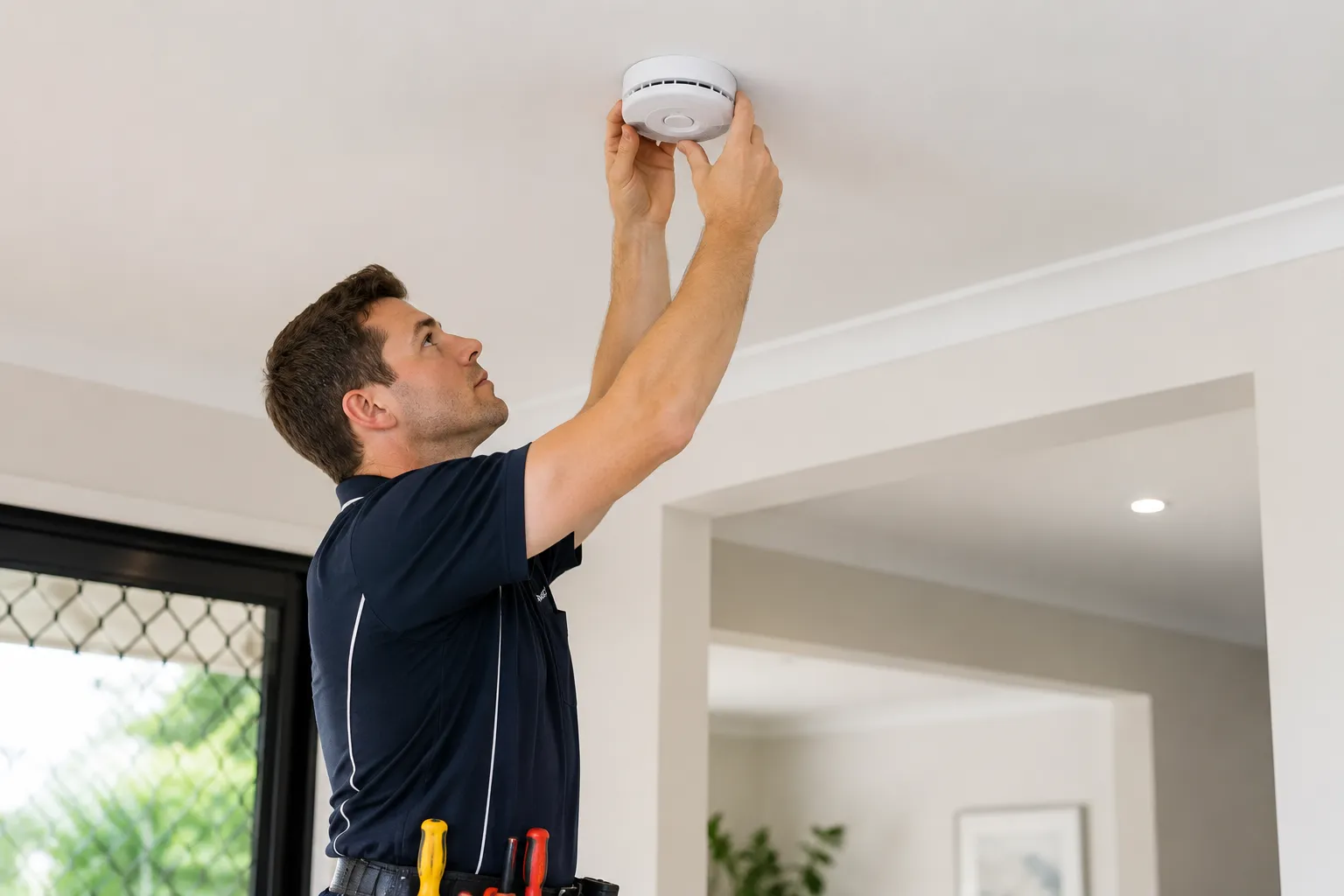
Queensland has the strictest smoke alarm laws in Australia, and the final compliance deadline is now close. From 1 January 2027, every owner-occupied home in Queensland must have interconnected photoelectric smoke alarms installed in every bedroom, in hallways between bedrooms and living areas, and on every storey — the same standard rental properties and homes being sold have been required to meet since 2022. Aurora Electrical Solutions installs fully QLD-compliant interconnected photoelectric smoke alarm systems across Brisbane, the Gold Coast, Logan and SEQ — for owner-occupiers preparing for the 2027 deadline, landlords ensuring rental compliance, and homeowners preparing properties for sale. Aurora is a fully licensed Queensland electrical contractor (Licence EC91972), Master Electricians Australia members, fully insured. Compliance certificate provided on every job — the document your conveyancer, property manager or insurer will need.
What's included
- QLD-compliant photoelectric smoke alarms to AS 3786:2014
- Interconnected installation (wired or wireless RF mesh) — one alarm sounds, all alarms sound
- Hardwired 240V mains-powered alarms with battery backup, OR sealed 10-year non-removable battery alarms
- Installation in every bedroom, hallway between bedrooms and living areas, and on every storey as legislated
- Removal and safe disposal of old non-compliant alarms (ionisation, expired, or non-interconnected)
- Suitable for owner-occupied homes (2027 deadline), rental properties, and pre-sale compliance
- Brands: Brooks, Clipsal, Cavius, Quell, Family First — all CSIRO ActivFire certified
- Smart alarm options with Wi-Fi connectivity and smartphone notifications where requested
- Heat alarms for kitchens (where smoke alarms aren't appropriate)
- Compliance certificate signed by a licensed contractor on completion
- Documentation suitable for property managers, conveyancers, building certifiers and insurers
- Bulk landlord audits — multiple properties assessed and quoted in one trip
When you need to upgrade your smoke alarms
If any of these apply, your home is either already non-compliant or about to be. Booking now avoids the supply rush expected before the January 2027 deadline.
- You own and live in a home in Queensland (2027 deadline applies to you)
- You're a landlord with one or more QLD rental properties (compliance was required from January 2022)
- You're selling a QLD property (compliance required at the point of sale)
- Your existing smoke alarms have a black 'radioactive' symbol marked on them (ionisation — banned)
- Your alarms aren't interconnected (when one sounds, the others stay silent)
- Your alarms aren't installed in every bedroom
- Your home is multi-storey but only has alarms on one level
- Your alarms are more than 10 years old (check the manufacture date stamped on the back)
- Alarms fail when you press the test button
- You're renovating or extending — new dwelling and major renovation work triggers the full requirements
- You inherited or purchased a property without checking the smoke alarm compliance
- Your property manager flagged smoke alarm non-compliance during a routine inspection
- Your conveyancer flagged missing or non-compliant alarms during pre-settlement checks
How much does QLD compliant smoke alarm installation cost?
Pricing depends on how many alarms are required (driven by bedroom and storey count), whether existing wiring can be reused, and whether you choose hardwired or 10-year battery alarms. As a general guide for Brisbane:
- Single-storey 3-bedroom home (typically 4-5 alarms — 3 bedrooms + hallway + living): $400 – $700 installed
- Single-storey 4-bedroom home (typically 5-6 alarms): $500 – $850 installed
- Two-storey 4-bedroom home (typically 6-8 alarms — bedrooms + hallways + each storey): $700 – $1,200 installed
- Larger homes (5+ bedrooms or 3 storeys): typically $1,000 – $1,800 installed
- Hardwired alarms (using existing ceiling cabling): typically $90 – $150 per alarm installed
- 10-year sealed battery alarms (no rewiring required): typically $80 – $130 per alarm installed
- Wireless RF mesh interconnection (no rewiring between alarms): adds $0 – $20 per alarm depending on brand
- Replacement-only (existing compliant alarms past 10-year life): typically $80 – $130 per alarm
- Same-day installation for urgent compliance (pre-settlement, lease commencement): typically $100 – $200 surcharge
- Bulk landlord audit (multiple properties): per-property pricing typically reduces 15-25% when 3+ properties booked together
Every job is fixed-price quoted up-front — you know exactly what it costs before we start. Most quotes can be provided remotely from a quick floor plan sketch or property description; for larger homes a 10-minute site visit gives the most accurate quote. No hidden fees, no callout charges, certificate of compliance issued on completion.
How long does the installation take?
Most QLD-compliant smoke alarm installations are completed in 1.5 to 4 hours and you have a fully working system before we leave. A standard single-storey 4-5 alarm install takes 90-120 minutes. A two-storey 6-8 alarm install takes 2-3 hours. Larger homes or systems with hardwired retrofit through existing ceilings can take 3-4 hours. We test every alarm with smoke aerosol before leaving to confirm both individual operation and interconnection. Same-day installation is available across Brisbane and SEQ for urgent compliance jobs (pre-settlement, rental compliance, sale disclosure) subject to availability.
QLD smoke alarm law — what the legislation actually requires
Queensland's smoke alarm law was introduced after the 2011 Slacks Creek house fire in Logan that killed 11 people — the deadliest house fire in Australian history. The legislative response has been progressively rolled out over a decade, and the final phase lands on 1 January 2027. Here's what the law actually requires:
- Photoelectric technology only — ionisation smoke alarms are banned; alarms must comply with Australian Standard AS 3786:2014
- Interconnected — when one alarm activates, every other alarm in the home must also sound (wired or wireless RF mesh both acceptable)
- Hardwired (240V mains) with battery backup, OR powered by a non-removable 10-year sealed battery
- Location: every bedroom — one alarm inside each bedroom is mandatory
- Location: hallways — in any hallway connecting bedrooms to other parts of the dwelling
- Location: every storey — at least one alarm on each level, even if no bedrooms are on that storey
- Less than 10 years old — alarms must be within their service life (manufacture date stamped on the back)
- Test button on each alarm — operational verification possible without removing the alarm
- Hush button — required to allow temporary silencing of nuisance activations
- Hardwired replacement rule — if you replace an existing hardwired alarm, the new alarm must also be hardwired (you can't downgrade to battery-only)
How smoke alarm installation runs
Most smoke alarm jobs are fast, clean and disruption-free. Here's the typical process:
- Free quote — usually remote — Tell us the number of bedrooms, the number of storeys, and the suburb. For most homes we can quote remotely within 30 minutes — number of alarms calculated, fixed price provided, install date booked. For larger or complex homes we do a free 10-minute site visit first.
- Pre-install — alarm choice and brand — We recommend the right alarm type based on your existing wiring and budget. Hardwired alarms (using existing ceiling cabling) are typically slightly cheaper per alarm than 10-year battery types where the wiring is already in place. 10-year sealed battery alarms with wireless RF mesh interconnection avoid any new cabling work and are usually the right answer for retrofit jobs. We work with all the QLD-compliant brands (Brooks, Clipsal, Cavius, Quell, Family First) — all CSIRO ActivFire certified.
- Install day — placement and mounting — We confirm the locations on arrival — every bedroom, hallway, and storey as required. Old non-compliant alarms removed and safely disposed (ionisation alarms contain a small amount of radioactive material and must be disposed of correctly). New alarms mounted to ceiling, hardwired where applicable to existing cabling with battery backup, or 10-year battery-powered if retrofit without rewiring.
- Interconnection — wired or wireless — Wired interconnection uses existing or new 3-core cable between alarms (used where alarms are already hardwired to mains). Wireless RF mesh interconnection is the modern default for retrofit — alarms pair to each other via low-power radio signal at install, no cables required between alarms. We commission the interconnection and verify every alarm responds when any single alarm activates.
- Testing and verification — Every alarm tested individually (manual test button + smoke aerosol where appropriate) to confirm correct operation. Interconnection verified by activating one alarm and confirming all others sound. Battery and mains-power indicators checked. Any failed alarms replaced before we leave — no exceptions.
- Compliance documentation and walkthrough — You receive a written Compliance Certificate signed by a licensed contractor — the document your conveyancer, property manager or insurer may need. We walk you through how to test the alarms (monthly), what the various beeps and signals mean, and when individual alarms will need replacing. For landlords we also provide the documentation pack property managers typically request for tenancy commencement.
The 1 January 2027 deadline — what owner-occupiers need to know
The 1 January 2027 deadline is now less than a year away as of mid-2026. From that date, every owner-occupied home in Queensland — houses, townhouses, units, manufactured homes — must have interconnected photoelectric smoke alarms installed to the same standard rental properties and homes being sold have been required to meet since 1 January 2022. There are no exemptions for older homes, smaller homes, or homes where the owner has lived without complaints for decades. The law applies to every dwelling.
After 1 January 2027, non-compliant homes face fines starting around $2,611, but the more significant exposure is liability. Home insurance policies increasingly include compliance clauses — a fire claim on a non-compliant home can be partially or fully denied if the missing or substandard alarms are deemed to have contributed to the loss. The reputational and personal cost of a fire that compliant alarms would have detected earlier is incalculable.
The practical advice for owner-occupiers: don't wait until December 2026. Supply of compliant alarms and installer availability will tighten significantly in the last quarter as people scramble to meet the deadline. Aurora has been delivering compliant installs across SEQ for years and we book ahead — installs scheduled in 2026 will be smoother and lower-priced than installs scheduled in the rush at year-end.
Landlords and rental properties — already mandatory since 2022
Since 1 January 2022, every rental property in Queensland has been legally required to have full interconnected photoelectric smoke alarm coverage. This is not a future deadline — it's a current legal obligation that's been in force for over four years. If you own a rental property that hasn't been upgraded to the 2022 standard, the property is currently non-compliant regardless of when the current tenancy started.
The Residential Tenancies and Rooming Accommodation Act gives the lessor (landlord) specific obligations: install and maintain compliant alarms; test each alarm within 30 days before the start of any new tenancy; replace faulty or expired alarms during the lease; respond promptly to tenant reports of alarm faults. Penalties for non-compliance can apply per property and per tenancy, and the civil liability exposure if a fire causes harm or death in a non-compliant rental is substantial — both for the landlord directly and for any property manager who failed to verify compliance.
Aurora delivers bulk compliance audits for landlords and property managers across SEQ — we'll assess and quote multiple properties in one trip, schedule installations between tenancies to minimise disruption, and provide consolidated compliance documentation for your portfolio records. Worth it if you have more than two rental properties — typically 15-25% per-property cost reduction compared to booking each separately.
Selling a Queensland property — compliance at point of sale
Properties being sold in Queensland have been required to have full interconnected photoelectric smoke alarm compliance since 1 January 2022. The seller is responsible for ensuring the alarms are in place and the property is compliant at settlement. Conveyancers now routinely check this as part of pre-settlement searches, and missing or non-compliant alarms are increasingly common reasons for buyers to renegotiate, request seller-funded installations, or in extreme cases withdraw from the contract.
If you're selling, the simplest path is to install compliant alarms before listing — typically a few hundred dollars for the alarms themselves, plus a few hundred for the install, removes a friction point from the conveyancing process and is genuinely a selling point with safety-conscious buyers. Aurora delivers same-day installation across SEQ for sellers needing pre-settlement compliance, with all the documentation conveyancers expect.
If you're buying a Queensland property and the contract disclosed non-compliance (or compliance status was unclear), make sure the install is booked in the first 30 days of taking possession. Whether you negotiate this with the seller before settlement or just absorb the cost as a buyer is between you and your conveyancer — but the install needs to happen either way.
Photoelectric vs ionisation — why the law changed
Older smoke alarms — many still installed in pre-2017 Queensland homes — use ionisation technology. These detect fast-flaming fires reasonably well, but they're slow to respond to the smouldering, smoke-producing fires that cause the vast majority of residential fire fatalities. The 2011 Slacks Creek house fire in Logan, which killed 11 people including eight children, was a smouldering-furnishings fire. Investigations after that and similar tragedies concluded that photoelectric alarms would have provided substantially earlier warning.
Photoelectric alarms detect visible smoke particles via a small light beam and photo-sensor inside the alarm. When smoke enters the chamber, it scatters the beam, the sensor detects the scatter, and the alarm sounds. They respond significantly faster to smouldering fires and the dense smoke produced by overheating PVC wiring, foam-filled furniture and bedding — the most common deadly residential fire scenarios.
The other change required by current law is interconnection. In a multi-room home, an alarm sounding in the kitchen does little good for sleeping family members two rooms away with the door shut. Interconnected alarms — when one sounds, all sound — give every occupant the same warning time regardless of where the fire starts. The combination of photoelectric detection and interconnection is the heart of the modern Queensland standard.
Hardwired or 10-year battery — choosing the right alarm type
Both hardwired and 10-year sealed battery alarms can be QLD-compliant when correctly specified and installed. The choice usually comes down to your existing wiring.
Hardwired alarms draw mains power from 240V cabling installed in the ceiling, with a battery backup to keep them running during power outages. They're the right answer when existing alarms in your home are already hardwired (since the wiring is in place) and for new builds and major renovations where the wiring is being run anyway. Hardwired alarms can be either wired-interconnected (3-core cable between alarms) or wireless RF-interconnected — most modern installs use wireless interconnection even on hardwired alarms because it avoids running new cable between alarm locations.
10-year sealed battery alarms use a non-removable battery sized to last the full 10-year service life of the alarm. They're the right answer for retrofit installs in homes where existing alarms are battery-powered (no rewiring required) and where running new ceiling cable would be disruptive. Wireless RF mesh interconnection between battery alarms is now the standard — no cabling required between alarms at all.
Important rule: if you're replacing an existing hardwired alarm, the replacement must also be hardwired. You can't downgrade a hardwired installation to battery-only. This catches many DIY replacements where homeowners install battery alarms over existing hardwired locations.
Alarm placement — where they actually need to go
Current QLD law specifies exact placement requirements that differ from older legislation many homes were originally fitted to. Old installations often had a single alarm in the hallway — that's no longer sufficient.
Inside every bedroom — one alarm in each room used or intended for sleeping. This is the biggest change for many older homes and accounts for most of the additional alarms required compared to legacy installations.
In hallways connecting bedrooms to the rest of the dwelling — typically one alarm in the main bedroom hallway. If the bedroom layout is such that there's no separate hallway (e.g. studio or single-room dwellings), the alarm goes in the living/kitchen area instead.
On every storey — at least one alarm on each level of the home, even if that storey has no bedrooms. Multi-storey homes typically need alarms in upper-floor hallways and lower-floor living areas regardless of where bedrooms are.
Not in or near kitchens or bathrooms — alarms shouldn't be placed where cooking steam, shower steam or normal kitchen smoke will cause nuisance activations. The right answer for kitchens is a heat alarm (different technology — detects rapid temperature rise rather than smoke) interconnected with the smoke alarms elsewhere.
Not within 400mm of corners, fans, or air conditioning vents — these spots can have dead air or excessive air movement that affects smoke entering the alarm chamber. Centre-of-ceiling placement is preferred where practical.
Testing, maintenance and 10-year replacement
Smoke alarms aren't install-and-forget. The QLD legislation includes ongoing maintenance obligations that property occupants need to follow:
Monthly: press the test button on each alarm to verify it operates. Takes 30 seconds per alarm. A non-responding alarm is faulty and providing no protection — replace immediately.
Every 6 months: clean each alarm with a vacuum brush attachment to remove dust and insects. Dust accumulation is the single most common cause of nuisance activations and false test failures.
Every 10 years: replace every alarm regardless of test results. The sensor element in photoelectric alarms degrades over time and after 10 years the alarm may no longer respond as designed. The manufacture date is stamped on the back of every alarm — check it now if you haven't already.
For landlords: the law requires the lessor to test each alarm within 30 days before the start of any new tenancy, and to respond promptly to tenant fault reports. Many landlords engage Aurora or a specialist alarm-maintenance company for annual scheduled testing across their portfolio — typically $50-$80 per property per year and provides documented compliance records.