
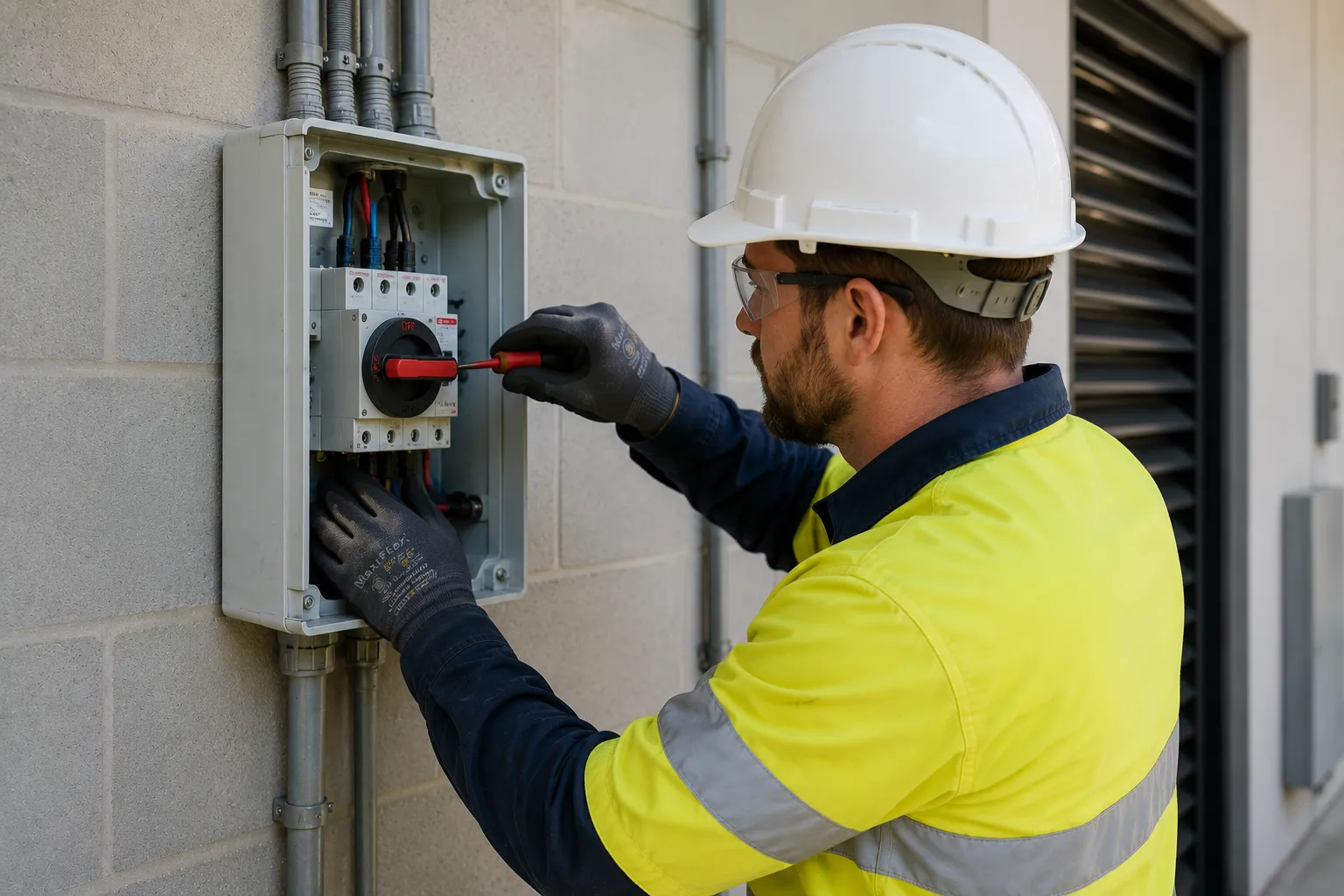
A safety switch (also called a Residual Current Device or RCD) is the single most important piece of electrical safety equipment in your home. It detects current flowing where it shouldn't — for example, through a person touching a live wire — and cuts power within 10 to 50 milliseconds. Fast enough to prevent fatal electric shock. Queensland has had mandatory safety switch laws since 1992, and the requirements have expanded steadily since — covering power circuits, lighting circuits, property sales, and rental properties. Aurora Electrical Solutions installs, tests and certifies safety switches across Brisbane, the Gold Coast, Logan and SEQ. Aurora is a fully licensed Queensland electrical contractor (Licence EC91972), Master Electricians Australia members, fully insured. Same-day installation available for property sale and rental compliance.
What's included
- RCD safety switch installation on power, lighting and dedicated circuits
- RCBO installation (combined safety switch + circuit breaker in one device)
- Type A RCDs (required for circuits feeding EVs, induction cooktops, modern electronics)
- Existing safety switch testing per AS/NZS 3760
- Replacement of faulty, worn or non-tripping RCDs
- Pre-sale compliance inspection and certification
- Landlord compliance audits for rental properties
- Whole-house safety switch coverage audit
- Certificate of Test and Compliance on completion
- Written compliance documentation for solicitors, conveyancers and property managers
- Switchboard space assessment — if no spare poles, we quote a switchboard upgrade
- Same-day installation available for urgent compliance jobs
Signs you need a safety switch installed (or replaced)
If any of these apply, your home isn't adequately protected — and may not be legally compliant. Book a compliance assessment.
- Your home was built before 1992 and the switchboard hasn't been touched since
- You're a landlord and aren't sure if your rental has compliant RCDs (legally required since 2006)
- You're selling a property and the conveyancer flagged missing safety switches
- You bought a property and have less than 3 months to install before the legal deadline
- Existing safety switches won't trip when you press the 'T' test button (means they're faulty)
- Safety switches trip constantly for no apparent reason (could be a faulty RCD or genuine fault)
- Only some circuits are RCD-protected — full coverage is current best practice
- You're installing major new equipment (EV charger, induction cooktop, hot tub, pool)
- Insurance review or property inspection flagged missing safety switches
- Switchboard has ceramic fuses or rewireable fuses (no safety switches at all)
- You can't identify a safety switch on your board (look for 'T' test buttons)
- Renovating or extending — alterations to circuits trigger mandatory RCD requirements
How much does safety switch installation cost in Brisbane?
Safety switch pricing depends on how many circuits you want protected, whether your switchboard has space for them, and whether the existing board needs upgrading first. As a general guide for Brisbane:
- Single safety switch (RCD) added to existing modern board: typically $180 – $350
- RCBO (safety switch + breaker combined, one pole): typically $200 – $400
- Two safety switches to cover power and lighting (minimum modern compliance): typically $400 – $700
- Full RCBO coverage on every circuit (best-practice protection): typically $600 – $1,400 depending on circuit count
- Same-day installation surcharge for urgent compliance: typically $100 – $200
- Replacement of a faulty existing RCD (one-for-one swap): typically $180 – $300
- Switchboard upgrade required (no spare poles, old ceramic fuses): typically $1,200 – $3,000 (see switchboard page)
- Safety switch testing only (no install): typically $80 – $180
- Pre-sale compliance inspection with written report: typically $150 – $300
Every job is quoted fixed-price up-front. We tell you honestly what your home needs to be compliant versus best-practice — minimum legal compliance is usually one RCD on the power circuit, but full RCBO coverage on every circuit is what we'd install in our own homes. No pressure either way.
How long does it take?
Most safety switch installations are completed in 1-3 hours and you have power back on before we leave. Adding one or two RCDs to an existing modern switchboard takes 45-90 minutes. Full RCBO coverage on every circuit (typically 8-12 RCBOs on a Queensland home) takes 2-4 hours. Replacement of a single faulty RCD takes 30-60 minutes. Power is only off while we're actively working on the board — usually 30-90 minutes total. For urgent compliance jobs (pre-settlement, rental compliance, sale disclosure), we offer same-day installation across Brisbane and SEQ subject to availability.
When safety switch installation is required by Queensland law
Queensland has the strongest safety switch laws in Australia, and they've been expanding since 1992. Here are the key requirements:
- All homes built or rewired since 1992 must have RCDs on power (general purpose outlet) circuits
- All homes built since 2000 must have RCDs on lighting circuits too
- Since 2002, when a property is sold or title is transferred, it must have an RCD on the power circuit — or the new owner has 3 months to install one
- Since 2006, all rental properties must have at least one RCD on the power circuit — leasing without one carries fines up to $1,500 for landlords
- AS/NZS 3000:2018 wiring rules require RCD protection on all final sub-circuits when any new circuit is added or modified
- All circuits feeding EV chargers must have Type A RCD protection (AS/NZS 3000 and AS/NZS 61851)
- Pre-purchase inspections and conveyancing checks now routinely flag missing or non-compliant RCDs
- Body corporate-managed properties have RCD requirements that may exceed individual unit requirements
- Commercial properties have separate workplace electrical safety obligations under the Electrical Safety Act 2002
- Pool and spa circuits have specific RCD requirements under AS/NZS 3004
How safety switch installation runs
Most safety switch jobs are fast and disruption-free. Here's how a typical job runs:
- Quote and switchboard assessment — We can quote remotely if you send a photo of your switchboard with the cover open (it's safe to remove the outer cover, just don't touch anything inside). We assess what you currently have, whether your board has spare capacity for new RCDs or RCBOs, and what's required to bring you to compliance or best-practice protection.
- Recommendation and fixed-price quote — We give you two options — minimum legal compliance (usually one RCD on the power circuit) and best-practice protection (RCBO on every circuit, including lighting, oven, hot water and AC). We explain the difference in plain English and quote both. No pressure.
- Scheduling — Standard installs are scheduled within 1-2 weeks. Urgent compliance jobs (pre-settlement, rental compliance, sale disclosure) get same-day or next-day attention subject to availability. We confirm the time with you the day before.
- Install day — isolation and replacement — We isolate power at the main switch (usually 30-90 minutes off), remove old single-pole breakers from the circuits to be protected, install new RCDs or RCBOs in those positions, terminate the active and neutral conductors correctly to the safety switch.
- Testing and commissioning — We test every new safety switch by pressing the 'T' button and confirming it trips, measure the trip current (must be below 30mA) and trip time (must be under 300ms) using a calibrated tester per AS/NZS 3760, and verify circuit integrity is preserved.
- Documentation and handover — You receive a Certificate of Test and Compliance signed by a licensed contractor — the document your insurer, conveyancer, property manager or future buyer may need. We show you how to test the safety switches yourself every 3 months (just press the 'T' button), and answer any questions.
Safety switches vs circuit breakers — they do different things
These two are often confused, but they protect against completely different things. A circuit breaker (also called an MCB — Miniature Circuit Breaker) protects the wiring from overload and short circuits. If too much current flows through a cable, the breaker trips before the cable overheats and starts a fire. This protects your house. It does NOT protect you from electric shock.
A safety switch (RCD — Residual Current Device) protects people from electric shock. It constantly measures the current flowing out on the active wire and the current returning on the neutral wire — if there's a difference (because some current is flowing through, say, a person to ground), the RCD trips within 30 milliseconds. This is fast enough to prevent fatal shock in almost all situations.
An RCBO is a single device that combines both functions — it protects the wiring AND people from shock. RCBOs are now the standard for new switchboard installations because they offer the best of both protections in one component, save space in the switchboard, and trip individually (so a fault on one circuit doesn't disable protection on others).
When we install safety switches, we install RCBOs on every circuit where possible. This gives you complete protection — wiring overload and personal shock — on a per-circuit basis. If something faults in your kitchen, the kitchen circuit trips, but your lights, fridge and air conditioning all keep running.
Landlords and rental properties — what you need to know
Since 2006, every rental property in Queensland must have at least one safety switch installed on the power circuit. This is non-negotiable. The Electrical Safety Act 2002 and Regulations 2013 make this a landlord's legal obligation, not a tenant's.
Failure to comply carries penalties up to $1,500 per breach, and crucially, can expose you to civil liability if a tenant is injured by an electrical fault that an RCD would have prevented. Insurance policies on rental properties may not cover claims where required safety devices were missing — read your policy carefully.
Property managers increasingly flag missing safety switches during routine inspections, and tenants can legally demand installation as a condition of lease. The smart play is to get every rental property checked and brought to current compliance — it's typically a $200-$500 job per property and gives you legal peace of mind plus a stronger position on insurance claims.
Aurora provides bulk compliance audits for landlords and property managers across SEQ — we'll assess and quote multiple properties in one trip and provide consolidated compliance documentation. Worth it if you have a portfolio.
Selling or buying a Queensland property
Since 2002, Queensland law requires that any property being sold or transferred must have an RCD on the power circuit at the time of settlement. If one isn't installed, the buyer is legally required to install one within 3 months of taking possession — and the seller is legally required to disclose the absence on the contract of sale.
Most conveyancers now check this as part of standard pre-settlement searches. Missing RCDs are increasingly common reasons for buyers to renegotiate price, request seller-funded installations, or in rare cases, terminate the contract. Sellers who don't disclose can face claims for damages from buyers later.
If you're selling, the simplest path is to install RCDs before listing — it's a few hundred dollars, removes a friction point from the conveyancing process, and is genuinely a selling point with safety-conscious buyers. If you're buying and there's no RCD, factor the installation cost into your offer and book the install within the 3-month deadline. We provide same-day installation across SEQ for both scenarios.
If you need it: see also our switchboard upgrades page — pre-sale upgrades to modern compliant boards are increasingly common and improve property appeal.
Type A vs Type AC RCDs — and why it matters more now
Older RCDs are typically "Type AC" — they detect AC fault currents but not DC fault currents. This was fine for decades, when household equipment was mostly resistive (kettles, irons, old lighting). But it's a problem now.
Modern equipment increasingly produces DC fault currents during failure modes — EV chargers, solar inverters, variable-speed pool pumps, induction cooktops, modern computer power supplies, LED drivers, heat pump compressors. A Type AC RCD can be "blinded" by DC current and fail to trip on a genuine fault. The standard for new installations has shifted accordingly — AS/NZS 3000:2018 mandates Type A RCDs for circuits feeding EV chargers and certain other equipment, and Type A is now the default we install on every modern board.
If your home has older Type AC RCDs and you're planning to add an EV charger, solar system, or induction cooktop, the existing RCDs may need to be replaced as part of that work. We check this during the quote and tell you up-front so there are no surprises.
Testing your safety switches — what you should do
Every safety switch has a small 'T' button (sometimes labelled 'Test'). Press it and the switch should immediately trip, cutting power to the circuits it covers. The Queensland Electrical Safety Office recommends doing this every 3 months — it takes 30 seconds, you reset the switch immediately afterwards, and it's the only way to know your safety switch is actually working.
If the switch doesn't trip when you press the test button, it's faulty and offering you no protection at all — replace it immediately. This is one of the most common faults we find on call-outs: an RCD that has been sitting there for 10-15 years without ever being tested, and is now silently non-functional.
For workplaces and certain commercial settings, AS/NZS 3760 requires more rigorous testing — push-button test every 3 months, plus an instrument trip-time test every 12 months by a licensed electrician. We offer this as part of our commercial maintenance contracts.
When your switchboard can't take new safety switches
Sometimes we get called out for a "just add a safety switch" job and find the existing switchboard physically can't accept one — no spare poles, old ceramic fuses, asbestos backing board, or a board so old it doesn't meet current AS/NZS 3000 requirements at all.
In these cases, the honest answer is that the right work is a switchboard upgrade, not just adding an RCD. We'll explain what's involved, why it's needed, and quote the full job — usually $1,500-$3,000 for a residential switchboard upgrade including all new RCBOs. See our switchboard upgrades page for more.
If your situation is borderline — old board but technically still functional — we'll often install the RCDs you asked for, while noting that the board itself is nearing end of life. We'd rather you have current protection now than wait six months for a board upgrade.