
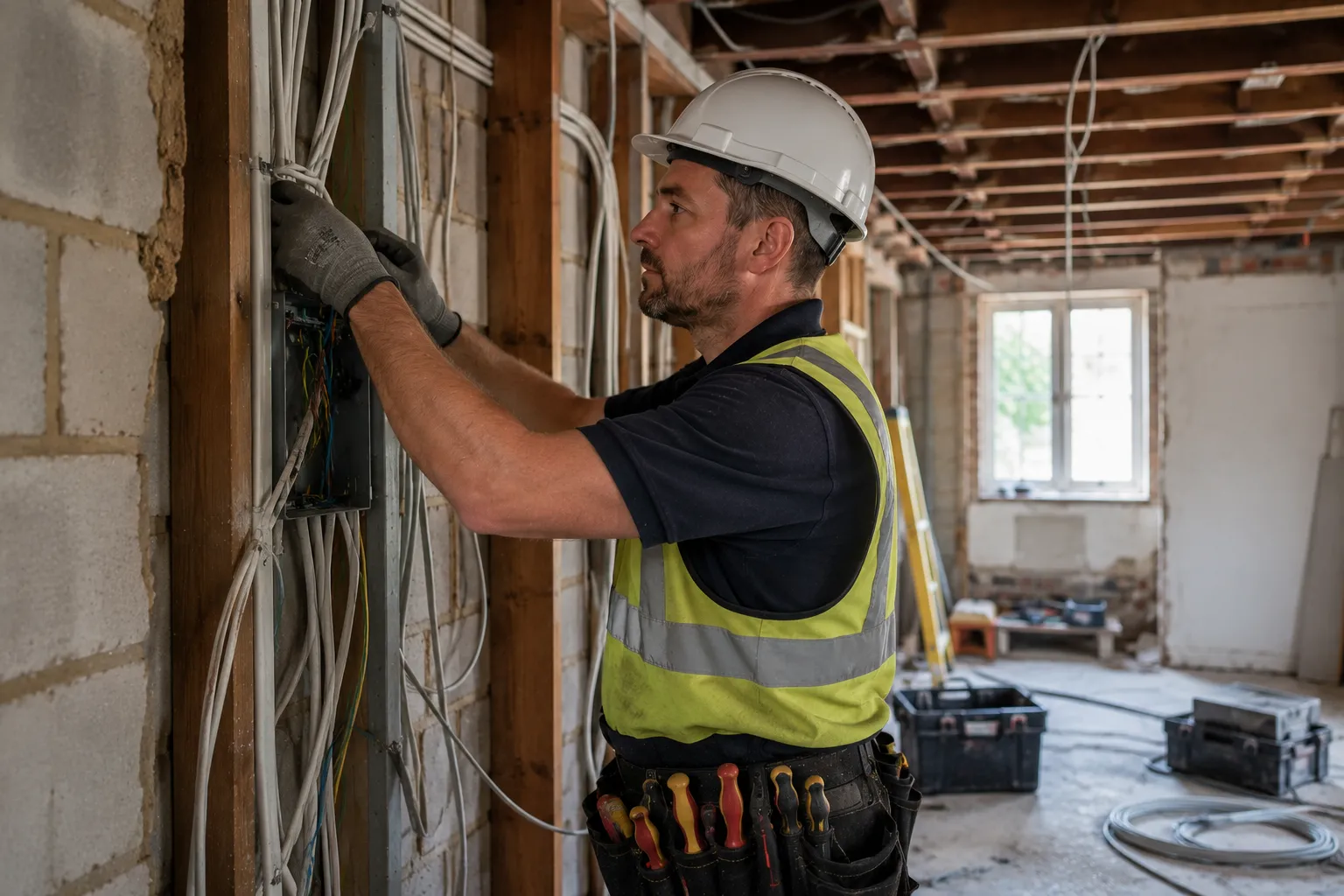
If your Brisbane home was built before 1970, the wiring inside the walls may be rubber-insulated, lead-sheathed, or vulcanised india rubber (VIR) cable that’s now brittle, deteriorating and dangerous. Electrical faults are responsible for an estimated 40% of house fires in Australia, and old wiring is one of the most common causes. Aurora Electrical Solutions provides full and partial house rewiring across Brisbane, the Gold Coast, Logan and the wider SEQ region — replacing dangerous old cabling with modern compliant TPS wiring, all installed to AS/NZS 3000 and certified on completion. We’re a fully licensed Queensland electrical contractor (Licence EC91972) and Master Electricians Australia members.
What's included
- Full house rewiring — every circuit replaced back to the switchboard
- Partial rewiring — single room, single storey, or specific circuits
- Pre-purchase and pre-renovation rewire planning and quoting
- Removal of VIR, lead-sheathed, rubber-insulated and other unsafe old cable
- New TPS cabling installed throughout, compliant with AS/NZS 3000
- New switchboard included where required (RCDs + surge protection as standard)
- New power points, light switches and fittings as part of the rewire
- Certificate of Test and Compliance on completion
- Energex notification and supply isolation coordinated where required
- Clean, labelled installation — every circuit identified and documented
Signs your house needs rewiring
Old or damaged wiring rarely fails dramatically — it deteriorates slowly until something gives. By the time most homeowners notice, the wiring has already been a fire risk for years. If any of these sound familiar, book an inspection — and don’t wait for a worse warning.
- The home was built before 1970 and hasn’t been rewired (likely VIR, rubber-insulated or lead-sheathed cable)
- Black rubber-insulated or fabric-wrapped cable visible in the roof space or switchboard
- Flickering lights across multiple rooms — a sign of degraded conductors or loose connections
- Frequent breaker trips even after a switchboard upgrade — the wiring itself is the issue
- A persistent burning smell that doesn’t come from one specific outlet
- Power points discoloured, brown-tinged, warm to the touch, or visibly scorched
- Lights dim when major appliances start up (kettle, microwave, air conditioner)
- Old two-prong outlets with no earth pin still in use
- You’ve had multiple separate electrical faults in the last year
- Renovating, extending or adding major loads (EV charger, AC, solar, induction cooktop) to an older home
- Pre-purchase inspection has flagged the wiring as dangerous or non-compliant
- Asbestos-backed switchboard from the pre-1990 era still in place
How much does it cost to rewire a house in Brisbane?
House rewiring costs in Brisbane vary substantially based on the size of the home, the construction type, and how accessible the existing wiring is. As a general guide:
- 2-bedroom home or unit: typically $4,000 – $8,000
- 3-bedroom home: typically $6,000 – $10,000
- 4-bedroom home: typically $8,000 – $14,000
- Larger or two-storey homes: typically $10,000 – $18,000+
- Character homes and Queenslanders: usually 20–30% premium due to access difficulty and heritage considerations
- Solid brick or rendered homes: higher labour due to chasing into walls
- Partial rewire (single room or specific circuits): typically $1,500 – $4,000
- Switchboard upgrade included where required: add $1,500 – $3,500
Every rewire is different — we provide a fixed-price written quote after an on-site assessment, so the number you sign off on is the number you pay. We’ll also tell you honestly whether you need a full rewire or whether a partial rewire (or even just a switchboard upgrade) will solve the problem.
How long does a house rewire take?
A typical Brisbane house rewire takes between 3 and 10 days on site. A small 2-bedroom unit can usually be completed in 3–5 days, a standard 3-bedroom house in 5–7 days, and a larger 4-bedroom or two-storey home in 7–10 days or more. Character Queenslanders with timber framing are generally faster than solid-brick homes (which require chasing into masonry). Power is off in the working areas during active rewiring, but we coordinate timing so you’re never left without power overnight — and where possible, we phase the work so part of the home stays live throughout. We’ll give you a realistic day-by-day schedule with the quote so you can plan around it.
When should you rewire your house?
The most common reasons Brisbane customers book a rewire with us:
- Buying a pre-1970 home — most building inspectors will flag old wiring as needing replacement
- Major renovation or extension — certifiers usually require the affected areas to be brought to current code
- Selling a heritage or character home — modernising the wiring increases sale value and removes a buyer objection
- Adding solar, an EV charger, ducted air conditioning or other major loads to an older home
- After a known fault — burning smell, scorching, repeated trips — the wiring is telling you it’s done
- Insurance assessor or pre-purchase inspector has flagged the wiring
- Landlords with rental properties — old wiring is a safety and legal liability
- You’re re-lining walls or ceilings anyway (the cheapest time to rewire is when walls are already open)
How the house rewiring process works
We make the process as clear and minimally disruptive as possible. Here’s what to expect from quote to certification.
- On-site assessment and fixed-price quote — We inspect the existing wiring, switchboard, roof space and any accessible cable runs. We discuss what you want from the new system — extra outlets, USB points, lighting changes — and provide a fixed-price written quote, usually within a few days.
- Planning and scheduling — We agree on a start date and a phased plan that minimises disruption. If we need Energex to isolate supply, we lodge the paperwork. If you’re living in the home, we phase the work so part of the home stays live throughout.
- Removal of old wiring — We safely remove VIR, rubber-insulated, lead-sheathed or other obsolete cabling. Where asbestos is present (common in pre-1990 backing boards), we follow licensed removal procedures.
- New TPS cable installation — Modern TPS cable is installed throughout — typically threaded through wall cavities, ceiling spaces and under floors with minimal cutting where possible. New outlets, switches, light fittings and dedicated appliance circuits are added per the plan.
- Switchboard and final connections — A new switchboard is installed where required — modern MCBs, RCDs on every circuit, surge protection, and labelled circuit identification. All new circuits are terminated and tested.
- Testing, certification and handover — Every circuit is tested to AS/NZS 3000. We issue a Certificate of Test and Compliance — the document your insurer, certifier or conveyancing solicitor may need. We walk you through the new system and answer any questions.
Full rewire vs partial rewire — which do you need?
Not every home needs a full rewire. A partial rewire — replacing just the worst circuits, just one storey, or just the wiring in a specific area being renovated — can often deliver the safety benefit at a fraction of the cost. We’re happy to recommend the lower-cost option when it’s genuinely the right one. We don’t upsell a full rewire when a partial would do the job.
That said, partial rewires have limits. If the original wiring throughout the home is rubber-insulated or lead-sheathed VIR, patching new TPS cable into the old system gives you a fragmented installation with mixed reliability. The new sections will be safe; the old sections won’t. A full rewire is the right call when more than about half the wiring is at end-of-life, when you’re selling the property, or when an insurer requires whole-of-home compliance.
When you book an assessment, we’ll inspect the existing wiring across the home and tell you honestly which approach makes sense for your situation.
Rewiring older Brisbane homes — Queenslanders and character properties
Brisbane has thousands of Queenslander and character homes built between 1900 and 1960, and most of them have never been fully rewired. Their original wiring — typically VIR (vulcanised india rubber) or lead-sheathed cable — has a service life of around 50–70 years. Today, almost all of it is well past that, with brittle insulation that can crack, fall away, or expose live conductors in roof spaces and wall cavities.
The good news is that Queenslander construction (timber framing, lifted on stumps, accessible underfloor space, generous roof voids) actually makes them *easier* to rewire than many newer brick-veneer homes. We can thread cable through wall cavities and ceiling spaces without removing internal wall linings in most cases. Where wall surgery is unavoidable, we coordinate with a plasterer or you can manage that separately.
Aurora has worked on character homes across Brisbane’s inner east — Bulimba, Morningside, Camp Hill, Coorparoo — and the inner-north suburbs like Nundah and Hendra. We understand the construction quirks of these homes and quote accordingly.
Why old wiring is dangerous
VIR (vulcanised india rubber) cable was used in Australia from the late 1800s to the late 1950s. Its rubber insulation slowly degrades, becoming brittle and crumbly. When it breaks down inside a wall cavity or roof space, live conductors can come into contact with each other (short circuit) or with metal building elements (earth fault) — both of which start fires.
Lead-sheathed cable (used into the 1960s) has a metal outer sheath that protected the conductors well at the time, but the rubber insulation underneath has the same ageing issues as VIR. The lead sheath itself is also a health concern during removal.
Modern TPS (thermoplastic-sheathed) cable replaces both with a tough, flexible PVC insulation rated for at least 50 years of service life. It’s safer, easier to work with, and what every modern Australian home is wired with today.
AS/NZS 3000 compliance and certification
Every house rewire Aurora completes is installed and tested to Australian Standard AS/NZS 3000 — the wiring rules that govern all electrical installations in Australia and New Zealand. On completion, we issue a Certificate of Test and Compliance signed by a licensed electrical contractor (QLD Licence EC91972).
This certificate is the document your insurer will want to see if you ever make a fire-related claim, what conveyancing solicitors look for at sale, and what building certifiers need for renovation sign-off. We keep a copy on file for you — if you ever lose your copy, just call and we’ll send you another.