
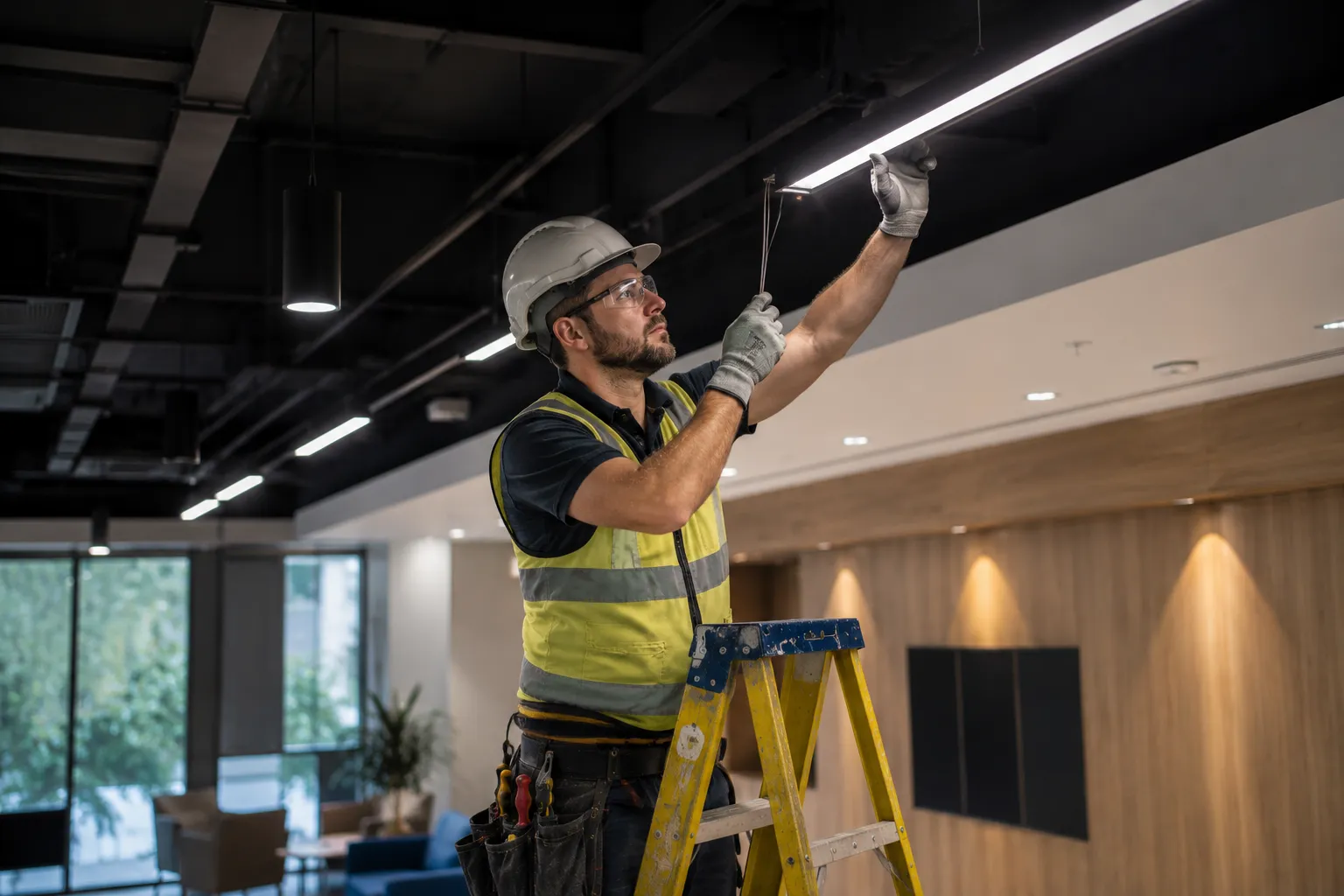
Lighting is typically 30–40% of a commercial building’s electricity bill, and a modern LED retrofit usually pays for itself in 18–30 months from energy savings alone — before counting maintenance reduction and improved lighting quality. Aurora Electrical Solutions handles commercial lighting design, supply and installation across Brisbane, the Gold Coast, Logan and SEQ. We work across offices, retail, hospitality, warehouses, factories, healthcare, strata buildings and outdoor commercial spaces. Aurora is a fully licensed Queensland electrical contractor (Licence EC91972), Master Electricians Australia members, fully insured, with certificate of currency provided for site induction.
What's included
- LED retrofit and upgrade of existing fluorescent, halogen or metal halide fittings
- Office lighting design — panel lights, troffers, linear pendants, downlights
- Retail and hospitality lighting — feature, accent, display and ambient
- High-bay and low-bay LED for warehouses and factories
- Emergency and exit lighting installation and certification (AS/NZS 2293)
- Outdoor and exterior lighting — car parks, building facades, security
- Sensor, dimmable and smart-controlled lighting systems
- Lighting energy audits with ROI and payback reports
- Lux level design to AS/NZS 1680 for workplace safety and comfort
- Lighting maintenance contracts with scheduled audits and re-lamps
- Rebate paperwork handled for eligible commercial retrofits
- Certificate of Test and Compliance on every installation
Signs your commercial lighting needs an upgrade
Most commercial lighting limps along well past its useful life because nobody notices the slow decline — it just gets dimmer, costlier and patchier year by year. If any of these sound familiar, an LED retrofit is almost certainly worth costing:
- Fluorescent tubes (T5 or T8), metal halide, or halogen fittings still in place
- Lights are visibly flickering, humming or buzzing
- Power bill is creeping up despite no change in operations
- Some areas of the workspace are noticeably dimmer than others
- You’re replacing globes or tubes monthly — and the scissor-lift hire is getting expensive
- Lighting colour temperature is inconsistent between fittings (warm + cool whites mixed)
- Emergency or exit fittings have failed the annual compliance test
- No emergency lighting system in place at all (legal requirement for most commercial buildings)
- Lighting layout doesn’t match the current room layout — dark zones over desks or display areas
- Renovating or refitting and need lighting design for the new layout
- Workplace safety review or insurance audit flagged lighting inadequacy
- Tenant lease requires baseline lighting compliance before move-in
How much does commercial LED lighting cost in Brisbane?
Commercial lighting pricing depends heavily on fitting type, quantity, ceiling access, and whether the work happens during or outside trading hours. As a general guide:
- LED panel light or troffer retrofit (per fitting, supplied & installed): typically $120 – $250
- Office LED retrofit (typical 200 m² office, 20–30 fittings): typically $4,000 – $9,000
- Retail or hospitality lighting design and install (per m²): typically $80 – $200
- High-bay LED retrofit (per fitting): typically $250 – $600
- Full warehouse high-bay retrofit (20–40 fittings): typically $8,000 – $25,000
- Emergency / exit lighting (per fitting, supplied & installed): typically $250 – $500
- Outdoor and exterior LED lighting (per fitting): typically $300 – $1,200
- Sensor and smart controls (per zone): add $150 – $400
- Full commercial lighting audit with payback report: typically $400 – $900 (often credited back against the retrofit quote)
Every commercial lighting project is quoted fixed-price after a site visit, with materials and labour itemised so you see exactly where the money goes. For larger retrofits we provide an ROI report showing the energy savings over 5 and 10 years, the payback period, and any applicable rebates — so the spend isn’t a leap of faith.
How long does a commercial lighting project take?
Project duration depends on scope and access. A typical office LED retrofit of 20–30 fittings takes 1–2 days. A retail or hospitality lighting fit-out usually runs 2–5 days. A full warehouse high-bay retrofit takes 1–3 days. Emergency and exit lighting installs for a typical commercial floor: half a day to a day. Larger multi-floor or multi-tenancy projects run longer and we schedule them in phases to minimise disruption. Almost all commercial lighting work can be done after hours, on weekends, or during planned downtime so there’s zero impact on trading or production — we price after-hours work separately and openly on the quote.
When businesses commission commercial lighting work
The most common reasons Brisbane businesses get in touch with us about lighting:
- Energy bill review highlighting lighting as a major cost — usually 30–40% of total electricity use
- Old fluorescent or halogen fittings starting to fail in clusters as they age out together
- New tenancy fit-out requiring fresh design for the layout and brand
- Refit or refurbishment of an existing space
- Adding or relocating workstations, display areas, retail fixtures or treatment rooms
- Building owner upgrading common areas in a strata or multi-tenant building
- Annual emergency lighting compliance test failure (AS/NZS 2293) requiring fitting replacement
- Workplace safety review identifying inadequate lux levels for the work being done
- Sustainability programme reducing carbon footprint or chasing a green building rating
- Image upgrade — the lighting in customer-facing areas no longer matches the brand
- Insurance review requiring documented compliance
How a commercial lighting project runs
Commercial lighting is part installation, part design — getting the right fittings in the right positions delivering the right light is what separates a competent job from a great one. Here’s how we run the process:
- Site assessment and lighting audit — We attend the site, measure existing lux levels, review the fittings in place, understand what the space is used for, and discuss your goals (energy savings, brand image, workplace comfort, compliance). For larger projects we provide a lighting audit with current consumption data and payback projections.
- Lighting design — For anything beyond a like-for-like retrofit, we produce a lighting design — fitting types, positions, lux levels for each zone, control logic for sensors and dimmers. Design is reviewed and signed off before procurement.
- Fixed-price quote with ROI report — Written quote breaking down fittings, labour, after-hours work (if needed), and the all-in price. For retrofits we include a 5-year and 10-year energy savings projection and the calculated payback period — so the business case is clear.
- Procurement and scheduling — We source fittings from reputable Australian-supplied brands (Aurora Lighting, Brilliant, Sylvania, Philips, Hager). Lead time is usually 1–3 weeks depending on quantity. We agree a start date and work around your trading hours.
- Installation — On-site work begins at the agreed time, almost always outside trading hours where business operation matters. Each day’s progress is documented and any variances flagged immediately.
- Commissioning, testing and documentation — All circuits tested to AS/NZS 3000, lux levels verified to AS/NZS 1680, emergency lighting certified to AS/NZS 2293. You receive a complete documentation pack — Certificate of Test, as-built lighting plan, fitting datasheets and warranties.
LED retrofits — the real numbers
The case for swapping old fluorescent, halogen or metal halide fittings for LED is overwhelming, but the marketing around it can be vague. Here are the real numbers: a typical LED fitting uses 50–70% less energy than the fluorescent it replaces, and 75–85% less than halogen or metal halide. For a commercial space where lighting runs 8–12 hours a day, that energy difference adds up fast.
Combined with the fact that LEDs typically last 5–10 times longer (50,000+ hours vs 8,000–15,000 for fluorescent), the savings on globe replacement and scissor-lift hire often equal the energy savings over the life of the system. For most commercial retrofits we’re looking at 18–30 month payback, then everything after that is pure margin recovery.
We don’t push retrofits where the existing lighting is genuinely OK and not at end of life. For sites where it makes sense, we’ll show you the numbers; for sites where it doesn’t, we’ll tell you that too.
Lighting design for offices, retail and hospitality
Good commercial lighting isn’t just about energy efficiency — it’s about creating spaces that work for the people in them. Office lighting needs even lux levels across workstations, glare control on screens, and colour temperatures (typically 4000K cool white) that keep people alert. Retail lighting works the opposite way: feature lighting on products, accent lighting to create mood and movement, warmer 3000K colour temperatures to make merchandise look its best.
Hospitality venues (restaurants, cafes, bars, hotels) need scene-based control — bright and lively at lunch, low and warm in the evening. Healthcare spaces need shadow-free, high-CRI lighting for treatment rooms and softer ambient lighting in waiting areas. We design for the space and the use, not a generic spec sheet.
Where the project warrants it, we produce a full lighting plan with fitting positions, lux level zones, and control diagrams — usually as part of a fit-out or refurbishment package.
Emergency and exit lighting — AS/NZS 2293 compliance
Emergency and exit lighting is a legal compliance requirement for most commercial, retail, hospitality, and industrial buildings in Queensland. AS/NZS 2293 mandates that emergency lights illuminate egress paths during a power failure for a minimum of 90 minutes, and that systems be tested every six months with results documented.
Aurora installs and certifies emergency and exit lighting to AS/NZS 2293 — both for new fit-outs and as replacements for systems that have failed compliance testing. We also offer scheduled compliance testing as part of our maintenance contracts so the six-monthly testing happens on time, every time, with the documentation your insurer or certifier needs.
High-bay LED for warehouses and factories
High-bay lighting is its own discipline. For warehouses, factories and large indoor industrial spaces, fitting selection has to balance lumen output, beam angle, mounting height, ambient temperature (warehouses get hot in Brisbane summers), and the specific tasks happening below. We design high-bay layouts to AS/NZS 1680 lux levels for safe forklift operation in aisles, packing benches, loading docks and pedestrian zones.
High-bay retrofits are particularly compelling on payback because the existing metal halide or T5 fittings use enormous amounts of energy. Most warehouse high-bay retrofits we deliver pay back in 12–24 months from energy savings alone. See our warehouse electrical page for more detail on warehouse-specific lighting.
Sensor controls, dimmers and smart systems
Modern commercial lighting almost always benefits from some level of intelligent control. Motion sensors in storerooms, toilets and rarely-used areas can cut lighting energy in those zones by 70%+ at minimal install cost. Daylight sensors in areas with natural light dim the artificial lighting when not needed. Time-of-day controls keep retail facades lit only during trading hours. DALI and Zigbee-based smart systems give scene control across hospitality and corporate environments.
We specify and install control systems appropriate to the budget and the use — sometimes that’s a simple PIR sensor, sometimes it’s a full DALI commissioning. We don’t oversell smart controls where simple is better.
Lighting maintenance contracts
For commercial sites, a lighting maintenance contract is almost always cheaper than reactive callouts. Scheduled bulk-relamping (where LED is not yet installed), emergency lighting testing every six months per AS/NZS 2293, lux level audits annually, and priority response for fitting failures.
For multi-site businesses (retail chains, hospitality groups, strata managers) we offer multi-site contracts with consolidated invoicing and a single point of contact across all locations.