
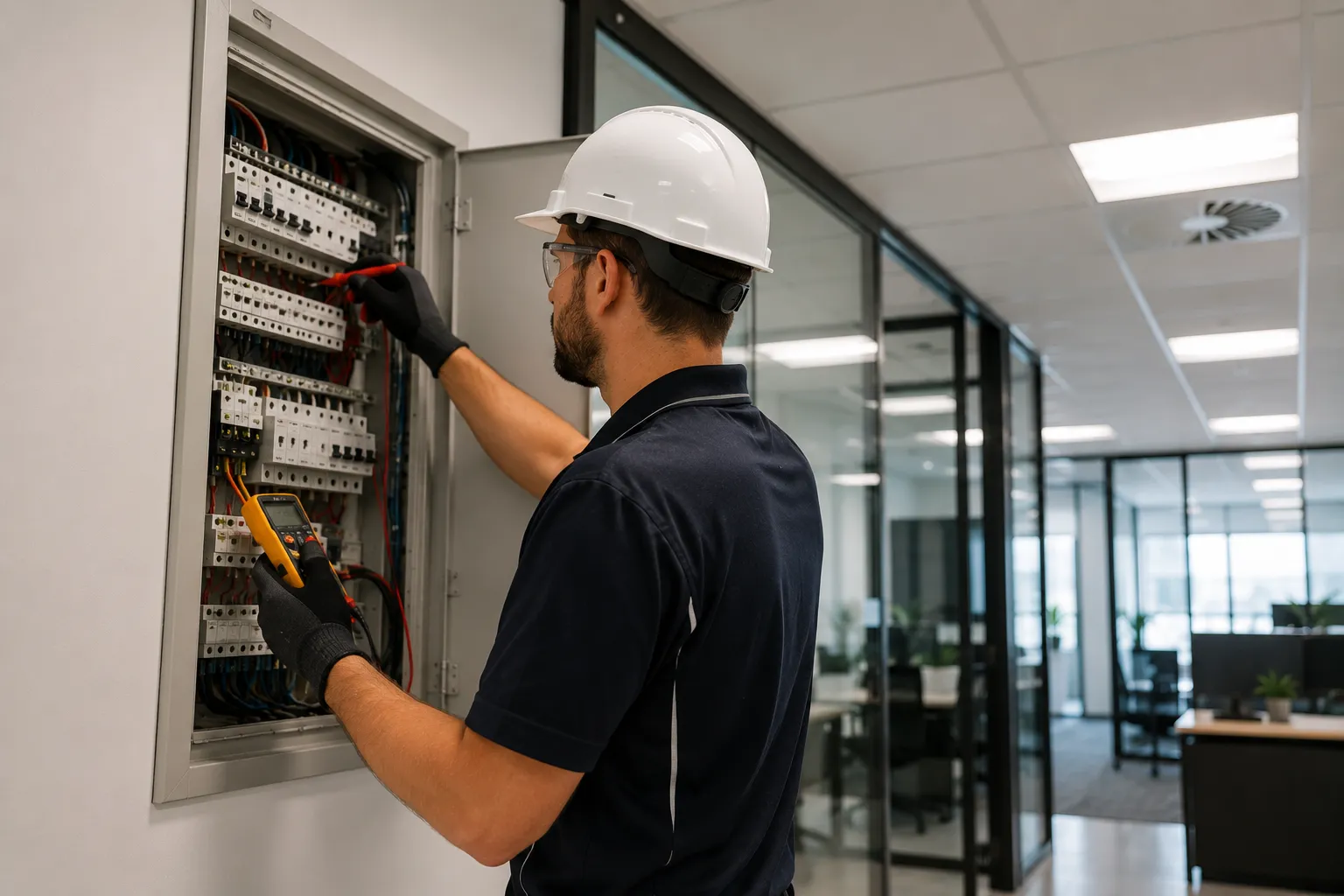
A single electrical failure can shut a Brisbane business down for half a day or longer — and the cost of that downtime almost always exceeds an entire year of proper preventive maintenance. The businesses that don't experience these failures aren't lucky; they have proper scheduled electrical maintenance in place. Aurora Electrical Solutions delivers commercial electrical maintenance contracts across Brisbane, the Gold Coast, Logan and SEQ — scheduled switchboard inspections, AS/NZS 3760:2022 test & tag, RCD push-button and trip-time testing, AS 2293 emergency and exit lighting maintenance, thermal imaging of switchboards and connections, lighting maintenance, and 24/7 reactive callouts with contract-rate response. One licensed contractor, one consolidated compliance documentation pack, one point of contact. Aurora is a fully licensed Queensland electrical contractor (Licence EC91972), Master Electricians Australia members, fully insured with $20M public liability — certificate of currency provided for site induction at any commercial customer.
What's included
- Scheduled switchboard inspection — annual minimum, more frequent for high-risk sites
- Thermal imaging of switchboards, sub-mains and major connections — catches overheating before fire risk
- RCD push-button testing (quarterly) and trip-time testing (annual) per AS/NZS 3760:2022 and AS/NZS 3760 Appendix C
- AS/NZS 3760:2022 test and tag of portable electrical equipment — frequency matched to equipment type and environment
- AS 2293 emergency and exit lighting inspection (6-monthly discharge test, annual full inspection)
- Lighting maintenance — fitting replacement, dimmer servicing, photocell and timer setup
- Power point and fixed appliance compliance verification
- Three-phase motor and machinery electrical condition checks (manufacturing, hospitality, warehouse)
- Asset register maintenance — every tested item logged with test history
- Consolidated compliance documentation pack delivered annually — audit-ready
- 24/7 emergency response with priority contract-rate dispatch for contract customers
- Bundled pricing — multiple services scheduled together reduce per-visit cost
- Single point of contact across all your sites
- Certificate of Currency, insurance, licence, and SWMS provided for site induction
When you need a commercial electrical maintenance contract
If any of these apply, your business is either operating with compliance gaps or paying significantly more in reactive callout fees than a scheduled maintenance contract would cost.
- You don't have current AS/NZS 3760:2022 test & tag records for all portable equipment
- Your emergency and exit lights haven't been inspected within the past 6 months
- RCD safety switches in your switchboard haven't been push-button tested in 90+ days
- Your last switchboard inspection was over 12 months ago (or you can't remember)
- WorkCover, your insurer, or a recent audit flagged electrical compliance gaps
- You've had unexpected electrical callouts in the past 12 months you'd rather avoid
- You're being charged premium emergency rates for reactive work that scheduled maintenance would have prevented
- Your existing electrician handles work job-by-job with no ongoing schedule
- You manage multiple sites and want consolidated maintenance and compliance documentation
- You're a body corporate or strata manager responsible for common-area electrical
- Your business operates in a hostile environment (commercial kitchens, workshops, dusty manufacturing) requiring more frequent inspection
- You're preparing for an insurance audit, ISO certification, or major tender that requires documented electrical maintenance
- Your tenants are starting to mention flickering lights, frequent breaker trips, or warm power points
- You want a single contractor across electrical, lighting maintenance, test & tag, emergency lighting — instead of three separate vendors
How much does a commercial electrical maintenance contract cost in Brisbane?
Maintenance contract pricing depends on site size, asset count, inspection frequency required, and the mix of compliance scopes included. Here are typical Brisbane ranges for 2026:
- Small office (under 30 staff, single tenancy): typically $1,800 – $4,000 per year for annual switchboard inspection + 12-monthly test & tag + 6-monthly emergency lighting
- Medium office (30-100 staff, multiple tenancies): typically $4,000 – $9,000 per year including thermal imaging and quarterly RCD testing
- Large office or commercial building (100+ staff or multiple floors): typically $9,000 – $25,000+ per year with full compliance pack
- Retail strip (single tenancy): typically $1,500 – $3,500 per year for office-equivalent compliance plus 6-monthly test & tag
- Restaurant or cafe (commercial kitchen): typically $2,500 – $5,500 per year — 6-monthly test & tag due to kitchen environment, plus emergency lighting and RCD testing
- Warehouse (small/medium): typically $3,000 – $8,000 per year — adds three-phase machinery inspection and exit lighting throughout larger floor area
- Manufacturing site: typically $8,000 – $25,000+ per year — quarterly test & tag for hostile environment, machinery condition checks, larger switchboard count
- Body corporate / strata common areas: typically $2,000 – $7,000 per year per property — common-area lighting, emergency lighting, common switchboards
- Per-asset test & tag (no contract): typically $4 – $12 per item depending on volume
- Thermal imaging switchboard scan (no contract): typically $400 – $1,200 per switchboard
- Emergency callout (non-contract): typically $200 – $400 service fee plus labour at premium rates
- Emergency callout (contract customer): typically reduced service fee, contract-rate labour, priority dispatch
Every contract is custom-scoped to your specific compliance requirements and site profile. Free site assessment to identify what's actually required (often less than what bundled vendors quote). No lock-in contracts — we want you to stay because the service works, not because the contract traps you. Flexible monthly billing or annual prepay options.
How long does maintenance scheduling take to set up?
A typical maintenance contract is operational within 2-4 weeks of initial agreement. Week 1: free site assessment and scope confirmation. Week 2: contract finalised, schedule built around your operating hours, asset register established (or imported from existing records). Week 3-4: first scheduled visits commence — typically starting with the most overdue compliance item (often switchboard inspection or emergency lighting if those have lapsed). After initial setup, ongoing visits are scheduled to match the compliance intervals required (some items 3-monthly, some 6-monthly, some annual) and bundled where possible to minimise on-site visits. We coordinate around your trading hours — most retail and hospitality work happens before opening or after closing, office work happens within or just outside business hours depending on the activity.
What the compliance frameworks actually require
Commercial electrical maintenance isn't optional — there are multiple legislative and standards frameworks that apply to every Queensland workplace. Here's what they actually require:
- Electrical Safety Act 2002 (QLD) — duty of care on employers, landlords, and PCBUs to ensure electrical installations and equipment are safe; penalties up to $600,000+ for breaches resulting in harm
- Electrical Safety Regulation 2013 (QLD) — specifies minimum testing intervals and competencies; takes precedence over AS/NZS 3760 where they differ
- WHS Act 2011 and WHS Regulation 2011 — broader workplace health and safety obligations that include electrical equipment safety
- AS/NZS 3760:2022 — In-service safety inspection and testing of electrical equipment; specifies test methods, intervals, tagging requirements, asset register requirements; records must be kept 5+ years
- AS/NZS 3000:2018 — Wiring Rules; the installation standard that any electrical work and inspection must verify against
- AS 2293 — Emergency and exit lighting; specifies 6-monthly discharge testing and annual full inspection with documented records
- AS 1851 — Maintenance of fire protection systems; relevant where electrical maintenance interfaces with fire system electrical components
- Test & tag frequencies — construction sites: 3 months; hostile environments (commercial kitchens, workshops): 6 months; offices and standard environments: 12 months; fixed low-risk equipment: up to 5 years
- RCD push-button testing — quarterly minimum; trip-time testing 12-monthly per AS/NZS 3760 Appendix C
- Asset register — every tested item logged with test date, result, tester ID, next test due; required for audit, insurance, and legal defence purposes
- Equipment failing testing — must be immediately removed from service, tagged "DO NOT USE," and either repaired by a licensed person or disposed of
How a commercial maintenance contract works
Aurora maintenance contracts are designed to be straightforward, scheduled, and documented. Here's how they typically work:
- Free site assessment — We attend your site, walk through the electrical assets (switchboards, sub-boards, emergency lights, RCDs, portable equipment), review your existing maintenance records (if any), and identify any immediate compliance gaps. Most assessments take 1-2 hours depending on site size. Free of charge, no obligation.
- Scope, frequency and quote — We propose a scheduled maintenance program tailored to your site: which inspection scopes are needed (switchboard, RCD, test & tag, emergency lighting, lighting maintenance, machinery checks), at what frequencies (matching the compliance requirements for your environment), bundled where possible to minimise on-site visits. Fixed-price contract — you know exactly what you're paying for the year.
- Contract activation and scheduling — Contract signed, scheduling commences. We work around your operating hours — most retail and hospitality work happens before opening or after closing; office work happens within or just outside business hours; warehouse and manufacturing typically during scheduled shutdowns or off-shift periods. First visits usually within 2-4 weeks of contract signing.
- Scheduled visits — multi-scope bundled — Each visit covers multiple compliance scopes where possible. A typical quarterly visit might combine RCD push-button testing, partial test & tag, emergency lighting partial inspection, and switchboard visual check — all in one 2-3 hour visit instead of four separate visits. Asset register updated in real-time on a tablet, results synced to our compliance database.
- Findings, repairs and documentation — Any items that fail testing are tagged immediately and either repaired on-site (where the scope allows and parts are available) or quoted separately for follow-up. Documentation generated for every visit — tested asset list, results, any actions taken, next visit due date. Available in real-time via our customer portal or emailed as PDF.
- Annual compliance pack and review — At the contract anniversary we deliver a consolidated annual compliance pack — all tests performed, all assets covered, all compliance certificates issued, all repairs completed, full asset register. Audit-ready in one document. We then review the contract scope with you, adjust frequencies if needed (sites change — new equipment, expanded floor area, new compliance requirements), and renew for the next year.
The cost of NOT having proper maintenance — and the real ROI of preventive contracts
The business case for scheduled electrical maintenance is overwhelming when you look at the actual numbers. A single electrical failure that shuts down a Brisbane business for half a day typically costs $3,000-$15,000 in lost trading and recovery time — more for hospitality, retail, and manufacturing operations. A switchboard fire (rare but catastrophic) can cause $100,000+ in damage plus weeks of business interruption.
Now compare to maintenance contract pricing: a small office contract is $1,800-$4,000 per year. A medium business contract is $4,000-$9,000. Even for larger sites, contract value is typically a fraction of one unplanned failure event. The ROI math is brutal for the businesses that don't bother — they pay 3-10× more reactive than preventive, and they carry undocumented compliance gaps that expose them to legal liability if anything goes wrong.
The other often-overlooked cost is insurance impact. Most commercial insurance policies now include electrical maintenance clauses — gaps in your test & tag records or missing emergency lighting documentation can void claims after a fire or electrical incident. We've seen genuine cases where insurers denied substantial claims because documented maintenance was missing, and the business owner had no contractual recourse against their previous electrician (who hadn't been engaged on a maintenance basis).
Aurora's maintenance contracts solve these problems with a single agreement: scheduled compliance work happens at the right intervals, documentation is generated automatically, reactive issues get priority response at contract rates, and you have a clear paper trail demonstrating ongoing electrical safety due diligence. Predictable cost, predictable compliance, no surprises.
Thermal imaging — the most underused predictive maintenance tool
Thermal imaging (infrared photography) is the single most valuable predictive maintenance tool in commercial electrical work, and it's still genuinely underused even by sophisticated maintenance providers. The principle: electrical connections that are starting to fail develop higher resistance, which produces heat. By the time you can smell burning or see discoloration, the connection is already in a dangerous state. By the time you hear a circuit trip, the failure event is happening.
A thermal camera scan of a switchboard reveals hotspots well before they're visible to the naked eye. A normal connection runs at ambient temperature; a developing fault might be 20-30°C hotter than the surrounding terminals; a serious fault might be 60-80°C above ambient. The progression from "slightly warm" to "fire" usually takes weeks or months — plenty of time to identify and remediate, but only if someone is looking.
Common hotspots we find on thermal scans: loose neutral terminations on heavily-loaded circuits, oxidised aluminium connections (older switchboards), undersized terminations on three-phase motor circuits, failing RCD contacts, deteriorating contactor coils, overloaded sub-mains. Each of these is a fire risk that visual inspection misses entirely.
Aurora includes annual thermal imaging on all commercial maintenance contracts of medium size and above. We deliver a photo report identifying any hotspots, with severity rating and recommended action timeline. Critical findings (>40°C above ambient) get same-day attention; significant findings (>20°C) get scheduled remediation within 30 days; minor findings get monitored on the next scheduled visit.
Test and tag (AS/NZS 3760:2022) — frequencies, methods, and the asset register
Test & tag is the most common compliance scope under commercial maintenance, governed by AS/NZS 3760:2022 (updated from 2010 in 2022 with several substantive changes). The standard specifies four test stages for every portable appliance: visual inspection, earth continuity test (for Class I appliances), insulation resistance test, and a polarity check where applicable. A passing item gets a durable tag showing test date, next test date, and tester identification.
Test frequencies are matched to the environment, not the equipment. The same kettle is tested every 12 months in a standard office but every 6 months in a commercial kitchen, and every 3 months on a construction site. The frequency reflects how hostile the environment is to the equipment — heat, moisture, mechanical damage, dust, vibration all accelerate degradation.
Standard frequencies under AS/NZS 3760:2022: construction and demolition sites: 3 months; commercial kitchens, factories, hostile environments: 6 months; offices and standard commercial environments: 12 months; fixed and rarely-moved low-risk equipment: up to 5 years; hire equipment: pre-hire and 3-monthly while in service.
The asset register is often the part businesses don't get right. The standard requires every tested item to be uniquely identified, with test history maintained — date, result, tester, next due date, any actions taken on failure. Aurora maintains the asset register electronically on every contract, with real-time updates during testing visits. Annual compliance pack exports the full register in audit-ready format.
Items that fail testing must be immediately removed from service, tagged "DO NOT USE," and either repaired by a licensed electrician or disposed of safely. We handle this on the spot — failed items get a clear red "DANGER DO NOT USE" tag, are noted in the visit report, and either repaired same-day (where the fault is straightforward and parts are available) or quoted separately for the customer to decide.
Emergency and exit lighting (AS 2293) — the most-neglected compliance scope
Emergency and exit lighting is the compliance scope most commonly found in non-compliant state during initial maintenance assessments. The reason is structural: emergency lights only matter during a power outage or fire, so faults aren't discovered during normal operations. A business can operate for years with degraded or fully-failed emergency lights and never know — until the day they're actually needed.
AS 2293 specifies the maintenance schedule: 6-monthly discharge testing (every emergency light forced to operate on battery for the full design duration, typically 90 minutes, then verified to have provided rated illumination), annual full inspection (battery condition, fitting condition, lamp condition, switching circuit operation, charger function), and documented logbook retained at the premises (not just with the contractor).
Common failure modes we find: batteries past their 4-5 year design life (won't hold charge for the required duration), failed LED or fluorescent lamps, broken or missing diffusers, inverter or driver failures, paint or building debris obstructing the light output. None of these are visible without proper testing — emergency lights have a "ready" LED indicator that only shows mains power is connected, not whether the unit will actually work when called upon.
Aurora's maintenance contracts include AS 2293 compliance as a default scope for any commercial site. We conduct the 6-monthly discharge tests (typically scheduled during off-hours since they require the lights to operate on battery for 90 minutes), document the results in the on-site logbook, and replace any failed units. Annual compliance documentation feeds into the consolidated yearly pack.
RCD testing — push-button quarterly + trip-time annual
Residual Current Device (RCD or "safety switch") testing is a two-stage compliance requirement that many businesses get wrong by treating it as a single annual test.
Push-button testing — every 3 months minimum on commercial sites. The test button on the RCD is pressed, and the RCD should trip immediately. This verifies the mechanical trip mechanism. Push-button testing can be performed by a competent person trained in the procedure (not necessarily a licensed electrician), but the results must be documented in the logbook.
Trip-time testing — annually minimum per AS/NZS 3760:2022 Appendix C. This requires specialised RCD test equipment that applies a known fault current and measures the actual trip time. The RCD must trip within 300 milliseconds at the rated current (30mA for residential and standard commercial, 10mA for medical and special applications). Trip-time testing requires a licensed electrician with appropriate test equipment.
Common failures we find: RCDs that pass push-button testing but fail trip-time testing (the mechanical button works but the actual current-sensing has degraded), RCDs that have been by-passed or jumpered out at some point in their history (often during nuisance trip resolution that didn't get reversed), Type AC RCDs in installations now requiring Type A (since AS/NZS 3000:2018) for modern loads like VSP pumps and LED drivers.
Aurora includes both push-button quarterly testing and annual trip-time testing on all commercial maintenance contracts. The push-button tests can be scheduled with other quarterly compliance work (test & tag rotation, visual switchboard checks); the trip-time testing is bundled with the annual switchboard inspection visit.
The bundled-compliance advantage — why one contractor beats three
Many Brisbane businesses end up with three or four separate vendors handling different aspects of their electrical compliance: one for test & tag, another for emergency lighting, a third for general electrical work, sometimes a fourth for fire systems. Each vendor knows their narrow scope but no one has the complete picture, and the documentation arrives in incompatible formats from different systems.
The bundled-compliance approach Aurora delivers means all scopes — switchboard inspection, RCD testing, test & tag, emergency lighting, lighting maintenance — are scheduled together and documented in one consolidated system. The customer benefits in several practical ways:
Reduced on-site visits — a single 3-hour visit covering RCD testing, partial test & tag, and emergency lighting partial inspection is far less disruptive than three separate visits across three different days.
Single documentation pack — annual compliance review delivers one PDF covering all electrical compliance, not three separate vendor packs that the customer has to manually combine.
Single point of contact — when a tenant complaint comes in or an audit question arises, one phone call covers everything. No "that's not in our scope, you need to ring the test & tag vendor."
Cross-scope insight — when our technician spots an RCD issue during test & tag work, or notices switchboard heat during emergency light testing, we cross-link the findings. Siloed vendors miss these connections.
Lower total cost — bundled scheduling typically costs 15-30% less than the equivalent separate vendor arrangement, even before counting the reduced internal admin time on the customer side.
24/7 emergency response for contract customers
Commercial electrical failures don't respect business hours. Refrigeration tripping a circuit at 11pm on a Friday night. Sub-board failure during a Saturday morning trading peak. Power loss during a major function or event. The cost of "wait until Monday" is rarely acceptable for a commercial operation.
Aurora maintenance contract customers receive priority 24/7 emergency response — a dedicated phone line, after-hours technician dispatch within 1-2 hours of call across the Brisbane metro area (longer for outer SEQ), and contract-rate labour rather than the premium emergency rates non-contract customers pay.
The economics of this are usually decisive. A non-contract emergency callout in Brisbane typically incurs a $200-$400 service fee plus labour at $180-$280 per hour after-hours. A contract customer typically pays a reduced service fee and contract-rate labour — often 30-50% lower total cost on the actual callout, plus much faster response.
More valuable than the cost saving is the priority dispatch. Non-contract emergency calls get scheduled around the existing day's commitments; contract customers get prioritised into the dispatch queue. For a business with time-critical electrical needs (hospitality during service, retail during sale events, manufacturing during shift), the response time difference can be the difference between a 1-hour and a 6-hour interruption.