
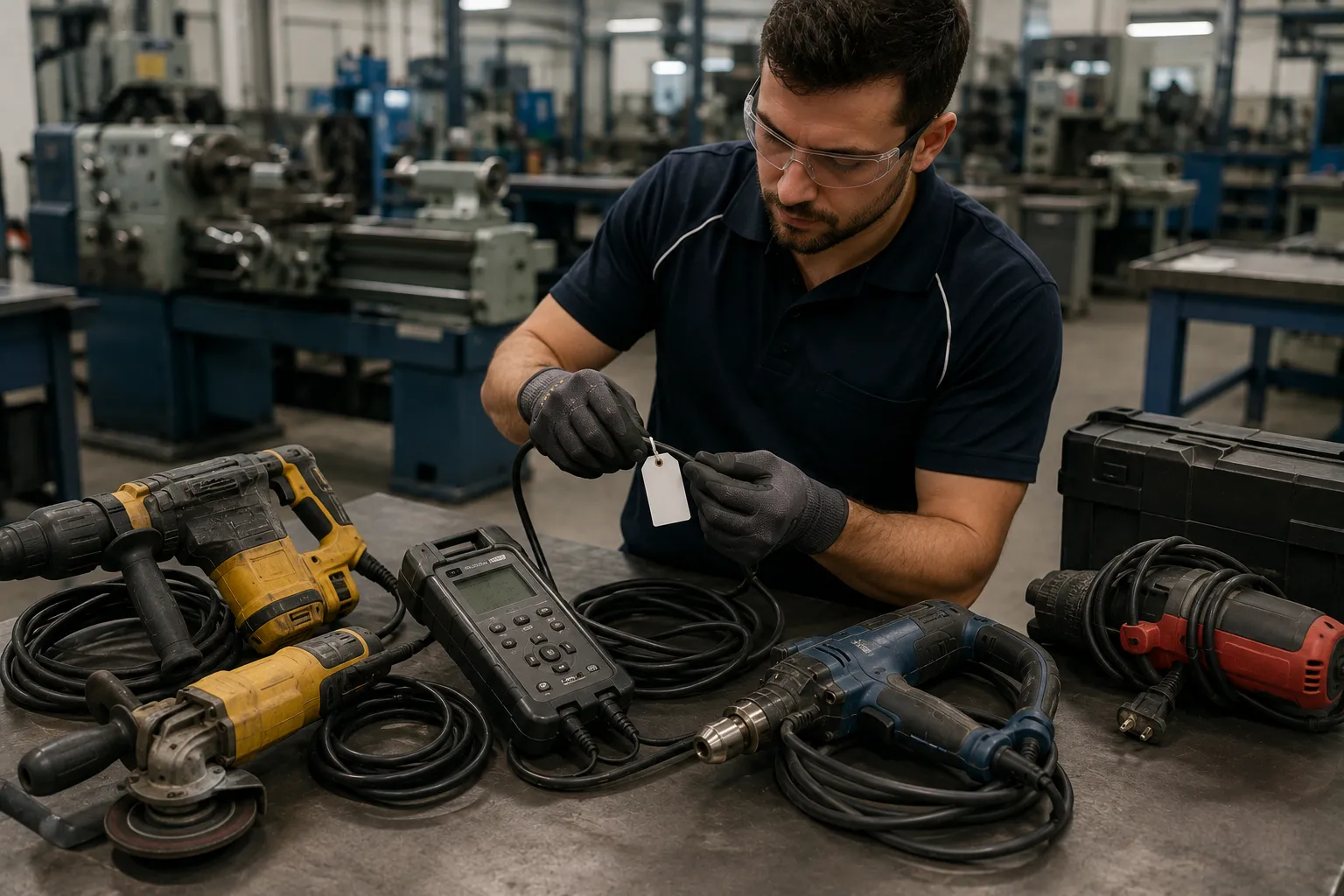
Test and tag is one of the simplest electrical compliance scopes to understand and one of the most-neglected in practice. Every Brisbane workplace has a duty under the Work Health and Safety Act 2011 to ensure electrical equipment is safe, and AS/NZS 3760:2022 specifies how that duty is discharged — periodic inspection and testing of portable electrical appliances, with documented records retained 5 years. The risk of getting it wrong is real: failed equipment that injures a worker, gaps in records that void insurance after an incident, audit failure that affects business operations. The cost of getting it right is modest: a typical 50-item office tests for $300-$500 annually, a construction site $500-$1,200 quarterly. Aurora Electrical Solutions delivers AS/NZS 3760:2022 test and tag across Brisbane, the Gold Coast, Logan and SEQ — offices, construction sites, warehouses, factories, commercial kitchens, hotels, retail, body corporate common areas, medical facilities, education. On-site testing by qualified technicians using calibrated PAT testers, on-the-spot tag replacement, repair where straightforward, digital asset register, audit-ready compliance reports within 24 hours, automatic scheduling for next due date. Aurora is a fully licensed Queensland electrical contractor (Licence EC91972), Master Electricians Australia members, fully insured.
What's included
- AS/NZS 3760:2022 four-stage test on every item: visual inspection, earth continuity (Class I), insulation resistance, polarity check (where applicable)
- Frequency matched to your environment: 3-monthly construction, 6-monthly hostile environments (warehouses, kitchens, factories), 12-monthly offices and retail, 5-yearly fixed low-risk equipment
- Calibrated portable appliance testers (Seaward, Metrel, Megger) with current calibration certificates
- Compliant tags applied to every passed item showing tester ID, test date, next test date, asset ID
- Red 'DANGER — DO NOT USE' tags on any failed items with immediate removal from service
- On-the-spot repair where straightforward (cord replacement, plug rewiring, basic mechanical fixes)
- Failed item disposal where the item is uneconomical to repair
- Digital asset register maintained on our system — every tested item logged with test history
- Audit-ready compliance reports delivered within 24 hours of every test cycle
- On-site logbook updates (paper copy maintained at customer premises if required)
- Automatic scheduling for next test cycle — customers don't need to track due dates
- RCD testing (push-button quarterly, trip-time annually) under AS/NZS 3760:2022 Appendix C
- New-equipment service for businesses receiving new tools/equipment (tag as 'New to Service' with next test date)
- Multi-site coordination for property managers, body corporates, retail chains, hospitality groups
- Same-day urgent visits for businesses with audit deadlines or incident-driven testing requirements
- Per-item pricing with no hidden fees — quote upfront for any volume
When you need test and tag
Test and tag is required for any business using portable electrical equipment under WHS Act 2011. If any of these apply, your testing is either non-compliant now or about to become so:
- Your last test cycle was more than 12 months ago (offices) or more than 6 months ago (warehouses, kitchens, factories)
- Your construction site equipment hasn't been tested in 90+ days (3-monthly testing mandatory)
- You can't produce a current test and tag asset register on request
- You've never had test and tag done — your business has been operating without compliance
- An audit, WorkCover review, or insurance assessment has flagged test and tag gaps
- You're moving into a new tenancy and need all equipment tested before opening
- You've recently bought a business and need to verify the compliance status of all equipment
- Equipment has caused an incident (shock, fire, injury) and post-incident testing is required
- You're a body corporate or property manager responsible for common-area equipment
- You're a builder needing site equipment tested before WorkCover or principal contractor inspection
- You're entering a high-compliance industry (mining, oil and gas, government contracts) that requires documented testing
- You operate a hostile environment (commercial kitchen, workshop, dusty manufacturing) requiring more frequent testing
- Your insurance renewal requires documented electrical equipment testing
- Your existing test and tag provider is unreliable, expensive, or doesn't deliver proper documentation
- You're tendering for work that requires test and tag certification as a contract condition
How much does test and tag cost in Brisbane?
Test and tag pricing is per-item with a minimum callout fee. Volume reduces per-item cost substantially. Here are typical Brisbane ranges for 2026:
- Minimum callout fee: typically $125 – $200 (covers technician travel, setup, asset register, reporting for small jobs)
- Per item (small job, 1-30 items): typically $5 – $9 per item
- Per item (medium job, 30-100 items): typically $4 – $6 per item
- Per item (large job, 100-500 items): typically $3 – $5 per item
- Per item (very large or recurring, 500+ items): typically $2.50 – $4 per item
- Typical small office (annual, ~30 items): typically $250 – $450 per visit
- Typical medium office (annual, ~80 items): typically $400 – $800 per visit
- Typical commercial kitchen (6-monthly, ~40 items): typically $300 – $600 per visit
- Typical warehouse (6-monthly, ~60 items): typically $400 – $750 per visit
- Typical construction site (3-monthly, ~80 items): typically $500 – $1,000 per visit
- Typical retail store (annual, ~50 items including office back-of-house): typically $350 – $650 per visit
- Multi-site portfolio (annual, body corporate or retail chain): typically $2.50 – $4 per item with consolidated scheduling
- RCD push-button testing (per RCD, quarterly): typically $20 – $40 per RCD
- RCD trip-time testing (per RCD, annually): typically $40 – $80 per RCD
- Failed equipment disposal: typically included at no additional cost
- On-the-spot repair (cord replacement, plug rewiring): typically quoted separately, $35-$95 per repair
- Asset register setup (first visit, new customer): typically included in initial callout
Pricing typically excludes GST. We provide fixed-price quotes upfront for any volume — no surprises on invoice. Recurring contracts get the best per-item rates and locked-in scheduling. Multi-site portfolios get consolidated invoicing and reporting. Same-day urgent visits available across Brisbane for businesses with audit deadlines or incident requirements.
How long does test and tag take?
A qualified technician with a calibrated PAT tester can test 30-50 items per hour for typical office equipment, 20-30 items per hour for workshop tools (more visual inspection time required), and 15-25 items per hour for kitchen equipment (more variation in cord types and inspection points). A typical 50-item office tests in 1-2 hours including documentation. A 200-item warehouse tests in 4-6 hours. Large multi-site portfolios are scheduled across multiple visits to minimise business disruption. Same-day service available across Brisbane for businesses with urgent audit deadlines or incident-driven testing requirements.
AS/NZS 3760:2022 testing frequencies — by environment
AS/NZS 3760:2022 Table 2.4 specifies testing frequencies based on the operating environment. The frequency reflects how hostile the environment is to the equipment — heat, moisture, mechanical damage, dust, vibration all accelerate degradation. Getting the frequency right is essential for compliance:
- 3-monthly testing — construction, demolition, mining, and other very high-risk environments where equipment is exposed to daily mechanical abuse, weather, dust, and shock. The most frequent testing requirement under the standard. Construction site equipment fails at substantially higher rates than office equipment, justifying the shorter interval.
- 6-monthly testing — factories, warehouses, commercial kitchens, manufacturing facilities, workshops, and other hostile environments. Heat, humidity, dust, vibration, and chemical exposure accelerate equipment degradation. Commercial kitchen equipment in particular faces heat, steam, and grease exposure that compromises cord insulation over months.
- 12-monthly testing — standard offices, retail front-of-house, medical clinics, hospitality dining areas, and other standard commercial environments. Equipment in these environments degrades slowly under normal use; annual testing catches developing faults before they become safety issues.
- 5-yearly testing — fixed and rarely-moved low-risk equipment in clean dry office environments (typically items like under-desk computer towers, IT equipment in racks, items that essentially never move). The longest interval under the standard, only applicable to specific equipment categories in specific environments.
- Hire equipment — pre-hire testing plus 3-monthly testing during hire periods. The standard recognises that hire equipment passes through multiple users and environments, justifying frequent testing regardless of the destination use.
- New equipment in service — brand-new equipment doesn't need immediate testing but should be tagged 'New to Service' with the next test date established. Some industries (high-risk, audit-sensitive) test new equipment on arrival regardless for documentation consistency.
- Repaired or serviced equipment — after repair or service that could affect electrical safety, testing under AS/NZS 5762:2022 (a separate standard covering repair, refurbishment and retest) is required before returning the item to service.
- Push-button RCD testing — quarterly minimum on all commercial sites. Can be performed by a competent person trained in the procedure. Documented in the logbook.
- Trip-time RCD testing — annually minimum per AS/NZS 3760 Appendix C. Requires specialised RCD test equipment and licensed electrician. Verifies the RCD actually trips within 300ms at rated fault current.
How test and tag works
Test and tag is straightforward when properly executed. Here's how Aurora delivers it:
- Initial scope and quote — We discuss your business, environment, and approximate equipment count. Quote provided upfront based on per-item pricing and minimum callout. For new customers, we estimate item count and provide a banded quote that locks in pricing for the actual count we find on site. No surprises on invoice.
- Scheduled visit booked — Visit scheduled around your operations — typically outside trading hours for retail and hospitality, within business hours for offices, around shift schedules for warehouses and manufacturing, or coordinated with site safety meetings for construction. Same-day urgent visits available where audit deadlines or incidents require fast turnaround.
- On-site systematic testing — Technician arrives with calibrated PAT tester (Seaward, Metrel, Megger) and current calibration certificate. Works systematically through the site by area (room by room for offices, by shift station for warehouses, by trade group for construction). Every item gets four-stage AS/NZS 3760:2022 testing: visual inspection, earth continuity (Class I), insulation resistance, polarity check where applicable.
- Tag and document on the spot — Every passed item gets a compliant tag showing tester ID, test date, next test date, and asset ID. Failed items get red 'DANGER — DO NOT USE' tags and are removed from service immediately. Asset register updated in real-time on our system. Any items needing repair are quoted separately (cord replacement, plug rewiring) and often completed on the spot.
- Compliance report within 24 hours — Digital compliance report generated showing every item tested with test results, any failed items and actions taken, asset register state, next due date. Delivered to customer by email within 24 hours. Format is audit-ready — WorkCover, insurer, principal contractor can all use it directly.
- Reminder scheduling for next cycle — Next test due date logged in our reminder system. Customer receives notification 2-4 weeks before next visit due so it can be scheduled around operations. No compliance deadlines to chase — we track them for you. For recurring contracts, the entire annual schedule is pre-booked.
AS/NZS 3760:2022 — what changed from the 2010 version
AS/NZS 3760:2022 was published in late 2022 as an update to the long-standing 2010 version of the standard. Several substantive changes affected commercial test and tag programs, and many Brisbane businesses haven't fully updated their procedures to reflect the new requirements.
Clearer scope definition: the 2022 standard provides much clearer guidance on what does and doesn't fall within its scope. Hardwired equipment (not portable), items requiring dismantling to test, and brand-new retail/warehouse equipment are explicitly outside the scope. This clarity reduces over-testing of items the standard never covered.
Updated test frequencies: the frequency table (now Table 2.4) provides more granular guidance on environment classification. The standard now explicitly recognises that the same item might need different test frequencies depending on where it's used — a kettle in an office tests annually, the same kettle in a commercial kitchen tests 6-monthly.
RCD testing integration: AS/NZS 3760:2022 explicitly covers RCD testing (push-button quarterly, trip-time annually), bringing what was previously a separate compliance scope into the unified framework. Aurora delivers both as part of the same testing visits where the customer has both portable equipment and RCDs to test.
Digital records explicitly recognised: the 2022 version recognises digital asset registers and digital compliance reports as acceptable record formats. Paper logbooks still acceptable but no longer the only compliant format. This matches how most modern T&T providers actually work.
Polarity testing requirements: clearer requirements for polarity testing of cord sets, extension cords, and power boards (EPODs). These items have specific failure modes (reversed polarity, swapped wires) that other test stages don't catch, and the 2022 standard mandates polarity testing for these item types.
Repair and retest under AS/NZS 5762:2022: cross-references to the separate repair standard, clarifying that repaired equipment returns to service via the AS/NZS 5762 retest protocol rather than just the standard AS/NZS 3760 test. Aurora's repaired items get the full 5762 retest before going back into service.
The four test stages — what we actually do to each item
Every item tested under AS/NZS 3760:2022 goes through four stages. Skipping stages (a common shortcut by under-trained or undertime testers) means the test isn't compliant and the item isn't actually verified safe. Here's what each stage actually involves:
Visual inspection — the first and most important stage. The technician examines the item, cord, plug, and case for damage, wear, missing components, or modifications. Common visual failures: cracked plug bodies, fraying cord insulation, broken strain reliefs, damaged casing exposing internal components, missing earth pins, signs of overheating or moisture damage. About 60-70% of items that ultimately fail testing fail on visual inspection alone — the other tests just confirm what the technician already saw.
Earth continuity test — for Class I equipment (earthed appliances with a metal case, three-pin plug). The technician connects the PAT tester between the earth pin and the case, applies test current, and measures resistance. Pass criterion: typically <1 ohm depending on cord length. Failures indicate broken earth conductors, loose terminations, or corroded earth points. Class II equipment (double-insulated, no earth pin) skips this stage by design.
Insulation resistance test — applies a high voltage (typically 500V DC) between the active+neutral conductors and earth (or the case for Class II), measuring leakage. Pass criterion: typically >1 megohm. Failures indicate degraded insulation, moisture ingress, or insulation breakdown between live and earth — all of which create real shock risk.
Polarity check — for cord sets, extension cords (EPODs), power boards, and items where the conductor arrangement matters. Verifies that active is on the active pin, neutral is on the neutral pin, and earth is properly connected end-to-end. Failures indicate miswired cords (active and neutral reversed), which create shock risk on appliances that depend on correct polarity.
Leakage current measurement — for some specific equipment types (medical equipment, IT equipment with switching power supplies). Measures the small leakage current that exists in normal operation, with pass criteria specific to the equipment type. Aurora performs this stage where the equipment class requires it.
Frequency selection — getting the environment classification right
The most common test and tag compliance mistake isn't skipping testing — it's testing at the wrong frequency for the environment. The result is either non-compliance (testing too infrequently for the actual risk) or wasted money (testing too frequently for low-risk environments).
The principle: the test frequency reflects environmental hostility to equipment, not the equipment itself. A drill in an office workshop space tests annually; the same drill on a construction site tests every 3 months. The equipment is identical; the environment differs in how rapidly it degrades the equipment.
Mixed environments are common: many Brisbane businesses have multiple environments under one roof. A construction company's office equipment tests annually; their site equipment tests every 3 months. A factory's office area equipment tests annually; the production floor equipment tests every 6 months. We classify by area and apply the correct frequency to each.
'Hostile environment' is a defined term: AS/NZS 3760:2022 defines hostile environments as those where one or more of these conditions apply — exposure to flexible-cord abuse (mechanical wear on cords), exposure to moisture or chemicals, exposure to elevated temperatures, exposure to dust or other contaminants, equipment subject to frequent relocation. Commercial kitchens hit several of these simultaneously (heat, moisture, grease, frequent moves) and clearly meet the hostile criterion.
The risk of testing too infrequently: items develop faults between scheduled tests. A kitchen kettle whose cord insulation has cracked from heat exposure can pass at month 6 and fail at month 11, but if testing is annual the failure isn't caught until month 12 — six months of risk exposure during which an incident could occur. WorkCover and insurance reviews after incidents look at testing frequency selection as much as at the testing itself.
The cost of testing too frequently: a low-risk office testing every 6 months instead of annually pays approximately double the annual testing cost. For a 50-item office that's $400-$1,000 of unnecessary annual cost. We won't recommend over-testing — we'll recommend the correct frequency for the environment.
On-the-spot remediation — why it matters operationally
Test and tag programs that test on one visit and quote remediation for a separate visit cost the customer substantially more than necessary in two ways: the separate remediation visit incurs another callout fee, and the failed equipment is out of service for the gap between visits. Aurora's approach is on-the-spot remediation where possible.
What we repair on the spot: cord replacement (most common — failed cord insulation or strain relief), plug replacement (cracked or damaged plug bodies), plug rewiring (loose or miswired terminations in moulded plugs that can be opened), basic mechanical repairs (reattached strain reliefs, replaced earth pins on three-pin plugs, replaced fuses where applicable). About 40-60% of items that fail testing have repairs in this category — quick, parts available on the van, customer keeps the item in service.
What requires separate quote: failed motors, failed switches, failed transformers, internal damage requiring full disassembly, items where the cost of repair exceeds replacement value. We tag these items out of service immediately, quote replacement separately, and the customer decides whether to repair or replace.
What we tag for disposal: items past their useful life, items where repair cost exceeds replacement cost, items with structural damage compromising safety. The 'DANGER — DO NOT USE' tag stays on until the item is disposed of or replaced.
Economic impact: on-the-spot repair typically costs $35-$95 per item depending on the repair complexity. Compared to a separate callout visit ($125-$200) plus the labour for the same repair ($60-$120), on-the-spot remediation typically saves 40-60% on the total cost of a failed item. Plus the item stays in service rather than being unusable for 1-4 weeks while waiting for a follow-up visit.
The 'while we're here' philosophy: Aurora's test and tag visits include the small remediations as part of the visit cost rather than nickel-and-diming for every minor fix. Customers consistently rate this as the most valuable element of the service — fewer callouts, less equipment downtime, more predictable cost.
Failed records and the WorkCover / insurance impact
The records dimension of test and tag is often underestimated. Many businesses focus on "we get our equipment tested" without thinking about what the documentation actually proves — and what happens when it's missing.
The WHS Act 2011 duty: Persons Conducting a Business or Undertaking (PCBUs) have a duty to ensure electrical equipment is safe. This duty is enforced by WorkSafe (Workplace Health and Safety Queensland in QLD) and breaches carry substantial penalties — up to $3.3 million for businesses, $600,000 plus imprisonment for individuals where harm results.
What documentation proves: testing records prove the PCBU discharged the duty by having equipment tested at appropriate intervals by competent persons. Records show the asset register (what's covered), test history (when each item was tested), test results (pass/fail), tester identity (who tested it), and rectification actions taken on failures.
Gaps in documentation void the defence: if an incident occurs and no testing records exist, the PCBU effectively can't prove the duty was discharged. The defence in any subsequent WorkSafe investigation becomes substantially harder. Insurance claim adjusters reviewing post-incident claims look specifically at maintenance and testing documentation — gaps tend to result in claim reductions or denials.
Real WorkCover patterns: when a workplace incident involves electrical equipment (shock, electrocution, fire), the investigation always reviews test and tag records. Properly maintained records protect the business legally and financially; missing or fragmented records create serious exposure. We've seen genuine cases where businesses lost the legal protection they were entitled to because records were partial or undocumented.
Records retention: minimum 5 years under AS/NZS 3760:2022. Some industries (mining, construction) require longer retention. Aurora maintains all customer records electronically with indefinite retention — your test history is available years later if needed for incident review, insurance claims, or business sale due diligence.
Audit-ready format: WorkCover, insurers, principal contractors, and certifiers all want the same things from test and tag documentation — asset register, test dates, results, actions on failures. Aurora's standard compliance report meets all these requirements in one document. Customers can hand the report directly to any reviewer without reformatting.
Multi-site coordination and recurring contracts
Test and tag scales naturally to multi-site operations — the same compliance requirements apply at every site, with significant efficiency gains from coordinated scheduling, consolidated reporting, and bulk pricing. Brisbane property managers, body corporates, retail chains, hospitality groups, and construction companies all benefit from coordinated multi-site test and tag.
Property managers typically have 5-50+ commercial sites with test and tag requirements at each. Without coordination, each site is a separate test cycle, separate vendor relationship, separate invoice, separate documentation. With coordination: single point of contact across all sites, single quarterly invoice, consolidated dashboard showing compliance status across the portfolio, prioritised scheduling for sites approaching audit deadlines.
Body corporates have common-area equipment (lifts, plant rooms, lobby equipment, gym equipment, BBQ area, pool equipment) that's the body corp's responsibility — separate from tenant equipment in individual lots. Coordinated common-area testing on a single annual schedule with consolidated reporting that the building manager can hand to certifiers and insurers directly.
Retail chains have repeated similar equipment lists across many stores — point of sale equipment, refrigeration, kitchen equipment, office back-of-house. Same equipment, same test requirements, different sites. Coordinated annual cycles roll across all stores efficiently with bulk per-item pricing.
Hospitality groups (multi-venue restaurant/pub/cafe operators) have kitchen equipment requiring 6-monthly testing across all venues. Coordinated scheduling minimises business disruption (each venue tested outside trading hours), bulk pricing reduces per-item cost, and consolidated reporting supports group-level compliance audits.
Construction companies with multiple active sites need 3-monthly testing across each site, plus testing for equipment moving between sites. Coordinated approach: project equipment registered to specific sites, transferred between sites tracked in the asset register, scheduling tied to project programs.
The economics: multi-site coordinated test and tag typically reduces per-item cost 20-40% compared to fragmented vendor arrangements, plus eliminates the customer's internal admin cost of coordinating multiple vendors. For a property group with 20+ sites the annual saving can exceed $30,000 while delivering better compliance outcomes and audit-readiness.