
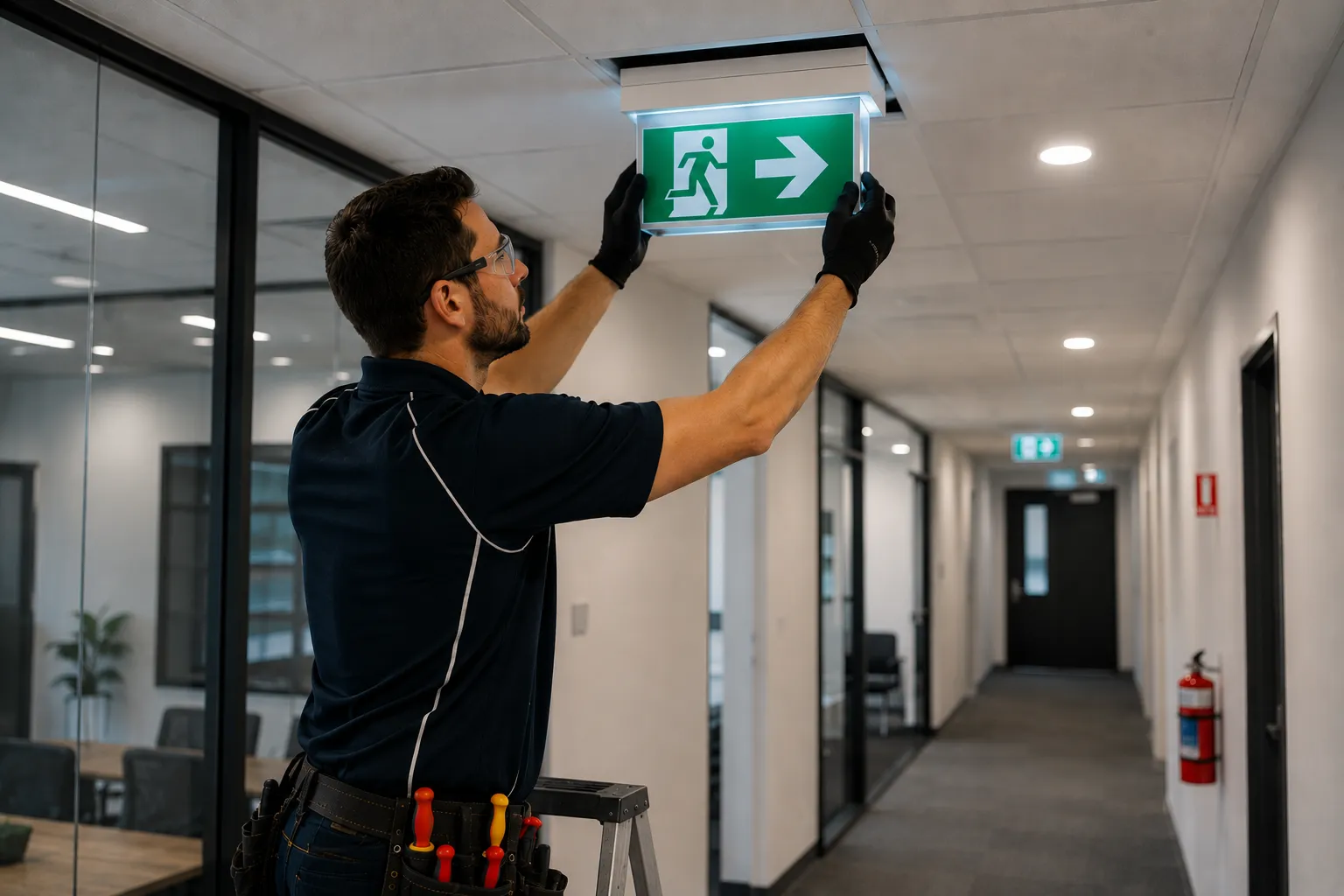
Emergency and exit lighting is the most-failed compliance scope in Brisbane commercial buildings. The reason is structural: emergency lights only operate during power outages or fires, so faults aren't discovered during normal business operations. A building can run for years with degraded batteries, failed lamps, and obstructed light paths — and never know until the day they're actually needed for an evacuation. The "ready" LED indicator only confirms mains power is connected, not that the unit will operate when called upon. AS/NZS 2293.2 mandates 6-monthly 90-minute discharge testing precisely because this is the only way to verify the system works. Aurora Electrical Solutions delivers AS 2293 emergency and exit lighting across Brisbane, the Gold Coast, Logan and SEQ — design and installation for new tenancies and fit-outs, ongoing 6-monthly discharge testing, annual full inspections, battery and lamp replacement, fluorescent-to-LED upgrade programs, and the audit-ready documentation that protects Annual Fire Safety Statements. Aurora is a fully licensed Queensland electrical contractor (Licence EC91972), Master Electricians Australia members, fully insured with $20M public liability.
What's included
- AS 2293 emergency and exit lighting design for new tenancies, fit-outs and extensions
- Installation of LED running-man pictogram exit signs (AS 2293.3 compliant) with directional arrows
- Emergency luminaire (spitfire, batten, downlight) installation for corridor and room emergency lighting
- 6-monthly 90-minute discharge testing per AS/NZS 2293.2
- Annual full inspection including battery condition, fitting condition, lamp condition, switching circuit, charger function
- On-site logbook maintenance (mandatory under AS 2293.2, retained 7 years)
- Lamp replacement (LED, fluorescent for legacy systems)
- Battery replacement programs (most failures trace to ageing batteries past 4-5 year life)
- Failed luminaire replacement
- Fluorescent-to-LED upgrade programs for older commercial buildings
- Self-test smart LED system retrofit (automated 90-minute discharge testing)
- Networked emergency lighting systems (RF, Wi-Fi, powerline communication)
- Real-time monitoring and fault notification
- Floor plan change reviews (new partition walls may block light paths and require additional fittings)
- Annual Fire Safety Statement (AFSS) preparation support
- Building extension and renovation emergency lighting integration
- Audit-ready digital compliance reports issued within 24 hours of every test cycle
- Multi-site coordination for property groups, body corporates, retail chains
When you need emergency lighting work
If any of these apply, your emergency lighting is either non-compliant now or will be at your next audit. Compliance gaps don't fix themselves and tend to compound as batteries age and lamps fail:
- Your last 6-monthly discharge test was more than 6 months ago (you're already non-compliant)
- You can't produce a current emergency lighting logbook on request
- Your Annual Fire Safety Statement is due and your emergency lighting documentation is incomplete
- Your building still has fluorescent emergency lights from the 1990s-2000s (typically past battery life and lamp end-of-life)
- You've never seen anyone test the emergency lights since you moved in
- An audit, insurance review or due diligence has flagged emergency lighting gaps
- You're fitting out a new tenancy and need an emergency lighting design from scratch
- You've added partition walls or changed the floor plan (may block existing light paths)
- You're extending or renovating and need the emergency lighting reviewed against the new layout
- You're a body corporate or property manager responsible for common-area emergency lighting
- You've had an evacuation drill and discovered lights that weren't operating
- You want to upgrade from fluorescent to LED to reduce running cost and maintenance burden
- Your existing system is testing-intensive and you want to retrofit self-test smart fittings
- You're buying or selling a commercial property and emergency lighting compliance is a settlement condition
- Multiple emergency lights have failed and you're considering a system-wide upgrade vs piecemeal repair
How much does emergency exit lighting cost in Brisbane?
Emergency lighting pricing has two main components: routine testing and maintenance (recurring) and installation or upgrade work (project-based). Volume discounts apply on larger sites. Here are typical Brisbane ranges for 2026:
- AS 2293 testing (per fitting, routine 6-monthly): typically $8 – $15 per fitting
- AS 2293 testing (small site, under 30 fittings): typically $300 – $650 per test cycle
- AS 2293 testing (medium site, 30-100 fittings): typically $650 – $1,800 per cycle
- AS 2293 testing (large site, 100+ fittings): typically $1,800 – $5,000+ per cycle
- Annual full inspection (additional to 6-monthly testing): typically $150 – $600 depending on site size
- Battery replacement (per fitting): typically $80 – $180
- Lamp replacement (LED): typically $40 – $120 per fitting
- New LED exit sign supply and install (ceiling recessed): typically $250 – $500 per fitting
- New LED running-man exit sign with arrow (premium): typically $300 – $600 per fitting
- New LED emergency luminaire (corridor batten, spitfire): typically $250 – $450 per fitting
- Self-test smart LED fitting (premium, automated testing): typically $400 – $750 per fitting
- Networked smart emergency lighting system retrofit: typically $30 – $80 per fitting added to base install
- Full emergency lighting design + install (new tenancy, ~30 fittings): typically $9,000 – $18,000
- Fluorescent-to-LED upgrade program (per fitting replaced): typically $300 – $550 per fitting
- AS 2293 design and documentation for building approval: typically $1,200 – $3,500
- Annual Fire Safety Statement preparation support: typically $400 – $1,500 depending on site size
All testing includes logbook updates, AS 2293 compliance reports, and digital records delivered within 24 hours. Failed batteries and lamps replaced on the spot where possible (saves return visit cost). Aurora maintains automatic reminder schedules for 6-monthly and annual cycles — customers don't need to track due dates. Volume discounts available for multi-site portfolios, body corporates and retail chains.
How long does emergency lighting work take?
Routine 6-monthly testing: 1 fitting takes 90 minutes (the discharge test duration). For multi-fitting sites we run multiple fittings in parallel — a 30-fitting site completes in 2-3 hours including documentation. Larger sites (100+ fittings) typically take 4-7 hours, often split across two visits to minimise disruption. Failed fitting replacement on the spot adds 30-60 minutes per fitting. New tenancy emergency lighting design and install: 3-7 days depending on site size, coordinated with the broader fit-out program. Fluorescent-to-LED upgrade programs are typically scheduled across multiple visits to spread cost — a typical 50-fitting site might be done in 3-5 visits of 8-12 fittings each.
AS/NZS 2293 — what the standard actually requires
AS/NZS 2293 is the Australian standard governing emergency lighting. It has three parts that together define the entire emergency lighting compliance framework — design, performance, and maintenance. Every Brisbane commercial building must comply with all three:
- AS/NZS 2293.1 Design, installation and operation — sets the design rules: where fittings are required, spacing, mounting heights, illumination levels (minimum 0.2 lux at floor level on the path of egress), exit sign placement (above every door leading to required exit, every fire stairway door, every discharge point), and viewing distance ratings (standard 24m, extended 40m for long sight lines).
- AS/NZS 2293.2 Inspection and maintenance — the ongoing compliance burden. Mandates 6-monthly 90-minute discharge testing of every luminaire, annual full inspection, monthly visual checks (good practice, not always mandatory), on-site logbook retained for 7 years, written records of every test and any rectification work.
- AS/NZS 2293.3 Performance of emergency luminaires and exit signs — specifies the technical performance every emergency luminaire and exit sign must meet: minimum 90-minute battery duration, light output ratings (Class C0, C50, D50, D100 etc), visibility ratings, durability under fault conditions. New fittings sold in Australia must be certified to AS 2293.3.
- Building Fire Safety Regulation 2008 (QLD) — makes AS 2293 compliance mandatory for occupied commercial premises, with penalties for non-compliance up to $66,000+ for businesses.
- National Construction Code (NCC) — mandates emergency lighting in rooms over 100m², corridors longer than 6m, and all public access areas in commercial buildings (Class 2-9 building classifications).
- Annual Fire Safety Statement (AFSS) — emergency lighting compliance documentation is a required input to the AFSS in Queensland for many building types. Gaps in AS 2293 documentation cause AFSS failure.
- Insurance impact — most commercial property insurance policies require documented AS 2293 compliance. Gaps in emergency lighting maintenance documentation can void fire-related claims, leaving the business with full replacement cost.
- Records retention — logbook must be retained on-site for 7 years minimum, available for inspection by certifiers, building owners, insurers and regulators on demand.
How emergency lighting work runs
Whether it's a routine 6-monthly test cycle or a new installation, Aurora's emergency lighting work follows a documented process from booking through certification:
- Site survey and asset register — For new customers we first do a site survey, count every emergency fitting (exit signs and emergency luminaires), note location, age, type and condition. This creates the asset register that all future testing references. Existing customers — we maintain the asset register on our system and update it at every visit.
- Schedule confirmation and reminder system — 6-monthly and annual cycles built into our reminder schedule. Customers receive notification 2-4 weeks before each test cycle due date so visits can be scheduled around business operations. No compliance deadlines to chase — we track them for you.
- On-site testing — discharge and inspection — 6-monthly visit: every fitting individually triggered into emergency mode (battery operation), 90-minute discharge timed, light output and operation verified, any fittings that fail to maintain rated output for full duration tagged for remediation. Annual visit adds battery condition assessment, fitting integrity check, lamp inspection, switching circuit verification, charger function check.
- Remediation on the spot where possible — Failed batteries replaced on the spot (saves return visit cost). Failed lamps replaced on the spot. Failed fittings tagged out and quoted for replacement (we install replacements typically within 1 week — we don't leave you non-compliant). Any new fittings required due to floor plan changes (new partitions blocking light paths) identified and quoted.
- Logbook update and documentation — On-site logbook updated by hand at every visit (required under AS 2293.2). Digital compliance report generated showing every fitting tested, result, any actions taken, next due date. Report delivered to customer within 24 hours, archived on our system, audit-ready format.
- Annual review and AFSS support — Annual review of the asset register, recommendations on any fittings approaching battery end-of-life (typically 4-5 years from install), upgrade pathways from fluorescent to LED where applicable. Annual Fire Safety Statement preparation support: we provide all the emergency lighting documentation the certifier needs to sign off AFSS.
Why emergency lighting is the most-failed compliance scope in Brisbane buildings
Emergency lighting is structurally different from every other building compliance scope. Most compliance items (fire extinguishers, exit doors, smoke alarms in residential) have some visibility during normal operations — a missing fire extinguisher is obvious, a broken exit door is obvious, a chirping smoke alarm is obvious. Emergency lights are different: they only operate during power outages or fires, so faults are invisible until they're actually needed.
The "ready" LED indicator that every emergency fitting includes is misleadingly named — it indicates mains power is connected to the charger circuit, nothing more. It does NOT indicate the battery is charged, the lamp works, or the unit will provide rated output for 90 minutes. A fitting can show "ready" while having a completely dead battery, a failed lamp, a degraded inverter, or a blocked light path — and the customer has no way to know without proper discharge testing.
When we conduct initial assessments at new commercial customers in Brisbane, we routinely find: 30-60% of fittings with batteries past end-of-life (won't hold 90 minutes), 10-30% of fittings with failed lamps, 5-15% of fittings with damaged or missing diffusers reducing output below the AS 2293 minimum, occasional fittings completely non-operational with the customer unaware. The pattern is consistent across building types — offices, retail, hospitality, warehouses — and the root cause is always the same: routine 6-monthly testing wasn't being done, or was done but failures weren't being remediated.
The Annual Fire Safety Statement framework was designed precisely because this compliance scope can't be self-managed by occupiers. The 6-monthly testing requirement and logbook requirement create the audit trail that proves the system was checked and worked. Without the documentation, even an actually-working system fails compliance review.
Aurora's approach to emergency lighting compliance is built on the reality that customers can't tell whether their system works without proper testing — and we make sure proper testing happens on schedule, gets documented, and stays current. The reminder system, on-site logbook, digital reporting, and on-the-spot remediation are designed to make compliance the default outcome rather than a project the customer has to manage.
The 90-minute discharge test — why it matters and what it actually involves
The 90-minute discharge test (mandated 6-monthly under AS 2293.2) is the most important emergency lighting check, and the one most commonly skipped by under-resourced testing programs. It exists because shorter functional tests ("turn the breaker off, see if the light comes on") prove nothing useful about emergency lighting capability.
What the test verifies: every emergency fitting in the building must operate on battery power for a full 90 minutes while maintaining rated light output. 90 minutes is the standard duration required for safe evacuation of a typical commercial building per AS 2293.1. A fitting that operates for 60 minutes and then fails is a non-compliant fitting — even though the failure won't be visible during normal operation.
How it works in practice: the test technician isolates the mains supply to the emergency lighting circuit (or triggers each fitting via its test switch), starts a 90-minute timer, monitors that the fitting maintains output throughout the duration, and verifies output at the end against AS 2293 minimums. Any fitting that fails to maintain output for the full duration is tagged for remediation — typically battery replacement, sometimes full fitting replacement.
Battery degradation pattern: emergency lighting batteries (typically sealed lead-acid or LiFePO4) lose capacity over time even when in good condition. New batteries hold 100%+ of rated 90-minute duration. After 2-3 years they typically hold 80-90%. After 4-5 years they typically hold 60-70% and start failing 90-minute tests intermittently. After 6-7 years they typically fail consistently. Battery replacement is therefore predictable — most fittings need batteries every 4-5 years.
Why batteries fail silently: a degraded battery still trickle-charges from the charger circuit and shows "ready" on the indicator. It will operate the fitting for a few seconds or minutes when emergency mode is triggered — long enough to convince casual observers it works. But it won't hold 90 minutes, which only the actual timed test will reveal.
Test efficiency: modern testing approach runs multiple fittings in parallel (the technician sets up the test on one fitting, moves to the next, returns to verify each fitting's end-state). A skilled technician can test 50-100 fittings in a working day this way. For larger sites (100+ fittings), tests may be split across multiple visits to minimise business disruption.
Self-test smart LED systems — the 2026 standard for new installations
The dominant trend in Australian emergency lighting since 2023 has been the shift to self-test LED fittings, increasingly networked into building-wide systems. For 2026, self-test smart LED is the gold standard for any new installation or major upgrade — and substantially reduces ongoing testing labour cost.
How self-test works: every fitting includes a microcontroller that runs its own discharge test automatically at scheduled intervals (typically monthly functional + 6-monthly 90-minute discharge per AS 2293.2). Test results are logged in the fitting's memory and reported via networked communication (RF, Wi-Fi, powerline) to a central monitoring system. The system generates audit-ready reports automatically — the technician's role becomes verifying the reports rather than running the tests manually.
What this changes: testing visits drop from 1-2 hours of on-site work per cycle to brief verification visits. Annual fitting inspection still requires physical attendance (no automation replaces visual inspection of fitting integrity, lamp condition, light path obstruction). But the 6-monthly 90-minute test becomes essentially zero-touch.
Test scheduling intelligence: smart systems schedule discharge tests during off-hours (typically 2am Sunday) to minimise business impact. Multiple fittings are staggered so the building never has all emergency lighting in test mode simultaneously — keeps the egress path operational at all times.
Real-time fault notification: smart systems send immediate notifications when fittings fail tests or develop faults, instead of waiting for the next scheduled test cycle. Failures are addressed within days rather than weeks. Compliance posture shifts from periodic to continuous.
Cost premium: self-test smart LED fittings typically cost 30-60% more than basic self-contained equivalents. The labour saving on testing typically pays back the premium within 3-5 years for medium and larger sites. Smaller sites may not justify the premium economically; medium and larger sites almost always do.
Retrofit vs new install: complete networked systems work best as new installations or major upgrades. Partial retrofits (some smart fittings, some not) still deliver value but lose the central monitoring efficiency. For ageing fluorescent systems being upgraded, full LED self-test retrofit is the right answer.
Fluorescent-to-LED upgrade — when it makes economic sense
Many Brisbane commercial buildings still have emergency lighting from the 1990s-2000s era — fluorescent or compact fluorescent technology that's now reaching multiple end-of-life points simultaneously. Battery end-of-life (4-5 years from install), lamp end-of-life (10,000-20,000 hours), fitting end-of-life (15-20 years for housings), and standard end-of-life (some older fittings don't meet current AS 2293.3 ratings) all hit at different times, creating compounding maintenance cost.
The economic case for LED upgrade: LED emergency fittings have substantially lower lifetime cost than fluorescent equivalents. LED lamps last 50,000+ hours (vs 10,000-20,000 for fluorescent), LED draws 60-80% less power continuously (running cost reduction), modern LED batteries (often LiFePO4) last 6-10+ years (vs 4-5 for older sealed lead-acid), and LED fittings often include self-test capability eliminating manual testing labour.
Total cost of ownership comparison over 10 years: a 30-fitting building with fluorescent emergency lighting typically incurs $4,500-$8,500 in maintenance (battery replacement, lamp replacement, occasional fitting failure) plus $1,500-$3,000 per year in testing labour. Same building converted to self-test LED: $1,000-$2,500 in maintenance (one battery replacement cycle, minimal lamp issues) plus $500-$1,000 per year in testing labour. Net 10-year saving typically $15,000-$35,000 for a 30-fitting building.
Capital cost of upgrade: full fluorescent-to-LED upgrade typically $300-$550 per fitting installed. For 30 fittings: $9,000-$16,500. Payback period typically 4-6 years from labour and maintenance savings alone, with continued benefit for 10-15+ years afterward.
Phased upgrade approach: rather than full upgrade in one project, many customers spread the cost across 2-3 years by upgrading sections progressively. We support phased approaches — upgrade one floor or wing per year, prioritise areas with the worst current performance, maintain a consistent system across the building eventually. Doesn't capture the full labour saving immediately but spreads capital cost.
When to upgrade vs maintain: full upgrade typically makes sense when 30%+ of fittings are simultaneously past battery life, when the building is undergoing other major works (renovation, fit-out, rebrand) that justify integration, when the existing system is fluorescent and approaching 15+ years total age, when the customer wants the audit simplification of self-test smart systems.
Floor plan changes — the most-missed cause of non-compliance
Emergency lighting designs are specific to building floor plans. A design that was compliant on the day it was installed can become non-compliant later if the floor plan changes — and the most common cause of "surprise" non-compliance findings in Brisbane buildings is undetected floor plan changes blocking emergency light paths.
How partition walls cause non-compliance: adding a partition wall to subdivide a space creates new rooms or new corridors that may not have adequate emergency lighting coverage. The path of egress now follows a different route than the original design envisaged. The minimum 0.2 lux at floor level on the path of egress requirement still applies, but the new partitions may create dark spots that weren't there before.
Common Brisbane scenarios: office subdivision (one tenancy split into two, requiring new exit pathways for each), retail refit (new internal partitions reshaping the customer flow), hospitality fitout (new bar, kitchen or function area changing egress routes), warehouse expansion (racking layout changes affecting clear egress paths), body corporate common area changes (new mailroom partitions, new lounge areas).
What to do when floor plans change: any time partitions are added or moved, the emergency lighting design should be reviewed against the new layout. We provide this as a standalone service or as part of office fit-out scope. The review identifies any new dark spots, recommends additional fittings if required, and updates the asset register so future testing covers the changed layout.
Annual review built in: Aurora's annual full inspection visit includes a floor plan review for any customer where we've been testing more than 12 months. If partitions have changed since our last design review, we identify it and recommend any updates needed. Catches this issue before it shows up at an audit.
The certifier perspective: building certifiers reviewing Annual Fire Safety Statements look specifically for floor plan changes since the last review. A compliance certificate that says "30 fittings tested and passed" doesn't help when the certifier walks through and sees a new partition wall creating an uncovered dark spot. Updated design documentation is the protection against this.
Multi-site coordination — body corporates, property groups, retail chains
Multi-site customers benefit substantially from coordinated emergency lighting compliance across their portfolio. The compliance requirements are identical at every site, but the scheduling, documentation, and reporting can be either fragmented (separate vendor per site, separate documentation per site, separate reminders per site) or coordinated (single vendor, single dashboard, single point of contact).
Property managers typically manage 5-50+ commercial sites with emergency lighting compliance at each. The compliance burden compounds: 50 sites × 6-monthly testing = 100 scheduling decisions per year, plus 50 annual inspections, plus failed fitting remediation, plus AFSS preparation. Without coordination, this fragments into a permanent administrative load.
Body corporates typically have common-area emergency lighting (corridors, lobbies, basement car parks, plant rooms) plus sometimes tenancy-specific emergency lighting. The common-area scope is the body corporate's responsibility; tenancy scope sits with the tenant. Coordinated testing makes sure both scopes stay compliant.
Retail chains have repeated similar layouts across many stores. Coordinated testing benefits from familiarity with the standard layout, efficient asset register management, and bulk pricing on testing, battery replacement and LED upgrades.
Aurora's multi-site approach: single point of contact across all sites, consolidated asset register, single dashboard showing compliance status across the portfolio, single quarterly invoice rather than separate per-site invoicing, bulk pricing for testing volume and battery/lamp replacement, prioritised scheduling for sites approaching audit deadlines, consolidated AFSS preparation documentation.
The economics: multi-site coordinated testing typically reduces per-site cost 15-30% compared to fragmented vendor arrangements, plus eliminates the property manager's internal admin cost of coordinating multiple vendors. For a property group with 20+ sites, the saving can exceed $50,000 per year while delivering better compliance outcomes.