
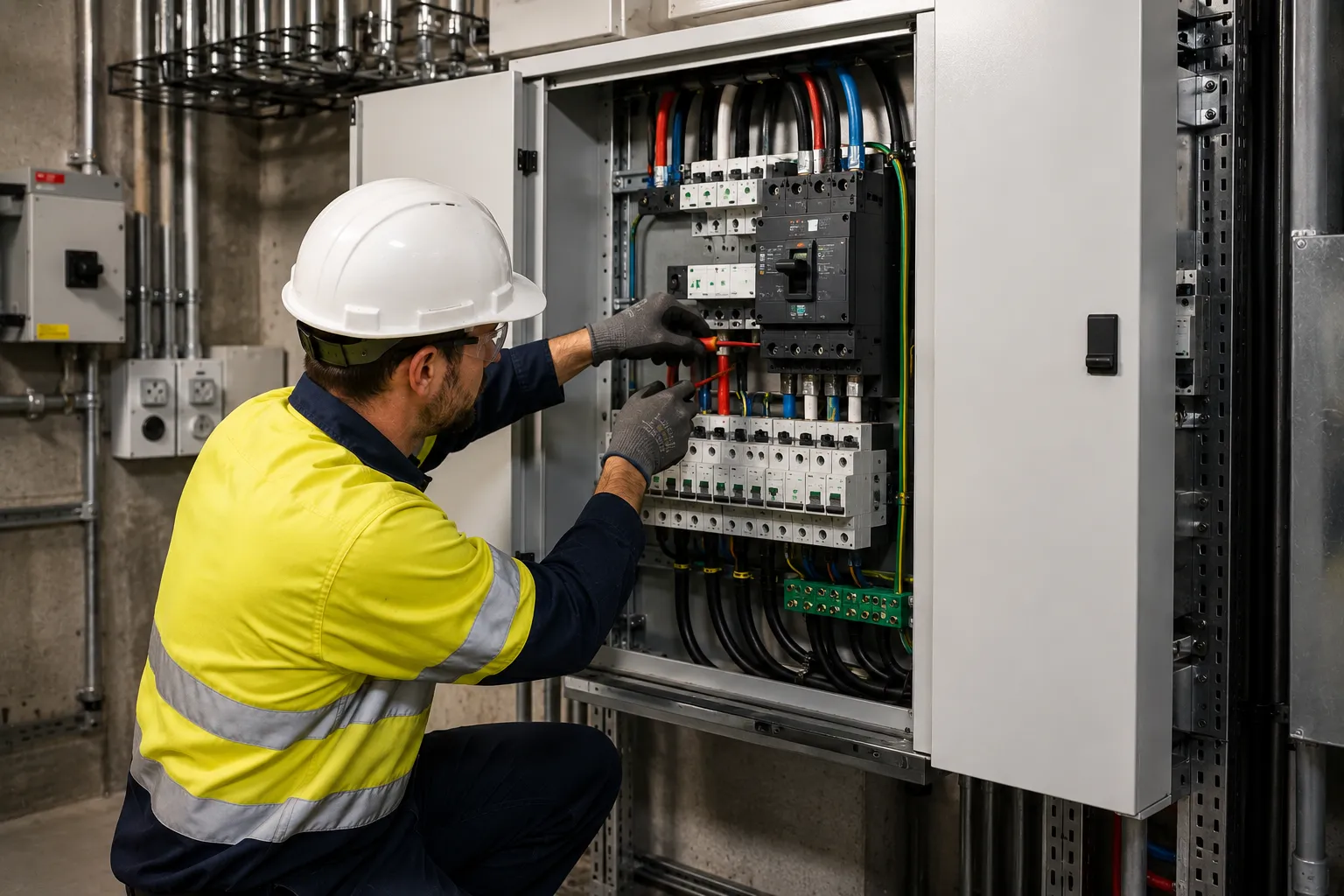
A commercial switchboard is the single piece of electrical infrastructure your business cannot afford to fail. It distributes power to every circuit, every machine, every workstation — and when it's overloaded, aged, or non-compliant, the consequences range from nuisance trips and equipment damage through to full production halts, insurance claim refusals and electrical fires. Aurora Electrical Solutions delivers commercial switchboard upgrades, sub-board installations, MCCB replacements and three-phase reconfigurations across Brisbane, the Gold Coast, Logan and SEQ — from small office tenancies through to industrial sites with multi-form switchboards and CT metering. Aurora is a fully licensed Queensland electrical contractor (Licence EC91972), Master Electricians Australia members, fully insured, certificate of currency provided for site induction. We schedule around your trading hours — after-hours, weekend and night work available where production schedules can't be interrupted.
What's included
- Site assessment, load calculation and switchboard scope
- Main switchboard upgrade — MCCB, busbar reconfiguration, phase balancing
- Sub-board and distribution board installation for tenancies, mezzanines, expansions
- Form 1, Form 2 and Form 3B internal separation switchboard construction
- CT metering coordination with Energex for installations over 100A per phase
- Three-phase upgrades and supply reconfiguration
- Surge protection device (SPD) — Type 1 and Type 2 as required by AS/NZS 3000
- RCD/RCBO protection on all final sub-circuits per AS/NZS 3000:2018
- MEN connection verification and earthing system upgrade
- Thermographic inspection (infrared imaging) to detect hot spots and loose connections
- Smart monitoring and metering integration where required
- Energex application for any supply changes (we handle the paperwork)
- After-hours, weekend and night-shift scheduling to avoid trading hour disruption
- Certificate of Test and Compliance, as-built drawings, full documentation pack
- Certificate of currency provided for site induction on request
Signs your commercial switchboard is overdue for an upgrade
Commercial switchboards rarely fail dramatically — they degrade slowly until something stops working or until a compliance audit forces the issue. If any of these apply to your business, get a quote on an upgrade now. Reactive work always costs more than planned work.
- Main switchboard installed pre-2000 and never significantly upgraded
- MCCBs (moulded case circuit breakers) showing signs of wear, discolouration, or carbon tracking
- Frequent main-switch or sub-board trips when machinery starts up together
- No spare poles or way for the board to accept new circuits — new equipment is blocked
- Buzzing, humming or sizzling sounds from the switchboard
- Visible scorch marks, melted insulation, or heat damage on busbars or terminations
- Switchboard is warm to the touch on the cabinet (not just at the breakers)
- No surge protection device (SPD) installed — modern AS/NZS 3000 requirement for most commercial
- RCD protection missing or partial — required on most circuits since 2018 wiring rules update
- Phase imbalance — one phase carrying much more load than the others, causing nuisance trips
- Recent thermographic survey flagged hot spots
- New tenancy fit-out where the previous occupant's load profile no longer matches
- Adding three-phase machinery, EV charging, large AC or solar that exceeds existing capacity
- Insurance review, building certifier, or workplace safety audit flagged switchboard compliance
- Asbestos backing board (common in pre-1990 commercial buildings, must be safely removed)
How much does a commercial switchboard upgrade cost in Brisbane?
Commercial switchboard pricing varies hugely with the scope — a small tenancy sub-board is closer to residential pricing, while a large industrial main board with CT metering and form-3 separation runs into mid-five figures. As a general guide:
- Small commercial tenancy sub-board (single-phase, modest load): typically $2,500 – $5,500
- Small commercial three-phase main board (office or shopfront): typically $4,500 – $9,000
- Mid-size commercial main board (cafe, hospitality, retail, ~125A per phase): typically $8,000 – $15,000
- Industrial main switchboard with MCCB and 200A+ per phase: typically $12,000 – $25,000
- Form 2 internal separation switchboard (mid-size commercial): typically $15,000 – $30,000
- Form 3B switchboard with full internal separation (larger commercial/industrial): typically $25,000 – $60,000
- CT metering coordination with Energex (for over 100A per phase): typically $1,500 – $4,000 (added to base price)
- After-hours / weekend scheduling premium: typically 25-50% loading on standard rates
- Asbestos backing board removal and disposal: add $800 – $2,500 depending on quantity
- Smart monitoring system integration: add $1,500 – $5,000+ depending on scope
- Thermographic inspection only (no install): typically $400 – $900
- Sub-mains upgrade (from main board to sub-board, where required): typically $2,000 – $8,000+
Every commercial job is quoted fixed-price after a site assessment, with materials and labour itemised separately so you see exactly where the budget is going. For larger upgrades we provide a phased proposal so capital can be staged across multiple budget cycles. After-hours pricing is shown openly so you can see the trade-off between cost and trading-hour impact.
How long does a commercial switchboard upgrade take?
Project duration depends on scope, board form classification, and whether work happens during or outside trading hours. A small commercial sub-board install is usually 1 day. A mid-size three-phase main board upgrade is typically 2-3 days. A large industrial main board with CT metering and form-3 separation can run 5-10 days from supply isolation to commissioning. Where Energex supply changes are involved, the Energex coordination adds 2-6 weeks of lead time on top, depending on whether you need a CT metering upgrade or supply increase. We work with you to confirm timing during quoting, schedule supply isolation periods to minimise trading hour impact, and provide weekly progress updates with photos for larger projects so there are no surprises.
When businesses book a commercial switchboard upgrade
The most common scenarios that bring Brisbane businesses to us for switchboard work:
- New tenancy fit-out — previous occupant's load profile doesn't match yours
- Expansion or refurbishment of existing tenancy with new circuits required
- Adding machinery, equipment, or large appliances that exceed existing capacity
- Upgrading from single-phase to three-phase to support modern machinery or AC
- Insurance review or workplace safety audit flagged switchboard compliance issues
- Pre-purchase electrical inspection on commercial building acquisition
- Switching to maintenance contract after a reactive callout cost more than expected
- Adding commercial EV charging for fleet, customer or workplace use
- Solar installation requiring board upgrade to support grid-connection and export
- Multi-tenancy building where individual sub-board metering is being added
- Backup generator integration requiring change-over switch and protection coordination
- Smart monitoring or energy management retrofit for facility manager visibility
- Building Code of Australia compliance for renovations or change-of-use applications
How we deliver commercial switchboard projects
Commercial switchboard work needs different rigor than residential — you need a single point of contact, predictable scheduling, documentation that satisfies certifiers and insurers, and minimal trading-hour impact. Here's how we run a project:
- Site assessment and scope — A licensed commercial electrician attends the site, inspects the existing board (with cover off, current and voltage measured on each phase under load), reviews your operations and equipment list, identifies any compliance gaps, and discusses what you're trying to achieve. We provide a written scope of works and fixed-price quote, usually within 3-5 business days for mid-size projects.
- Design and engineering — For larger upgrades, we produce a switchboard design including single-line diagram, busbar configuration, MCCB and breaker schedule, phase balancing analysis, and form-classification specification. Design is reviewed and signed off before procurement. For smaller upgrades we use a stock board configured to your circuit schedule.
- Procurement and Energex coordination — We order materials and components — Schneider Electric, NHP, Hager, ABB, Clipsal MAX9 — typically 2-4 weeks lead time for commercial-grade boards. Where Energex coordination is required (CT metering, supply changes), we lodge the application immediately on quote acceptance so the clock starts running.
- Pre-install planning and isolation scheduling — We agree the isolation window with you — typically after-hours or weekend for trading premises, or planned downtime for industrial sites. Energex supply isolation (if required) is booked in advance. We confirm timing 5-7 days before the job to allow you to plan operations around the outage.
- Install — make-safe, removal, reinstallation — Power isolated at the agreed time. Old board removed (including asbestos backing safely disposed where present). New board mounted, cables re-terminated to the new MCCBs and breakers with proper torque settings, phase rotation verified, MEN connection re-established and tested.
- Testing, commissioning and energisation — Every circuit tested to AS/NZS 3000, voltage and current measured on each phase under load, phase balance verified within tolerance, RCD trip times confirmed per AS/NZS 3760, thermographic imaging performed on all terminations to confirm no hot spots. Energex meter re-commissioned if applicable. Power restored.
- Handover and documentation — We walk you through the new board with the site manager — single-line diagram explained, breaker schedule walked through, location of each isolation point shown. You receive a complete documentation pack: Certificate of Test and Compliance, as-built single-line diagram, breaker schedule with circuit labelling, manufacturer data sheets, and warranty registration. We also offer an optional maintenance contract for ongoing thermographic inspection and compliance.
Main switchboards, sub-boards and distribution boards
Commercial electrical systems are usually hierarchical: the main switchboard sits at the supply entry point and contains the MCCB (Moulded Case Circuit Breaker) main switch, metering, and the busbars that distribute power to sub-boards throughout the building. Sub-boards (also called distribution boards) sit at strategic points around the site — one per tenancy, one per floor, one per production area — and contain the final circuit protection (MCBs and RCBOs) for the equipment in their zone.
Most commercial switchboard work we deliver involves at least two of these levels. A new tenancy fit-out usually means a new sub-board fed from the building's main switchboard. An expansion might mean upgrading both the main board (to handle the increased load) and adding new sub-boards (to distribute it). An industrial production line might involve a main board, a motor control centre as a major sub-board, and dedicated sub-boards for each production area.
Aurora designs and installs at every level, from a simple single-phase sub-board for a small tenancy through to multi-section form-3 main boards with 400A+ per phase. We coordinate the work across all levels so the hierarchy operates as one integrated system — proper coordination of protective devices, correctly sized cables between levels, and full documentation for facility management.
MCCB upgrades — when the main breaker is the bottleneck
The MCCB (Moulded Case Circuit Breaker) is the main switch on a commercial board — it controls power to the entire installation downstream. MCCBs are sized in amperage per phase (100A, 125A, 160A, 200A, 250A, 400A, 630A and up) and selecting the right size is critical: too small and you'll nuisance-trip on legitimate load; too large and you compromise downstream cable protection.
When businesses outgrow their existing capacity, an MCCB upgrade is often the bottleneck operation. Common scenarios: a 100A main switch that's nuisance-tripping needs to upgrade to 125A or 160A (requires supply increase coordination with Energex if it exceeds existing supply); an old 200A MCCB with deteriorated contacts needs straight replacement with a new modern unit; a CT-metered installation needs the MCCB upgraded as part of a larger supply increase.
MCCB upgrades are generally a 1-day job once the parts arrive, but the supply isolation needs careful coordination with Energex and with your operations. We routinely do these after-hours or on weekends to avoid trading-day disruption. Brands we install: Schneider Electric Compact NSX, NHP Terasaki, ABB Tmax, Hager h3+.
Form 1, Form 2 and Form 3B — switchboard internal separation
Australian commercial switchboards are classified by their internal separation — how much the switchboard isolates internal components from each other to limit fault propagation. The forms are defined in AS/NZS 61439 (replacing the older AS 3439):
Form 1 — No internal separation. Everything sits in one cabinet. Suitable for small commercial boards up to about 250A.
Form 2a / 2b — Separation between busbars and functional units (the actual circuit components). The minimum standard for most commercial switchboards over 100A per phase.
Form 3a / 3b — Form 2 separation plus separation between functional units themselves, so a fault on one circuit can't propagate to adjacent circuits. Standard for larger commercial and most industrial sites.
Form 4 — Full separation of busbars, functional units, and terminals. Used in high-reliability industrial applications where business continuity is critical.
We design and install all forms, with the right form selected for the installation's size, criticality and budget. For tenancies and small commercial, Form 2b is typical. For industrial sites and high-reliability commercial, Form 3b is the modern standard.
CT metering and supply over 100A per phase
Where commercial supply exceeds 100A per phase (which most mid-size and larger commercial sites do), Energex requires Current Transformer (CT) metering instead of the direct-read meters used for residential and smaller commercial. CTs are coils installed around each phase conductor that step down the current to a level the meter can safely read, enabling accurate measurement of large loads.
CT metering involves separate coordination with Energex — the meter is supplied and configured by them, the CTs are supplied by them but installed by your electrical contractor, and there's a specific commissioning procedure to verify the meter and CTs are matched correctly. Aurora handles all this on commercial switchboard projects, including the Energex application, CT installation, and commissioning verification.
Lead time for CT-metered installations is typically 6-12 weeks at Energex's end. We lodge the application immediately on quote acceptance and use the lead time to pre-fabricate the switchboard so on-site installation runs efficiently once Energex is ready.
Phase balancing and load distribution
A three-phase commercial switchboard is only as good as its load balance. Phase balance means distributing the single-phase loads (the majority of circuits) evenly across the three actives so each phase carries roughly the same current under normal operation. Done right, voltage is stable across all three phases, breakers don't nuisance-trip, equipment runs cooler and lasts longer, and you maximise the available capacity of your supply. Done badly, one phase runs hot while the other two sit idle.
We balance loads as part of every commercial switchboard project. The process: identify every single-phase circuit, calculate its typical and peak load, distribute them across the three actives so total draw is roughly equal at any moment. For commercial sites with significant single-phase loads (lighting, small appliances, computers), this is usually straightforward. For sites with mixed three-phase machinery and single-phase loads, it's an exercise in optimisation.
On larger projects we also measure actual load distribution after commissioning using clamp meters or built-in current measurement — and rebalance if needed. The documentation handover includes a load balance report showing phase currents at commissioning, which becomes the baseline for ongoing maintenance.
Thermographic inspection — finding faults before they fail
Thermographic (infrared) inspection is one of the most powerful preventative maintenance tools for commercial switchboards. An infrared camera reveals hot spots on terminations, breakers and busbars — usually caused by loose connections, deteriorating contacts, or overloaded circuits. These hot spots are invisible to the eye but precede the vast majority of switchboard failures by weeks or months.
We offer thermographic inspection as both a standalone service (typically $400-$900 for a single site) and as part of our commercial maintenance contracts (annual or six-monthly thermographic scans, with a written report and any urgent issues flagged for immediate attention).
For larger sites we recommend annual thermographic inspection regardless of board age. For sites with critical production infrastructure (cold storage, manufacturing lines, data rooms), six-monthly inspection is standard practice. The cost of one detected loose terminal is usually less than 1% of the cost of one production halt — the maths is overwhelming.
Multi-tenancy and metering arrangements
Multi-tenancy buildings (office buildings, shopping centres, industrial estates) usually have a main switchboard owned by the building or strata, with individual tenancy sub-boards each metered separately for tenant billing. Common projects we handle: installing a new sub-board for an incoming tenant including coordinating the meter with their chosen electricity retailer; reconfiguring an existing tenancy where the previous occupant's circuit layout doesn't match the new occupant's needs; adding sub-metering to common-area circuits (lifts, lighting, HVAC) so costs can be apportioned to body corporate or shared across tenants.
Body corporate work has its own coordination requirements — strata committee approval, common-property access, after-hours scheduling around all tenants. We've worked with body corporates and building managers across Brisbane CBD, South Brisbane, Fortitude Valley and the Gold Coast on these projects and understand the multi-stakeholder dynamics involved.
Smart monitoring and energy management
Modern commercial switchboards increasingly incorporate smart monitoring — facility managers want real-time visibility into power consumption, fault detection, and load trends. The data drives energy management decisions, identifies inefficient equipment, and provides early warning of developing problems.
Common monitoring retrofits we deliver: per-circuit current and voltage monitoring with cloud dashboard (for energy disaggregation and sub-tenant billing); aggregated meter data feeds for building management systems (BMS); anomaly detection (sudden current changes, voltage sags) with alert notifications to the facility manager; integration with renewable energy systems (solar, battery, BESS) for combined monitoring.
We integrate with most major BMS platforms (Schneider EcoStruxure, ABB Cylon, Siemens Desigo, Honeywell) and standalone monitoring systems (Wattwatchers, Solar Analytics for solar sites, Carbon Track). For sites without existing BMS, we deploy standalone cloud-based monitoring with web dashboards. Cost is usually modest compared to the operational savings from improved energy visibility.