
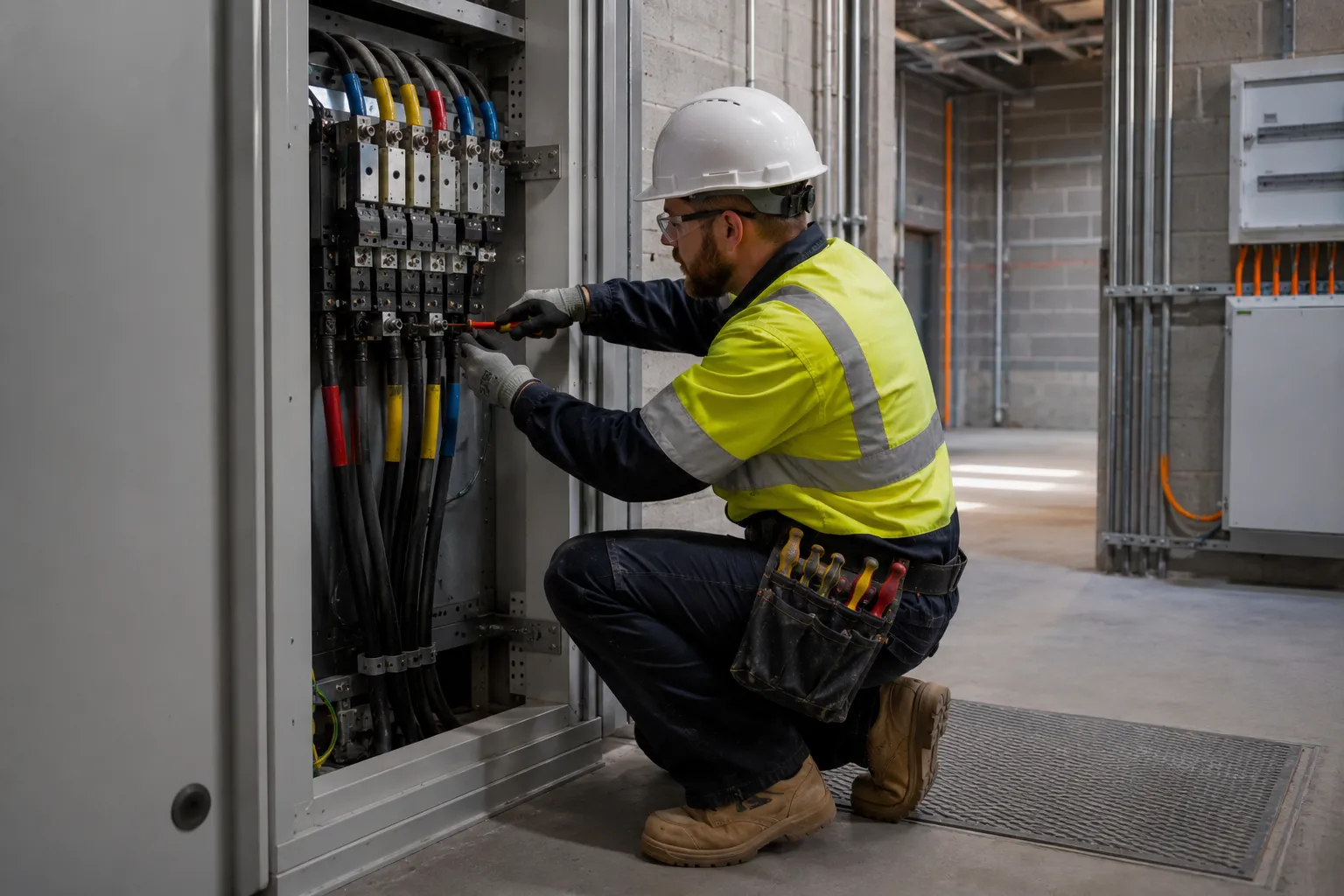
Three-phase power delivers triple the capacity of single-phase supply and is what makes modern high-draw equipment possible — 22kW EV chargers, large solar and battery systems, ducted air conditioning across a whole home, workshop machinery, industrial motors, large hot water systems, and most commercial and industrial loads. Aurora Electrical Solutions handles three-phase power installation and single-to-three-phase upgrades across Brisbane, the Gold Coast, Logan and SEQ. We manage the entire process end-to-end — site assessment, load calculations, Energex application, point-of-attachment work, meter upgrade, switchboard reconfiguration, and final connection. Aurora is a fully licensed Queensland electrical contractor (Licence EC91972), Master Electricians Australia members, fully insured for residential and commercial work.
What's included
- Site assessment and load calculation
- Energex application and supply coordination handled by us
- Point of attachment upgrade (overhead or underground)
- Energy meter upgrade to three-phase compatible smart meter
- Main switch and switchboard reconfiguration for three-phase
- Sub-mains cabling sized per AS/NZS 3008
- Load balancing across all three phases
- Three-phase outlets, isolators and circuits for machinery and appliances
- 22kW three-phase EV charger installation where required
- Motor circuit protection and starter wiring
- Compliance testing to AS/NZS 3000
- Certificate of Test and Compliance on completion
Signs you need three-phase power
Single-phase supply is fine for most everyday households, but it has limits. If any of these apply to you, it’s worth getting a quote on a three-phase upgrade now — doing it at the planning stage is always cheaper than retrofitting after.
- You’re installing a 22kW EV charger (only possible on three-phase) or two single-phase 7kW chargers
- Adding ducted reverse-cycle air conditioning, or three or more split systems running simultaneously
- Installing a large solar system (10kW+) or solar with battery and inverter
- Workshop with machinery — lathes, mills, compressors, welders, large extraction fans
- Frequent main-switch trips when multiple high-draw appliances run at once
- Lights dim or flicker when the AC or oven kicks in (sign of voltage drop on overloaded supply)
- Adding an induction cooktop, instantaneous electric hot water, or large pool heat pump
- Building a granny flat, second dwelling, or shed that needs its own supply
- Commercial tenancy with three-phase machinery or equipment requirements
- Energex flagged your supply or refused additional load increases
- Insurance, certifier or lease conditions require three-phase capacity
How much does a three-phase power upgrade cost in Brisbane?
Three-phase upgrade pricing varies based on the existing supply, how far the property sits from the street, whether the meter and switchboard also need work, and what Energex needs to do at their end. As a general guide for Brisbane:
- Residential single-to-three-phase upgrade (basic, overhead supply, short cable run): typically $3,500 – $5,500
- Residential upgrade with new switchboard included: typically $5,000 – $7,500
- Underground supply upgrade (trenching required): add $1,500 – $4,000 depending on distance
- Long supply run (over 30m from street): add $1,000 – $3,000
- Meter upgrade to three-phase smart meter: typically included with Energex application (no separate fee)
- Three-phase EV charger circuit (after upgrade is in place): typically $1,200 – $2,500
- Three-phase outlet installation (workshop, machinery): typically $400 – $1,500 per circuit
- Commercial three-phase upgrade with larger main switch and sub-board: typically $6,000 – $15,000+
- Industrial three-phase supply increase (larger amperage): quoted on assessment
Every job is quoted fixed-price after a site assessment. We tell you up-front exactly what’s included — the supply work, switchboard work, Energex coordination, and any trenching or making good — so the number on the quote is the number on the invoice.
How long does a three-phase upgrade take?
Most residential three-phase upgrades take 1-2 days on site once Energex has approved the application. Energex coordination usually adds 2-6 weeks of lead time depending on their workload — we lodge the application as soon as you accept the quote, so the clock starts immediately. Larger commercial upgrades that involve significant supply infrastructure can take longer at Energex’s end (sometimes 6-12 weeks) but on-site work is still typically 1-3 days. Power is only off for the time we’re actively working on the supply and switchboard — usually 4-6 hours of the install day, scheduled to minimise disruption.
When customers book a three-phase upgrade
The most common reasons Brisbane homeowners and businesses get in touch with us about three-phase:
- Buying an electric vehicle and wanting fast 22kW home charging
- Adding ducted air conditioning to a whole-home renovation
- Installing a 10kW+ solar system or solar with battery
- Building a granny flat or second dwelling with its own electrical load
- Workshop or shed build with machinery requirements (welders, lathes, compressors)
- Pre-purchase upgrade before settling into a new home so future loads are no problem
- Commercial tenancy with three-phase equipment from the previous occupant disconnected
- Manufacturing or industrial business expansion requiring more capacity
- Large multi-AC commercial fit-out (retail, hospitality, healthcare)
- Renovation or extension triggering Energex review and capacity flag
How a three-phase upgrade works
A three-phase upgrade is multi-stage — we coordinate the supply side, switchboard side, and Energex paperwork so you don’t have to. Here’s how a typical job runs:
- Site assessment and load calculation — We attend the site, look at your existing supply (single-phase rating, meter, switchboard age, point of attachment), discuss what equipment you’re adding or planning to add, and calculate the total three-phase load you actually need. No point paying for capacity you’ll never use.
- Fixed-price quote and Energex application — Written quote breaking down supply work, switchboard work, Energex fees, and any trenching or making good. Once accepted, we lodge the Energex application immediately. Lead time for approval is typically 2-6 weeks for residential, longer for commercial.
- Pre-install preparation — We confirm Energex approval, schedule the install date around your operating hours, and arrange any trenching or pre-work needed. For underground supplies, this can be a separate visit before the main install.
- Install day — supply, meter and point of attachment — On the day, we coordinate with Energex for supply isolation, upgrade the point of attachment (overhead service mast or underground entry), install the three-phase service mains, and Energex installs the new three-phase smart meter. This is usually the longest part of the install day.
- Switchboard reconfiguration — The main switch is upgraded to three-phase, circuit breakers are redistributed across the three phases to balance the load, and any new three-phase circuits (EV charger, AC, machinery) are wired in. Load balancing is critical — it determines voltage stability, breaker performance and longevity.
- Testing, commissioning and certification — Every circuit is tested to AS/NZS 3000, phase rotation is verified, voltage and current are measured on each phase under load, and the new three-phase smart meter is commissioned with Energex. You receive a Certificate of Test and Compliance — the document your insurer, certifier or future buyer may need.
What is three-phase power, and how is it different from single-phase?
Single-phase supply uses two wires — one active conductor at 240V and one neutral — delivering power in a single sinusoidal wave. This is what 95% of Australian homes are wired with. It’s sufficient for typical residential loads (lights, power points, single AC, oven, hot water) but the total capacity is limited — usually 63-80 amps, equating to roughly 15-18kW of continuous load before the main breaker becomes a bottleneck.
Three-phase supply uses four wires — three active conductors and one neutral — with each active wire delivering 240V to neutral and 415V between any two actives. The three phases are offset by 120 degrees, meaning power delivery is continuous (it never drops to zero like single-phase does), which is why motors run smoother and more efficiently on three-phase. Total capacity for a residential three-phase service is typically 100A per phase — effectively triple the available power of single-phase, around 60kW continuous.
For most equipment, three-phase isn’t about needing higher voltage, it’s about needing more total capacity and smoother power delivery. A 22kW EV charger, for instance, simply cannot run on single-phase regardless of upgrade level — the physics requires three actives.
Single-to-three-phase upgrade for Brisbane homes
Residential three-phase upgrades are the most common job in this category for Brisbane households. The trigger is almost always one of three things: a new EV (and the desire for 22kW fast home charging), a major solar/battery install (10kW+ systems often need three-phase to grid-connect efficiently), or a whole-home renovation adding ducted AC and an induction cooktop simultaneously.
The work involves replacing the single-phase service cable from the street (or pole) with a three-phase cable, upgrading the point of attachment (the bracket and mast where the supply enters your property), upgrading the energy meter to a three-phase smart meter (Energex provides and installs this), and reconfiguring the main switchboard with a three-phase main switch and circuit breakers distributed across the three phases.
For most Brisbane homes this is a 1-2 day job once Energex approves the application. We handle all coordination with Energex — you don’t need to deal with the utility directly. Quotes are fixed-price up-front including the Energex fees, so you see the all-in number before committing.
Three-phase for EV chargers, large AC and solar
The single biggest driver of residential three-phase upgrades in Brisbane right now is EV charging. A 7kW single-phase charger is enough for most overnight charging, but if you have a long-range EV, drive significantly each day, or have two EVs in the household, a 22kW three-phase charger is genuinely faster — same charge in roughly a third of the time. Three-phase is also required for any commercial AC charging station.
For ducted air conditioning, the typical 14-20kW outdoor unit on a whole-home ducted system runs much better on three-phase — lower starting current, smoother compressor operation, less voltage drop on long cable runs. Many ducted AC manufacturers now specify three-phase supply for their larger units.
Larger solar systems (10kW and up) and solar-plus-battery installations often need three-phase to grid-connect efficiently. Energex export limits are typically 5kW per phase for single-phase connections, so a 10kW system can export much more on three-phase. Hybrid inverters and Tesla Powerwalls work better on three-phase too.
Three-phase for workshops, sheds and machinery
Workshops, sheds and home workshops with proper machinery almost always need three-phase. Welders, large compressors, lathes, mills, vacuum extraction systems, and industrial-grade tools are usually built for three-phase 415V supply — they run on more efficient three-phase motors that are smaller, lighter, and last longer than single-phase equivalents.
When we install three-phase for a shed or workshop, we typically run sub-mains underground from the main house switchboard or from a new three-phase supply at the street, install a dedicated three-phase sub-board in the shed, and wire each piece of machinery to its own circuit with appropriately-sized circuit protection. Each machine gets a local isolator for safe maintenance and lockout.
For workshops with motor-driven equipment, motor circuit protection (overloads, contactors, starters) is critical — a motor that starts and stops thousands of times needs the right protection to prevent nuisance trips and motor burnout.
Commercial and industrial three-phase
Commercial and industrial three-phase work is its own discipline. Where residential upgrades are usually 100A per phase, commercial sites can run 200A, 400A or higher per phase — with corresponding requirements for larger main switches, current transformer (CT) metering, and form-2 or form-3 switchboard construction.
Common commercial scenarios include new tenancies moving into a space where the previous occupant had three-phase equipment removed, manufacturing or industrial expansion requiring more capacity, retail or hospitality fit-outs with large AC loads, and commercial EV charging stations (workplace charging, customer destination charging, fleet charging hubs).
Aurora handles commercial three-phase work end-to-end — supply increase applications with Energex (which take longer than residential), CT metering coordination, main switchboard construction, sub-board distribution across the tenancy, and full compliance documentation. See our commercial switchboard upgrades and warehouse electrical pages for related commercial work.
Energex coordination and the application process
Any three-phase upgrade in Brisbane involves Energex — they own the network up to the point of attachment, supply the meter, and approve any change to the connection type. We handle the entire Energex application on your behalf so you don’t need to deal with the utility yourself.
The application involves submitting the Connection and Energisation Service forms with your property details, requested load, and intended use. Energex reviews the application against network capacity in your street, approves (or occasionally requires network upgrades on their side, which adds time), schedules the meter and supply work, and provides a notification once you’re cleared to proceed.
Lead times vary — most residential applications turn around in 2-6 weeks, commercial applications can take 6-12 weeks if network upgrades are required. We lodge the application immediately on quote acceptance so the clock starts straight away. While we wait for approval, we can pre-fabricate the new switchboard and stage materials so the on-site work runs fast once approval comes through.
Load balancing and supply quality
A three-phase upgrade is only as good as its load balancing. The whole point of three-phase is that loads are distributed evenly across the three actives — if your AC and EV charger are both on phase 1 while phases 2 and 3 sit idle, you’ve effectively wasted two-thirds of your supply.
Proper load balancing means looking at every circuit in the home or business, calculating each circuit’s typical and peak load, and distributing circuits across the three phases so total draw is roughly equal at any moment. For homes with EV chargers and large AC, we often install dedicated three-phase circuits for those loads (so the device itself balances across all three phases automatically) and balance the remaining single-phase circuits across the three actives by hand.
Done right, voltage stability is rock-solid even under heavy combined load, breakers don’t nuisance-trip, and the supply lasts longer because no single phase is being over-worked. Done badly, you get exactly the same voltage drops and nuisance trips you had before the upgrade — just at a higher cost. Aurora documents the load balance in writing as part of the certification handover.