
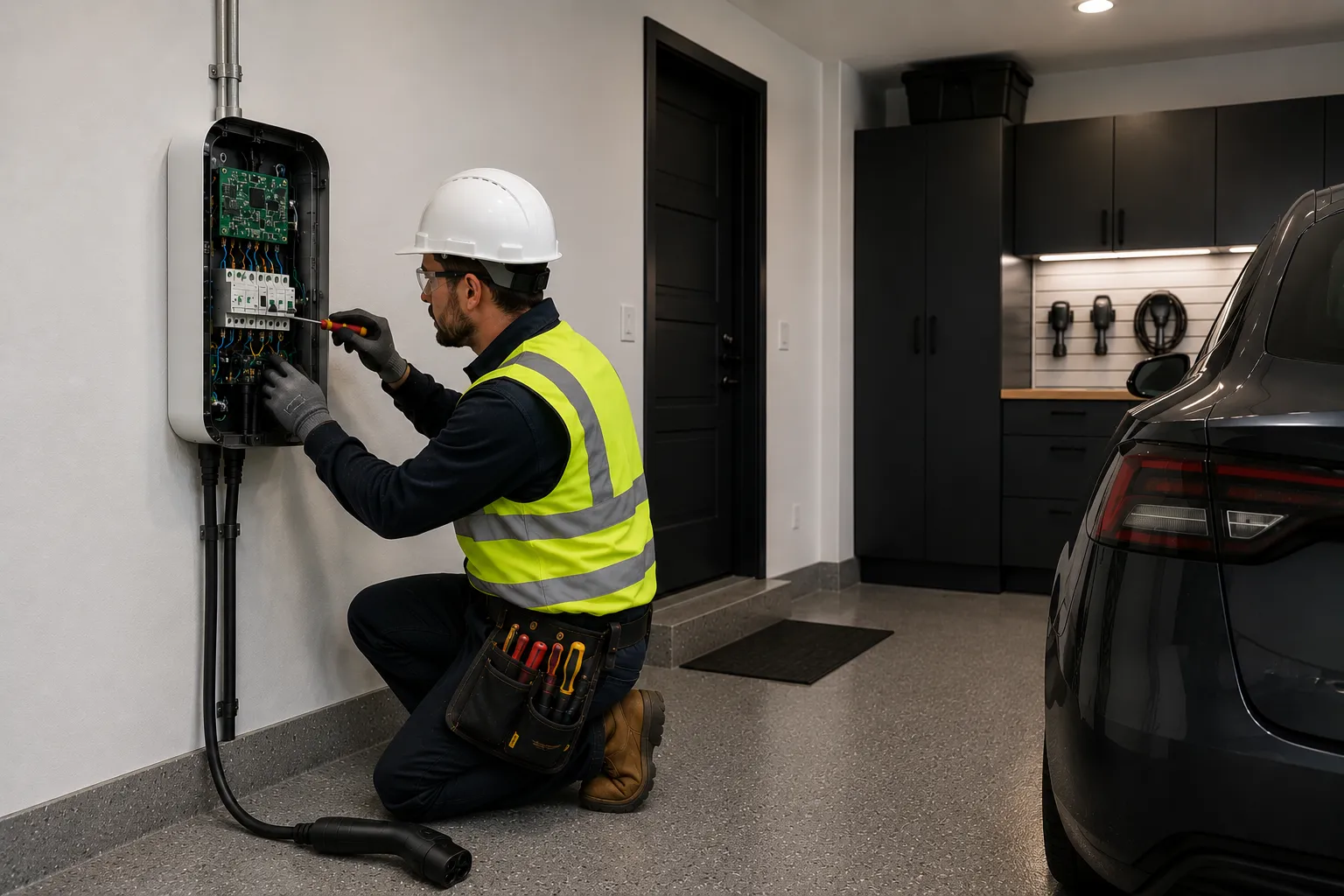
A home EV charger pays for itself in under two years compared to public charging — and turns the EV from a hassle into the easiest car you've ever owned. Plug it in when you get home, drive it fully charged in the morning. Aurora Electrical Solutions installs home EV chargers across Brisbane, the Gold Coast, Logan and SEQ — single-phase 7kW and three-phase 22kW units from all major brands (Tesla Wall Connector, Zappi, Wallbox, Fronius Wattpilot, Ocular, EVnex). We assess your switchboard, run a dedicated RCBO-protected circuit, mount and commission the charger, and lodge the Energex Electrical Work Request — all fixed-price, no hidden fees. Aurora is a fully licensed Queensland electrical contractor (Licence EC91972), Master Electricians Australia members, fully insured.
What's included
- Site assessment and switchboard load calculation
- Dedicated RCBO-protected circuit to AS/NZS 3000 and AS/NZS 61851
- Type A RCD protection (legal requirement for EV charging)
- Cable sized per AS/NZS 3008 for the run length and load
- Wall mounting, internal or external rated to IP location
- Charger commissioning and Wi-Fi app setup
- Energex Electrical Work Request (EWR) lodgement
- Switchboard upgrade where required (often needed on older boards)
- Single-phase 7kW or three-phase 22kW installation
- Solar diversion configuration for Zappi, Wallbox, Fronius Wattpilot
- Certificate of Test and Compliance on completion
- Workmanship and manufacturer warranty pass-through
When to install a home EV charger
If any of these apply, it's worth getting a quote now. Installing during a related electrical job (switchboard upgrade, solar install, renovation) saves money compared to a standalone visit later.
- You've just bought an EV, or your delivery date is locked in
- You're tired of trickle-charging from a 10A power point (5km of range per hour is painful)
- You're tired of driving to a public DC fast charger to top up
- Two EVs in the household, or planning a second one
- You're installing solar and want to charge from excess generation
- You already have a battery (Powerwall, Sungrow, BYD) and want the EV to charge from stored solar
- Building a new home — install the cabling and switchboard provision now, fit the charger later
- Renovating the garage or carport and want the cabling done while walls are open
- You're a long-distance driver and a 7kW charger isn't keeping up — you want 22kW
- EV charger came bundled with the car purchase and you need it installed
- Strata building approval received and you need a qualified installer
How much does EV charger installation cost in Brisbane?
Pricing depends on three things: the charger itself (40-60% of total cost), the cable run from your switchboard, and whether your switchboard needs an upgrade. As a general guide for Brisbane:
- Tesla Wall Connector (Gen 3) unit: typically $850 – $1,200
- Zappi (solar-integrated) unit: typically $1,200 – $1,600
- Wallbox Pulsar Plus unit: typically $900 – $1,400
- Fronius Wattpilot unit: typically $1,200 – $1,700
- Standard single-phase 7kW install (charger within 10m of switchboard, supply only): typically $700 – $1,100 install labour
- Single-phase 7kW supply-and-install package (charger + labour): typically $1,500 – $2,500 all-in
- Three-phase 22kW supply-and-install package (charger + labour, where three-phase already exists): typically $2,200 – $3,500 all-in
- Long cable run (over 15m or through difficult walls): add $200 – $800
- Switchboard upgrade required: add $1,200 – $3,000 (see our switchboard page)
- Single-to-three-phase upgrade required (to enable 22kW): add $3,500 – $7,500 (see our three-phase page)
- Solar diversion configuration: typically included with compatible chargers, no extra cost
Every job is quoted fixed-price after a site visit (or remote quote with photos of your switchboard and proposed charger location). We tell you up-front exactly what's included and what might add cost — so the number on the quote is the number on the invoice. No surprise add-ons.
How long does EV charger installation take?
A standard single-phase 7kW install on a charger within 10-15m of your switchboard takes 2-4 hours. Three-phase 22kW installs take 3-5 hours (more terminations, more testing). Installs that also need a switchboard upgrade add another 4-8 hours. Installs that also need a single-to-three-phase supply upgrade take 1-2 full days plus the Energex application lead time (typically 2-6 weeks). Power is only off while we're actively working on the switchboard — usually 1-3 hours. We coordinate timing so you're not without power overnight.
What we cover in the install
An EV charger install isn't just bolting a box to the wall — it's a dedicated, RCBO-protected, AS/NZS-compliant circuit feeding a specialised piece of equipment. A bad install is a fire risk. A good install just works for 10+ years. Here's what's involved in the right way to do it:
- Switchboard assessment — confirming you have spare capacity, a spare pole for the new breaker, and Type A RCD compatibility
- Cable sizing — typically 6mm² or 10mm² depending on length and current, per AS/NZS 3008
- Type A RCD or RCBO — Type AC RCDs do NOT detect DC fault currents from EV chargers; Type A is required by AS/NZS 3000
- Dedicated circuit — never sharing with other loads, sized for the charger's rated current
- Charger location — sheltered or IP-rated, within reach of the parking spot, away from heat or water exposure
- Cable run — through wall cavities, conduit, or external surface mount depending on the building
- Earthing and bonding — proper main earth verification, RCD continuity test
- Commissioning — phase rotation check, voltage verification under load, charger Wi-Fi setup
- Energex notification — EWR lodgement for any new circuit installation
- Documentation — Certificate of Test, charger commissioning report, warranty registration
- Customer walkthrough — how to use the app, schedule charging, monitor sessions
How the install runs
From first call to charging your car, here's how a typical job runs:
- Free quote and site assessment — Send us photos of your switchboard, your intended charger location, and the route between the two. For most jobs we can provide a remote quote within 24 hours. Where the situation is more complex (long cable run, switchboard at capacity, three-phase upgrade required), we do a free on-site assessment first.
- Charger selection and ordering — We help you choose the right charger for your vehicle, driving patterns, and whether you have solar. If you've already bought a unit, we install it. If not, we order the unit and any required components — usually 1-2 weeks lead time for in-stock brands.
- Pre-install — switchboard and circuit planning — We confirm switchboard capacity, plan the new circuit, and order any switchboard components needed. For installs requiring a switchboard upgrade, we schedule that as part of the same visit so it's all done in one trip.
- Install day — circuit installation — On the day, we isolate power, install the new circuit from the switchboard to the charger location (through walls, ceiling, or external conduit depending on the building), terminate at the switchboard with the new RCBO, and mount the charger.
- Commissioning and testing — We test the new circuit to AS/NZS 3000, verify phase rotation and voltage under load, commission the charger software, connect it to your Wi-Fi, set up the app on your phone, and configure solar diversion if applicable.
- Energex EWR and certification — We lodge the Electrical Work Request with Energex (legal requirement for new circuits) and provide you with the Certificate of Test and Compliance. We walk you through using the charger, the app, scheduling charging for off-peak rates, and answer any questions.
Single-phase 7kW vs three-phase 22kW — which do you need?
This is the single most-asked question on EV charger installs. The honest answer for most Brisbane households: a single-phase 7kW charger is enough. A 7kW charger adds roughly 40-50km of range per hour. Plug in at 6pm, you've got 400-500km by 6am. For 95% of households who drive 50-100km a day, that's massively overkill.
A three-phase 22kW charger adds roughly 120-140km per hour — three times faster. It's worth the upgrade in three scenarios: you have two EVs and need to charge both overnight; you drive significantly more than average (long commute, sales rep, rideshare); or you regularly take long road trips and need fast turnaround charging at home between legs.
There's a hidden constraint: most EVs sold in Australia have a 7-11kW onboard AC charger, meaning even on a 22kW wall unit they'll only charge at the slower rate. Check your specific car — Tesla Model 3 and Model Y SR/LR accept 11kW (so a 22kW charger gives you full 11kW), Model 3 Performance accepts 11kW, BYD Atto 3 accepts 7kW (so 22kW gives you no benefit over 7kW), Polestar 2 accepts 11kW, Kia EV6 accepts 11kW. We'll tell you what your car can actually use.
If you've already got three-phase supply at home, get the 22kW charger — the install cost difference is small and you future-proof. If you only have single-phase, the question is whether the cost of a three-phase upgrade ($3,500-$7,500) plus the larger charger is worth the speed gain for your driving patterns. For most, no. See our three-phase power page for more on supply upgrades.
Charger brands we install
Aurora installs every reputable home EV charger brand on the Australian market. Here's a quick guide to the most common:
Tesla Wall Connector (Gen 3) — The default choice for Tesla owners and increasingly popular with non-Tesla owners too. Australian Teslas use Type 2 (not the proprietary Tesla connector used in the US), so the Wall Connector charges any EV with a Type 2 socket. Sleek, fast Wi-Fi-connected, app-controlled via the Tesla app, supports up to 11kW single-phase or 22kW three-phase, very reliable. Around $850-$1,200 for the unit.
Zappi (myenergi) — The leading solar-integrated charger in Australia. Monitors your solar production and household consumption in real-time, diverts surplus solar to the EV instead of exporting to grid at low feed-in rates. Three charging modes: Fast (grid + solar), Eco (mostly solar with grid top-up), and Eco+ (solar only). Worth the price premium if you have solar. Around $1,200-$1,600 for the unit.
Wallbox Pulsar Plus — Compact, modern design, good app, supports OCPP for advanced load management and dynamic pricing. Cheaper than Tesla/Zappi but solid quality. Around $900-$1,400.
Fronius Wattpilot — Excellent integration if you already have Fronius solar inverters. Solar diversion built in, scheduling, app control. Around $1,200-$1,700.
Ocular and EVnex — Newer Australian-focused brands, OCPP compatible, growing reputations. Worth considering if you want something specifically designed for the Australian market.
We don't push one brand — we install what suits your car, your home, your budget, and your solar setup. Tell us about your situation and we'll recommend the right unit.
Solar integration — charging from excess solar
If you have rooftop solar, a solar-integrated EV charger can dramatically improve your return on investment from both the solar system and the EV. The principle: when your solar panels are producing more power than the house is using (a typical Brisbane home exports 4-8kW of excess solar in the middle of the day), the charger diverts that excess to the car instead of exporting it to the grid at low feed-in tariff rates.
On Queensland's typical 6-8c/kWh feed-in tariff vs 28-35c/kWh import rate, every kWh you redirect to the EV instead of exporting saves around 20-28c. Over a year, that's $400-$1,200 in additional savings depending on driving patterns and solar size — often paying off the price premium of a smart charger (Zappi, Wallbox, Fronius Wattpilot) in 2-3 years.
Solar diversion needs both the right charger and the right configuration. The charger needs a CT clamp installed at your main switchboard to measure real-time grid import/export, then it dynamically adjusts the EV charge rate to match available solar. Aurora installs the CT clamps, configures the charger software, and validates the diversion is working correctly before handover.
If you don't have solar yet but are considering it, this is a great time to coordinate both installs. See our solar panel installation page for more on combined solar + EV charging packages.
Why a proper install matters — and what to avoid
EV chargers draw 30-40 amps continuously for hours on end. That's a heavier sustained load than almost anything else in a typical home — more than an oven, more than a kettle (which only runs for 2-3 minutes), more than a single AC compressor. A poorly-installed charger is a real fire risk.
Things we see when we're called out to fix bad installs from other contractors: undersized cable (2.5mm² instead of the required 6mm² or 10mm²) causing the cable to overheat and the insulation to degrade; Type AC RCDs instead of Type A (Type AC doesn't detect the DC fault currents EVs can produce, leaving the safety switch effectively non-functional during a DC fault); circuits shared with other loads (e.g. the garage power circuit) causing nuisance trips and overload damage; missing Energex EWR notification (which makes the installation non-compliant and can affect insurance claims).
Aurora installs every EV charger to AS/NZS 3000 (general wiring rules), AS/NZS 61851 (electric vehicle conductive charging system), and the manufacturer's specifications. Type A RCBO every time. Dedicated circuit every time. Proper cable sizing every time. EWR lodged every time. We provide the Certificate of Test and the manufacturer commissioning record — the documents your insurer or future buyer may need.
Apartment, strata, and rental considerations
EV charging in apartments and strata-managed buildings is its own challenge. Most buildings weren't designed with EV charging in mind, so capacity, metering, and approval issues all need to be worked through before installation.
Common scenarios: charging on your individual parking spot from your own meter (cleanest option, but only if your meter and supply can reach the spot); shared building charging from a common-area meter with billing back to residents (needs OCPP-compliant chargers and a billing platform like Chargefox or EVUp); installation on common property requiring strata committee approval (sometimes a long process).
We've installed in strata buildings across Brisbane and the Gold Coast and can advise on what's feasible at your building. The first step is usually a discussion with your strata manager and building maintenance to understand the supply situation. Send us photos of your parking spot and the main switchboard area, and we'll tell you what's possible.
Smart features — apps, scheduling, off-peak charging
Modern EV chargers are connected devices, not dumb wall sockets. Once installed and Wi-Fi connected, you get app control over every aspect of charging: start and stop remotely, schedule overnight charging during off-peak rates (Energex Tariff 33 starts at 9pm and is roughly half the cost of peak), set charging session limits (charge to 80% only, or set a hard kWh cap), monitor energy usage and cost per session, integrate with home energy management systems.
For Queensland customers on time-of-use tariffs, scheduling overnight charging is the single biggest cost saver. A typical EV uses 12-15kWh per day for average driving (50km). At peak rate (28c) that's $3.40-$4.20/day. At off-peak rate (16c) that's $1.90-$2.40/day — saving $40-$50 per month on charging cost alone, just by scheduling correctly.
We set up the app on your phone during commissioning, configure scheduling for your tariff, and walk you through the daily use. Most customers never need to touch the charger again after install — just plug in when you get home, walk away.