
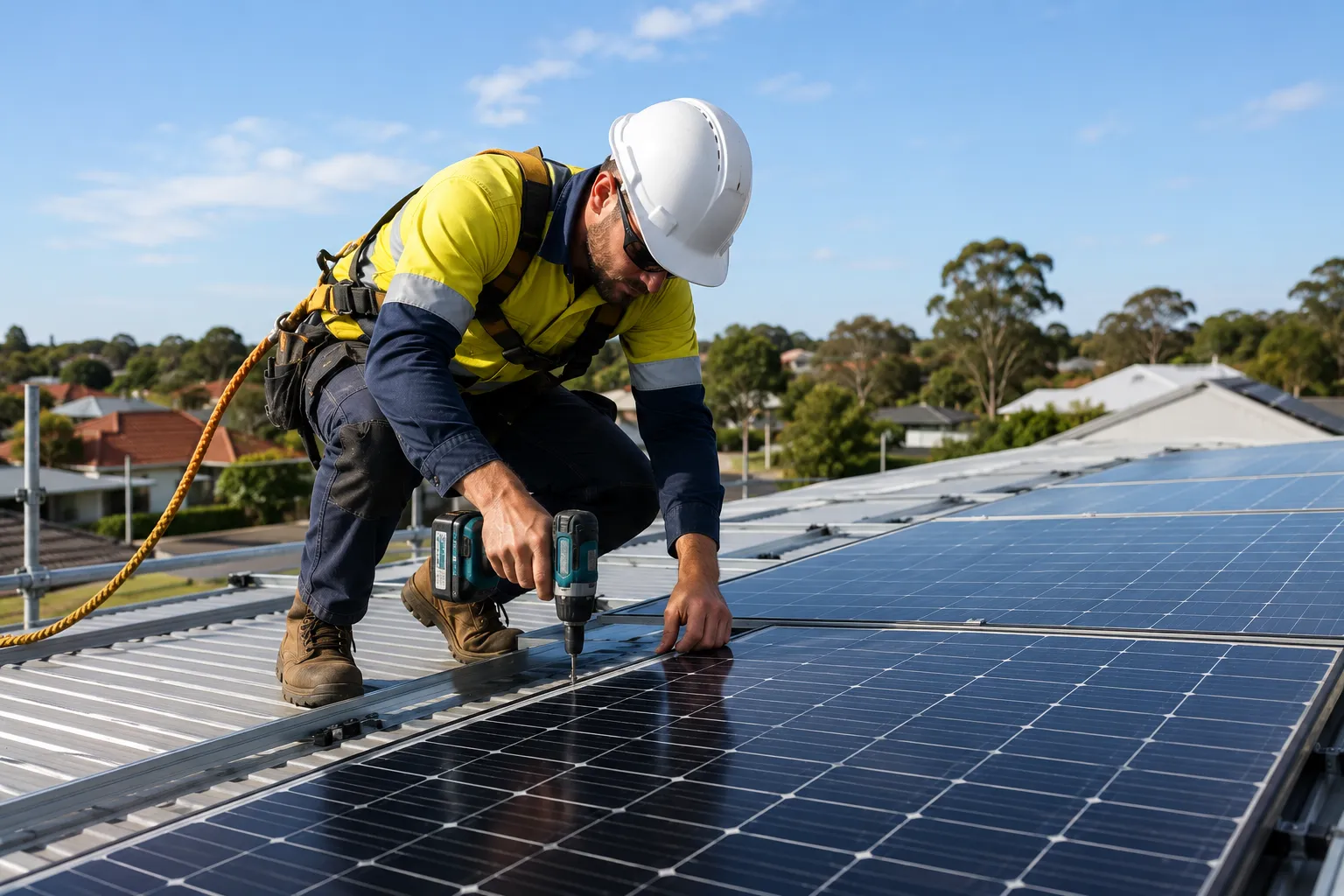
Brisbane gets more sunshine hours than almost any capital city in the world — and household electricity prices have risen 20%+ over the past two years. A modern rooftop solar system pays for itself in 2.8 to 3.5 years for a typical Brisbane home, then runs for another 15-20+ years saving $1,800 to $2,800 per year on electricity bills. Aurora Electrical Solutions provides CEC-accredited solar panel installation across Brisbane, the Gold Coast, Logan and SEQ — Tier 1 panels, hybrid inverters, battery-ready systems, full STC rebate and Energex grid-connection paperwork handled end-to-end. Aurora is a fully licensed Queensland electrical contractor (Licence EC91972), Master Electricians Australia members, fully insured, with the dedicated electrical capability that pure solar resellers don't have for switchboard upgrades, sub-mains and supply work that many solar installs actually need.
What's included
- Site design with shading analysis using satellite tools and on-roof inspection
- Tier 1 panels from CEC-approved manufacturers (Jinko, REC, Trina, LG, Q Cells, Longi)
- String or hybrid inverters from CEC-approved brands (Fronius, SMA, GoodWe, Sungrow, Enphase)
- Battery-ready inverter configuration for future battery upgrade
- Full STC (Small-scale Technology Certificate) rebate paperwork handled
- Energex grid-connection application and pre-approval submitted on your behalf
- Bi-directional smart meter coordination with your electricity retailer
- Switchboard upgrade where required to support the solar system
- Roof-penetration waterproofing to manufacturer specifications
- DC isolators, AC isolators and fire-safety compliance
- System commissioning, monitoring app setup and customer walkthrough
- Certificate of Test and Compliance, plus mandatory QLD pre-grid-connection inspection
Signs it's time to go solar
Solar isn't right for every home — but in Brisbane, it's right for most. If any of these apply, get a quote. The numbers are usually more favourable than people expect.
- Your quarterly electricity bill is over $400 (annual savings will be $1,500+)
- You own your home (or have landlord approval for permanent fixtures)
- You have a north, east or west-facing roof with reasonable sun exposure
- You're home during the day (or running pool pump, AC, EV charging during daylight)
- You're planning an EV — solar + EV is the highest-return household energy investment
- You're installing a heat pump hot water system (off-peak solar + heat pump is very cheap hot water)
- Your roof is metal (Colorbond or tin) or tile in good condition — easiest install
- You have ducted air conditioning that runs through summer (massive solar use case)
- Electricity bill review showed rising costs you can't control
- You're building or renovating — installing solar during construction is significantly cheaper
- You're future-proofing for battery — install a hybrid inverter now, add the battery later when prices drop further
- Your existing solar system is 10+ years old and underperforming (string failure, microcracks, old inverter)
How much does solar cost in Brisbane in 2026?
Brisbane solar pricing has stabilised after years of decline. Prices below are installed, after the federal STC rebate is applied at point of sale. Quality matters — the difference between a $4,500 6.6kW system and a $7,500 one is panel and inverter brand, installer experience, and warranty terms.
- 6.6kW system (typical 3-4 bedroom home, 18 panels): typically $4,500 – $7,500 installed
- 10kW system (large family home or three-phase property): typically $7,500 – $11,500 installed
- 13.2kW system (large home with EV and pool): typically $10,000 – $15,000 installed
- 20kW+ system (commercial or large rural property): quoted on assessment
- Hybrid inverter upgrade vs string inverter: add $1,000 – $2,500 (worth it for battery future-proofing)
- Battery storage (10-13.5kWh — Tesla Powerwall, Sungrow, BYD): typically $9,000 – $15,000 installed
- Switchboard upgrade required (older home): add $1,200 – $3,000 (see switchboard page)
- Single-to-three-phase upgrade (for 10kW+ systems): add $3,500 – $7,500 (see three-phase page)
- Pre-grid-connection electrical inspection (QLD requirement): typically $200 – $400, often included in install
- Solar diversion EV charger (Zappi, Wallbox): add $1,800 – $2,800 installed (see EV charger page)
Every quote shows three clear numbers: before-rebate price, STC rebate value, after-rebate price. Beware quotes that hide the rebate or quote in vague "premium Tier 1" terms without naming the actual panel and inverter models — that's the biggest red flag in Brisbane solar. We name brands and models on every quote and include written warranty terms.
How long does solar installation take?
From quote to switched-on solar typically takes 3-6 weeks in Brisbane. On-roof installation itself is usually 1 day for a standard 6.6kW system, sometimes 2 days for 10kW+ systems or complex roofs. The full timeline breaks down as: 1 week for quote acceptance and design finalisation, 1-3 weeks for Energex grid-connection pre-approval, 1 day for the install itself, then 1-2 weeks for the mandatory QLD pre-grid-connection electrical inspection and final commissioning. Power is only off for 2-4 hours during install (while we're terminating at your switchboard). We coordinate with your electricity retailer for the bi-directional meter upgrade so you can start exporting as soon as Energex gives final approval.
What we cover in the install
A solar install is more than panels on a roof — it's a grid-connected electrical system that needs proper design, compliant installation, and end-to-end paperwork. Here's what's involved in the right way to do it:
- Roof inspection — checking structural condition, tile/sheet integrity, age and shading patterns
- System sizing — calculating optimal kW based on your usage, roof area, orientation and future plans (EV, battery, pool)
- Panel selection — Tier 1 manufacturer with strong Australian warranty support (Jinko, REC, Trina, LG, Q Cells, Longi)
- Inverter selection — sized correctly for the array (oversizing within Energex limits), string vs micro vs hybrid
- Mounting design — to AS/NZS 1170.2 wind loading, with proper roof penetration and waterproofing
- DC system — proper string design, DC isolator placement, fire safety per AS/NZS 5033
- AC system — circuit termination at switchboard, AC isolator, anti-islanding protection
- Switchboard assessment — most modern boards are fine; older boards may need upgrade first
- STC rebate — full paperwork handled, value deducted at point of sale, not paid back later
- Energex grid-connect — application, pre-approval, and post-install notification
- Bi-directional smart meter — coordinated with your retailer for export metering
- Monitoring setup — Wi-Fi app for production tracking, fault alerts, daily/monthly/yearly reports
- QLD pre-grid-connection inspection — mandatory before Energex approves export
- Documentation pack — Certificate of Test, warranty registrations, system specifications, installation report
How the install runs
From first call to your first export credit, here's how a typical job runs:
- Free quote with system design — Send us photos of your roof, your latest electricity bill, and your switchboard. We use satellite imagery and shading tools to produce an initial design and energy production estimate, then provide a fixed-price quote with system size, panel brand and model, inverter brand and model, STC rebate value and after-rebate price all itemised. No vague "premium Tier 1" wording — exact models named.
- Site assessment and design finalisation — For systems over 6.6kW or homes with complex roofs we do an on-site assessment to confirm panel layout, check structural integrity, verify access, and identify any switchboard or supply work needed first. Final design is signed off and the order placed.
- Energex grid-connection pre-approval — We lodge the connection application with Energex on your behalf. Pre-approval typically takes 1-3 weeks for residential systems. We can't legally install until pre-approval is received. While waiting, we order materials and schedule the install date.
- Install day — on the roof — Two-person team on site for 1 day (standard 6.6kW) or 2 days (10kW+). Mounting rails installed first, then panels, then DC cabling. Roof penetrations sealed to manufacturer specifications. Edge protection and safety harnesses on the roof throughout.
- Install day — electrical and switchboard — DC cabling brought down to the inverter location (usually garage or external wall), inverter mounted, AC connection back to the switchboard, DC and AC isolators installed, anti-islanding protection verified. Power is off for 2-4 hours during this phase. Switchboard upgrades (if quoted) happen at the same visit.
- Commissioning, testing, inspection and grid-connection — System commissioned and tested. Bi-directional smart meter coordinated with your retailer. QLD pre-grid-connection electrical inspection booked (mandatory, takes 1-2 weeks). Once inspected and approved, Energex confirms grid-connection and you start exporting. We set up the monitoring app on your phone and walk you through reading the production data.
How much does Brisbane solar actually save you?
Brisbane is one of the best solar markets in Australia. Sunshine hours are higher than Sydney or Melbourne, electricity prices are higher than they've been in a decade, and feed-in tariffs (though much lower than peak) still cover a portion of exported solar. The combination produces some of the fastest solar payback periods in the country.
Real numbers for a typical 3-4 bedroom Brisbane home with a 6.6kW system: annual production around 9,500-10,500 kWh, of which around 30-40% is self-consumed (saving 28-35c/kWh import cost) and 60-70% is exported (earning 6-10c/kWh feed-in tariff depending on your retailer). Annual savings: $1,800-$2,800. System cost after STC: $4,500-$7,500. Payback: 2.8-3.5 years.
After payback, the system continues producing for another 15-20+ years (panels carry 25-year performance warranties for a reason). Over the lifetime, a typical 6.6kW Brisbane system saves $40,000-$60,000 in net present value terms compared to grid-only electricity.
The savings improve significantly if you have an EV (much more self-consumption during daytime charging), a pool pump (run it on a timer during peak solar hours), or ducted air conditioning (run it through the day off solar). Pair solar with an EV charger and a heat pump hot water system and you're essentially running your whole home on sunshine — see our EV charger and hot water pages for those.
System sizing — 6.6kW vs 10kW vs 13.2kW
The most popular system size in Brisbane has been 6.6kW for years — it's the sweet spot under most single-phase Energex export limits (5kW single-phase + 30% inverter oversizing), produces enough to make a meaningful dent in the bill, and qualifies for full STC rebate. For a typical 3-4 bedroom Brisbane home with modest air conditioning use, 6.6kW is still the right answer.
10kW systems have grown rapidly. They make sense if you have three-phase supply (allowing higher export), an EV, ducted air conditioning, a pool, or you're planning to add a battery. The higher production also means more excess available for an EV charger to use during the day, which compounds the savings.
13.2kW+ systems suit large homes with multiple high-draw loads or where the household plans to be on solar-only as much as possible. These almost always need three-phase supply for grid export — see our three-phase power page if you don't already have it.
We don't push the biggest system. We look at your actual usage from 12 months of bills, factor in known future loads (EV, hot water, AC), and recommend the size that delivers the best payback. Sometimes that's 6.6kW. Sometimes it's 10kW. Occasionally it's a 5kW system on a smaller home with low usage. Brand-neutral, no commission incentives, just the right size for your situation.
Panel and inverter brands we install
All panels and inverters Aurora installs are CEC-approved (Clean Energy Council list), which is mandatory for the STC rebate, and from Tier 1 manufacturers with strong Australian warranty support — because the warranty is only as good as the company's ability to honour it 10-15 years later.
Panel brands we install: Jinko Solar (Tiger Neo series — excellent value and proven Australian track record), REC Group (premium European-made, 25-year product warranty), Trina Solar (Vertex series, strong performance), LG NeON (no longer manufactured but stocked supply available), Q Cells (German engineering, Hanwha-backed warranty), Longi (Tier 1, large global presence). All come with minimum 25-year performance warranty and 12-25 year product warranty depending on tier.
Inverter brands we install: Fronius (Austrian premium, exceptional Australian support, our default for hybrid systems), SMA (German, very reliable, slightly higher price), Sungrow (excellent value, strong recent track record, popular for hybrid + battery), GoodWe (good value, suitable for cost-conscious systems), Enphase (microinverter system, best for complex roofs with shading or multiple orientations).
We don't install no-name imports that have a 2-3 year warranty and a manufacturer that may not exist when you need to claim. The price difference is usually $500-$1,500 over the install lifetime — small money for the assurance that warranty claims will actually be honoured.
STC rebate — how it actually works
The federal Small-scale Technology Certificate (STC) rebate is the main solar subsidy and it's applied at point of sale — meaning the rebate value is deducted from your quote up-front, not paid back to you later. For a 6.6kW system in Brisbane (Zone 3), the STC rebate is typically worth $1,800-$3,500 depending on the current STC spot price.
Calculation is straightforward: kW × Zone deeming rate × current STC spot price = rebate value. Brisbane is Zone 3 with a 1.382 deeming rate. The STC spot price fluctuates between $30-$40 per certificate. So a 6.6kW system generates roughly 64 STCs × $35 average = $2,240 rebate (this varies). The deeming period reduces by 1 year every year as the SRES scheme phases down toward 2030 — so the rebate is worth more today than it will be next year.
Aurora handles all the STC paperwork, applies the rebate to your quote up-front, and submits the documents to the Clean Energy Regulator on your behalf. You don't need to do anything — the quote you accept is the final price after rebate.
Beware quotes that don't clearly itemise the STC value. Some installers bundle the rebate into the headline price (so you don't see the actual hardware cost), and some quote in vague "premium Tier 1" terms. Both are red flags. Every reputable quote shows: before-rebate price, STC rebate value as a clear line item, after-rebate price you pay. Aurora always does.
Battery storage — and why hybrid-ready matters
Battery storage has come a long way. The federal battery rebate (Cheaper Home Batteries Program) launched in mid-2025 and changes again from 1 May 2026 — reducing the available incentive each year as the technology becomes cheaper and more mainstream. Combined with the QLD Battery Booster rebate, the economics of adding a battery are better than they've been.
That said, batteries still don't always pay back as fast as solar does on its own. A 13.5kWh Tesla Powerwall 3 typically costs $13,000-$15,000 installed, and saves around $1,200-$1,800/year for a household with solar — payback 8-12 years. Worth it for backup power during outages, energy independence, and the political/environmental dimension, but not the same financial slam-dunk as the panels themselves.
The smart play for most households: install a hybrid-ready inverter now (Fronius GEN24 Plus, Sungrow SH-RT series, GoodWe ET series), get the panels paying back from day one, and add the battery in 2-4 years when prices drop further or your situation changes. The hybrid inverter costs $1,000-$2,500 more than a string inverter up-front, but saves the inverter replacement cost when you add the battery later (a string + battery install needs a separate battery inverter, doubling the equipment cost).
Aurora installs Tesla Powerwall 3, Sungrow SBR battery system, BYD Premium HVS/HVM, and SolarEdge battery systems — all CEC-approved, all with Australian warranty support, all configurable for backup power during outages.
Why the electrical side matters (and why solar-only companies miss it)
Most solar installs in Brisbane are quoted by solar-specialist companies that subcontract the on-roof work and minimise the electrical work. This is fine when everything's straightforward — modern switchboard, single-phase supply that can handle the export, no complications. But when something needs more than the basic install, solar specialists often fall short.
Common scenarios where the electrical depth matters: older switchboards that can't accept the new solar circuit (need a switchboard upgrade first); single-phase supply that needs upgrading to three-phase to support a 10kW+ system; properties where the inverter location requires sub-mains from the main board; older properties with VIR or rubber wiring that won't pass the pre-grid-connection inspection; properties adding an EV charger or heat pump alongside the solar (which then becomes a multi-trade coordination job).
Aurora is a fully licensed electrical contractor first and a CEC-accredited solar installer second. That means we quote and deliver the full job — solar, switchboard upgrade, three-phase upgrade, EV charger, hot water, whatever the property actually needs — under one licence, one contract, one warranty. If your property needs supporting work, we tell you up-front and quote it. No surprise add-ons after the contract is signed.
Energex, inspection and grid-connection — the paperwork side
Solar installation in Brisbane involves three separate utility/government touchpoints: Energex (grid-connection approval and the bi-directional meter), the Clean Energy Regulator (STC certificate creation and rebate), and a QLD-licensed electrical inspector (mandatory pre-grid-connection inspection before Energex can approve export).
Aurora handles all three on your behalf. The Energex application is lodged when you sign the quote and pre-approval typically takes 1-3 weeks. The STC paperwork is submitted as part of the install. The mandatory pre-grid-connection inspection is booked after install and typically takes 1-2 weeks to schedule and complete — this is one of the longer parts of the timeline and the most common reason customers wait a few extra weeks before exporting solar to grid.
The bi-directional smart meter is supplied by your electricity retailer (not by Energex directly). We coordinate with your retailer when the system is commissioned so the meter is upgraded around the same time. Until the smart meter is installed, your system produces solar (saving you import costs during the day) but can't export to grid (no feed-in tariff). This is usually a 2-4 week gap.
Once the inspection is passed and the smart meter is in, Energex sends final connection approval and you start earning feed-in credits. Aurora keeps you informed at every step so you're not left wondering what's happening.