
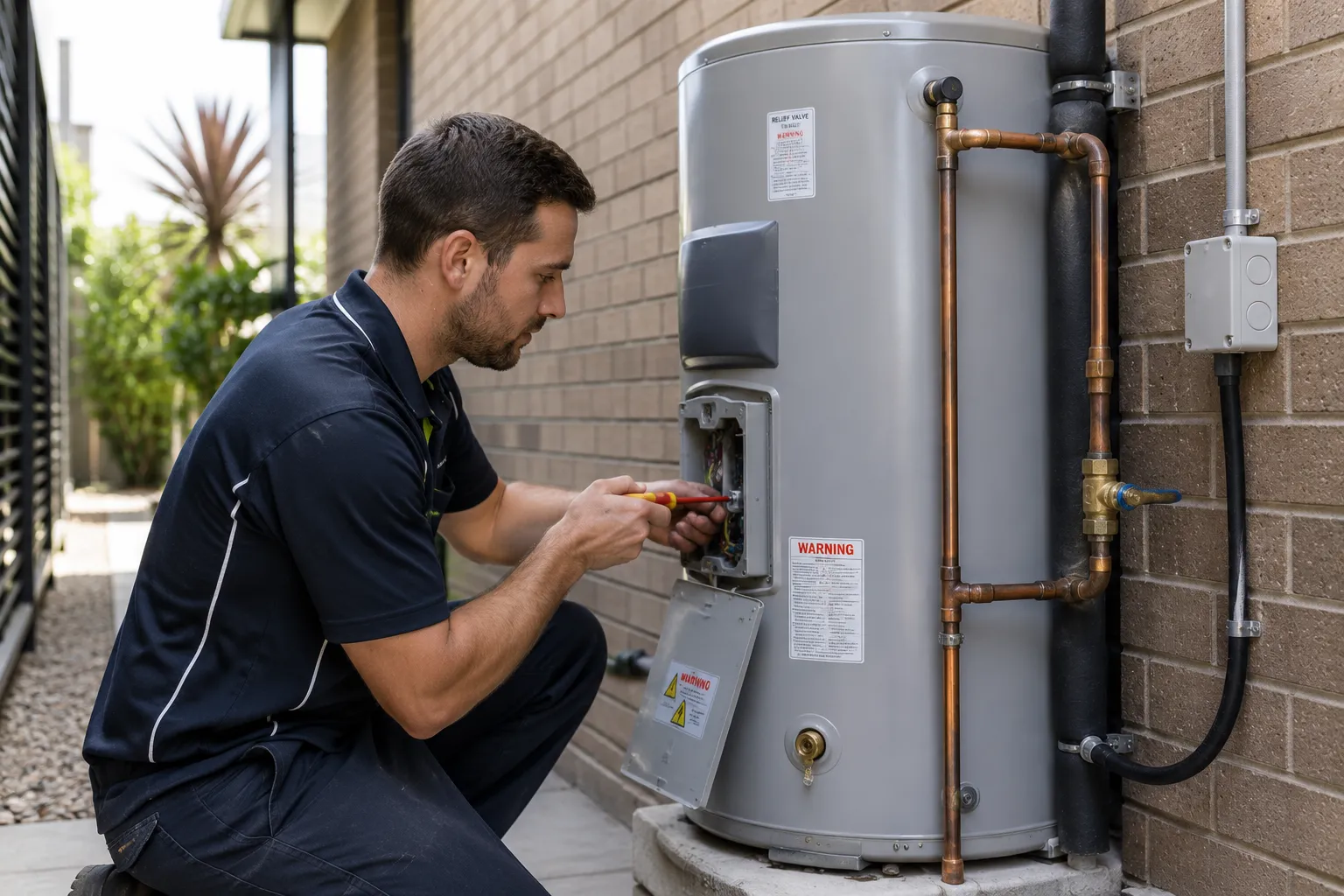
Hot water is the single biggest electrical load in a typical Brisbane home — roughly 25-30% of your annual electricity bill. Switching from an old electric storage system to a modern heat pump cuts that by 60-70%. Pair it with solar and you're essentially heating water for free during the day. Aurora Electrical Solutions handles the electrical scope on hot water system installations across Brisbane, the Gold Coast, Logan and SEQ — heat pumps, electric storage, instant electric, and the off-peak tariff wiring most installs need. We work alongside QBCC-licensed plumbers for the water connections, and deliver the electrical scope under our licence (EC91972) with full insurance and Certificate of Test on completion. Aurora is also CEC-accredited for solar — which makes us uniquely placed to deliver hot water + solar projects as one coordinated electrical install rather than three separate trade visits.
What's included
- Heat pump hot water installation (Sanden, Reclaim Energy, Rheem Ambiheat, iStore, Stiebel Eltron, Aquatech)
- Electric storage hot water replacement (Rheem, Dux, Vulcan, Aquamax)
- Instant electric hot water installation (continuous flow)
- Dedicated circuit installation and switchboard verification
- Off-peak tariff (Tariff 33 / Controlled Load) wiring and meter coordination
- Solar diversion configuration — timer setup for solar-hour heating
- Element, thermostat, and PTR valve replacement on existing electric systems
- Sub-meter installation for separately-billed hot water
- STC (Small-scale Technology Certificate) rebate paperwork for heat pump installs
- Coordination with QBCC-licensed plumber for water connections (or referral)
- Switchboard upgrade where required (older boards may not support new heat pump circuits)
- Certificate of Test and Compliance on completion
Signs you need a new hot water system (or want to upgrade)
Hot water systems usually fail at the worst possible time — typically a Sunday morning with a houseful of people. If any of these apply, get a quote now and plan the change rather than reacting to a failure.
- Your existing system is over 10 years old (typical electric storage lifespan; heat pumps last 12-15 years)
- Rusty or discoloured hot water suggests internal tank corrosion (replacement, not repair)
- Visible water leaking from the tank or pressure relief valve
- Hot water running out faster than it used to (failing element or thermostat)
- Your electricity bill keeps climbing and hot water is a major component
- You're installing solar and want to use excess solar production for hot water
- You're going all-electric (removing gas connection) as part of a renovation
- Federal STC heat pump rebates make the switch financially attractive (rebates reduce every year until 2030)
- Your home is on the standard tariff but eligible for off-peak Tariff 33 (significantly cheaper)
- Selling your home — old hot water systems can flag on pre-purchase inspections
- Renovation or extension adding bathrooms — existing system may be undersized
- Pressure relief valve (PTR) is constantly dripping — element or thermostat fault
How much does hot water installation cost in Brisbane in 2026?
Pricing depends heavily on system type and whether you're replacing like-for-like or switching fuel types. The numbers below are total installed cost in Brisbane in 2026 — including unit, plumbing, electrical, removal of the old system, and STC rebate where applicable.
- Electric storage replacement (like-for-like, 250-315L): typically $1,200 – $2,500 installed
- Heat pump installation (250-315L, including STC rebate): typically $2,500 – $5,000 installed — Brisbane average ~$4,200
- Premium heat pump (Sanden Eco Plus, Reclaim Energy CO2): typically $4,500 – $6,500 installed (longer life, better cold-weather performance)
- Instant electric (continuous flow): typically $1,200 – $2,800 installed
- Gas-to-heat-pump conversion: typically $3,500 – $6,000 (additional electrical work and gas isolation)
- Element and thermostat replacement on existing electric storage: typically $250 – $450
- PTR (pressure relief) valve replacement: typically $180 – $350
- Off-peak tariff (Tariff 33) wiring and meter coordination: typically $200 – $500 if not already in place
- Dedicated circuit installation (for heat pumps needing more than existing supply): typically $300 – $800
- Switchboard upgrade if required (older boards): typically $1,200 – $3,000 (see switchboard page)
- Federal STC rebate (heat pumps only, Zone 3 Brisbane): typically $400 – $700 — already deducted from quotes above
Quotes show the unit price, the labour (plumber and electrician separately), the rebate deduction (clearly itemised), and the after-rebate total. No hidden fees, no surprises. For straightforward like-for-like replacements we can quote remotely from a photo of your existing system. For fuel-switch conversions (gas to heat pump) or installations with extensive electrical work, we do a free site visit first.
How long does the installation take?
A like-for-like electric storage replacement takes 2-4 hours. A heat pump installation (replacing existing electric storage in the same location) typically takes 4-6 hours and involves both a plumber and an electrician on site. Gas-to-heat-pump conversions take a full day (6-8 hours) due to gas isolation, new electrical circuit installation, and the larger plumbing scope. Element or thermostat repairs on existing systems are usually 1-2 hour jobs. We schedule the install for a window that suits you — hot water is out only while we're actively working on it (typically 2-4 hours).
Which type of hot water system suits your home?
There are four main types of hot water system commonly installed in Brisbane. Each has different upfront cost, running cost, lifespan and ideal application. Here's the honest comparison:
- Electric storage (resistive element) — Cheapest upfront ($800-$2,500), highest running cost. Typical 250-315L tank uses an immersion heating element. Lifespan 8-12 years. Best for: rental properties where the landlord pays upfront and the tenant pays running costs, or homes where heat pump isn't viable.
- Heat pump — Higher upfront ($2,500-$5,000 after rebates), 60-70% lower running cost than electric storage. Works like a reverse air conditioner — pulls heat from ambient air to warm water. Lifespan 12-15 years. Best for: owner-occupied homes where the homeowner pays the bill, homes with solar (or planning solar), households going all-electric.
- Instant electric (continuous flow) — Mid-range upfront ($1,200-$2,800), high running cost but no standby losses. No tank — heats water on demand. Best for: smaller households (1-2 people), holiday homes, secondary units, situations where tank space is constrained.
- Gas storage / continuous flow — Mid-range upfront, mid running cost (depends on gas vs electricity prices in your area). Requires gas connection. Best for: homes with existing gas connection and where heat pump isn't viable. Note: many Brisbane homes are now switching away from gas due to rising gas prices and supply concerns.
- Solar hot water (evacuated tube or flat panel) — High upfront ($4,000-$7,000), very low running cost but only when the sun shines (booster element fills the gap). Largely replaced by heat pump + PV solar combination, which is more flexible and slightly cheaper.
How the install runs
Hot water replacement is usually a same-day job. Here's how it typically runs:
- Quote — usually from photos — Send us photos of your existing hot water system (front, side, switchboard connection if visible), the meter box, and the space around it. For straightforward like-for-like replacements we can quote remotely within 24 hours. For fuel-switches or complex installs we do a free site visit first.
- System selection and STC paperwork — We recommend the right unit for your household size, available space, hot water usage pattern, and budget. For heat pumps, we lodge the STC paperwork so the rebate is applied at point of sale — you don't claim it back later, it just comes off the quote.
- Install day — preparation and isolation — Two trades on site for heat pump or new-fuel installs (plumber for water, electrician for power). For like-for-like electric storage swaps, often just an electrician. Water isolated, power isolated, old system drained and removed.
- Install — new unit and connections — New unit positioned, plumbed in (tempering valve fitted as required), electrical connection made to dedicated circuit. For heat pumps: condenser unit positioned with adequate airflow clearance (some models are split system, some are integrated tank).
- Off-peak tariff coordination — If you're on the standard Tariff 11 and we're installing electric storage or a heat pump suitable for controlled load, we coordinate the Tariff 33 (Controlled Load) switching with your electricity retailer. This is typically a separate meter circuit and provides electricity at roughly half the peak rate.
- Testing, commissioning and handover — System filled, electrical tested, temperature checked at the tempering valve (50°C max at the outlet per AS/NZS 3500). For heat pumps with timer/scheduling we set the run windows for off-peak tariff or solar-diversion hours. You receive the Certificate of Test, manufacturer warranty registration, and operating instructions.
Heat pumps — why they've taken over the market
Heat pump hot water installations across Australia grew by roughly 70% in 2025 and are still climbing rapidly through 2026. The reasons are simple: running costs are dramatically lower, federal STC rebates make the upfront cost competitive with electric storage, and Brisbane's mild climate is genuinely well-suited to heat pump operation.
The principle is the same as a reverse-cycle air conditioner — but reversed in purpose. Instead of using electricity to move heat out of your house, a heat pump uses electricity to move heat from the surrounding air into your hot water tank. The ratio is dramatic: 1 kWh of electricity input typically produces 3-4 kWh of hot water heat output (a Coefficient of Performance, or COP, of 3-4). A traditional electric storage system gets a COP of 1.0 — every kWh of electricity produces exactly 1 kWh of heat.
For a typical Brisbane household, that COP difference translates to running costs of $150-$300/year for a heat pump versus $600-$900/year for old-style electric storage. Over the 12-15 year life of the unit, that's $5,000-$9,000 in savings — far more than the upfront cost difference.
Heat pumps do have downsides. They're physically larger than tank-only systems (most are integrated 250-315L units, similar footprint to electric storage but slightly taller). They need ambient air circulation (can't be enclosed in a tight cupboard). They make a low compressor noise when running (similar to a fridge). And in genuinely cold weather (below ~5°C) their efficiency drops; below freezing they switch to backup electric element. None of these are dealbreakers in Brisbane's climate.
Brands we install and why brand matters
Hot water systems are 12-15 year assets — brand choice matters because the manufacturer needs to still exist (and still support warranty claims) a decade from now. We work with established brands with strong Australian support and proven track records.
Premium heat pump brands: Sanden Eco Plus (Japanese-made, CO2 refrigerant, excellent cold-weather performance, premium price); Reclaim Energy (Australian-designed, CO2 refrigerant, very efficient, premium price); Stiebel Eltron (German engineering, strong build quality, premium price).
Mid-range heat pump brands: Rheem Ambiheat (Australian-supported, integrated tank, mid-range pricing, excellent value); iStore (Australian-supported, integrated tank, popular choice); Aquatech (Australian, increasingly popular).
Electric storage brands: Rheem (the workhorse — most common in Brisbane, strong warranty support); Dux (Australian, similar pricing to Rheem); Vulcan and Aquamax (entry-level, lower price, lower lifespan).
We don't push one brand — we recommend based on your household size, available space, intended life, and budget. If you have a strong preference, we install it. If you want our recommendation, we'll give you a couple of options at different price points with the trade-offs explained.
Off-peak Tariff 33 — the most underused saving
Most Brisbane households have their entire electricity supply on Tariff 11 (the standard residential rate, currently around 28-35c/kWh including supply charges). What many don't realise is that QLD has a separate cheaper tariff specifically for hot water: Tariff 33 (Controlled Load 1), currently around 18-22c/kWh.
Tariff 33 supplies electricity to a dedicated metered circuit for hot water only, with the network controlling when the circuit is energised — typically overnight off-peak hours when grid demand is lower. The hot water heats during these cheap hours and stores it for use during the day. For a typical household running a 250-315L electric storage tank, switching from Tariff 11 to Tariff 33 saves $200-$400/year — more if hot water usage is high.
Setting up Tariff 33 requires a separate meter point (your electricity retailer's responsibility) and the hot water circuit needs to be wired to that separate meter (our responsibility). For homes where the existing meter box already has a Tariff 33 meter point, the connection is straightforward — usually included in the install cost. For homes without one, your retailer may need to install one (occasionally a small charge from them).
Important caveat: Tariff 33 works for systems that can heat overnight and store hot water for the next day (electric storage, most heat pumps). It doesn't suit instant electric (continuous flow) units which heat on demand whenever you turn the tap on.
Solar + heat pump — the best running-cost combination
If you have solar (or are planning to install it), pairing it with a heat pump produces the cheapest hot water available in Brisbane — close to free during the day. The principle: instead of heating water overnight on off-peak tariff (cheap, but still costing money), heat it during the day on excess solar production (essentially free, since you'd otherwise export the excess at 6-10c/kWh feed-in tariff).
The economics: heating water with grid power costs roughly $150-$300/year for a heat pump household. Heating with diverted solar costs essentially $0 during sunny months, $50-$100 during winter when solar production is lower. Over the 12-15 year heat pump life, that's another $1,800-$3,000 in savings on top of the heat pump's already-lower running cost.
Implementation is straightforward: we install a timer or smart controller that runs the heat pump during daylight hours (typically 10am-3pm) instead of overnight. The controller can be a simple analogue timer, or a smart unit that monitors actual solar production and runs the heat pump only when there's surplus to use. Aurora installs both — the simple timer suits most households; the smart controller is worth it for larger solar systems with significant excess production.
If you're planning both solar and a heat pump, install them together if possible — Aurora delivers the combined project as one electrical install (we're CEC-accredited for solar), saving on mobilisation costs and ensuring the systems are configured to work together from day one. See our solar page for more on the solar side.
The federal STC rebate — and why it matters now
The federal Small-scale Renewable Energy Scheme (SRES) provides a rebate on heat pump hot water installations via Small-scale Technology Certificates (STCs). For a typical heat pump in Brisbane (Zone 3), the rebate is currently worth $400-$700 — deducted directly from the quote at point of sale, no paperwork for the homeowner.
The rebate calculation is based on the deemed energy savings of the heat pump over its rated life, multiplied by the current STC spot price. Brisbane is in STC Zone 3 (Temperate Coastal), which is favourable but not as high as colder climate zones.
Critical timing point: the SRES scheme winds down by 31 December 2030, with the deeming period reducing by 1 year every year from now until then. This means the rebate is worth more this year than it will be next year, and significantly less in 2029 than today. Heat pump installs in 2026 capture roughly 60% more rebate value than equivalent installs in 2029.
Aurora handles all the STC paperwork on your behalf. The rebate value appears as a clear line item on your quote and is deducted from the total — you don't claim it back, it just reduces the price upfront. This is standard practice for CEC-approved installers and required for the rebate to apply.
The plumber/electrician split — and what Aurora actually does
Hot water installation is a two-trade job in Queensland. The plumbing side (water connections, tempering valve, PTR valve, removal of old system) requires a QBCC-licensed plumber. The electrical side (dedicated circuit, switchboard verification, tariff connection, RCD compliance, Certificate of Test) requires a licensed electrician.
Aurora is the electrician in this pairing. We work alongside QBCC-licensed plumbers we trust for the water connections, and we deliver the electrical scope under our licence (EC91972) with full insurance. The split lets each trade do what they're qualified for and ensures all aspects of the install are properly certified.
What this means in practice: we coordinate the plumber and the electrician on the same day so the install completes in a single 4-6 hour window. The plumber handles the water side and we handle the electrical side. The Certificate of Test (for the electrical) and the Plumbing Compliance documentation (for the water) are both provided. Two separate trades, one coordinated install.
For homeowners who already have a plumber they want to use, we work alongside them. For homeowners who don't, we recommend QBCC-licensed plumbers we've worked with reliably. Either way, the electrical scope is ours, the documentation is clean, and there's no finger-pointing between trades if something needs a callback later.
Switchboard considerations — what your board needs to support a heat pump
Most modern Brisbane switchboards can accommodate a new heat pump circuit with no issues. But there are several common scenarios where the switchboard needs work first:
Older boards without spare poles: switchboards installed before 2000 frequently have no spare pole positions for a new circuit. Adding a heat pump requires either a switchboard expansion or full replacement. Typically $1,200-$3,000 for a residential switchboard upgrade (see our switchboard page for more).
Boards without Type A RCDs: AS/NZS 3000:2018 requires Type A RCD protection on any new circuit. Older Type AC RCDs aren't acceptable for new installations. If your existing board only has Type AC, we install a Type A RCBO for the heat pump circuit.
Boards without separate Tariff 33 supply: if you want to put the new heat pump on off-peak tariff and your meter box doesn't have a Tariff 33 meter point, your retailer needs to install one (and we may need to reconfigure the switchboard accordingly).
Boards near full capacity: heat pumps draw 2-3kW continuously when running, which can push older boards beyond their design rating if other loads are high. We measure existing load distribution and confirm capacity before committing to the install.
We assess all of this during the quote and tell you up-front if any switchboard work is needed. No surprise add-ons after the contract is signed.