
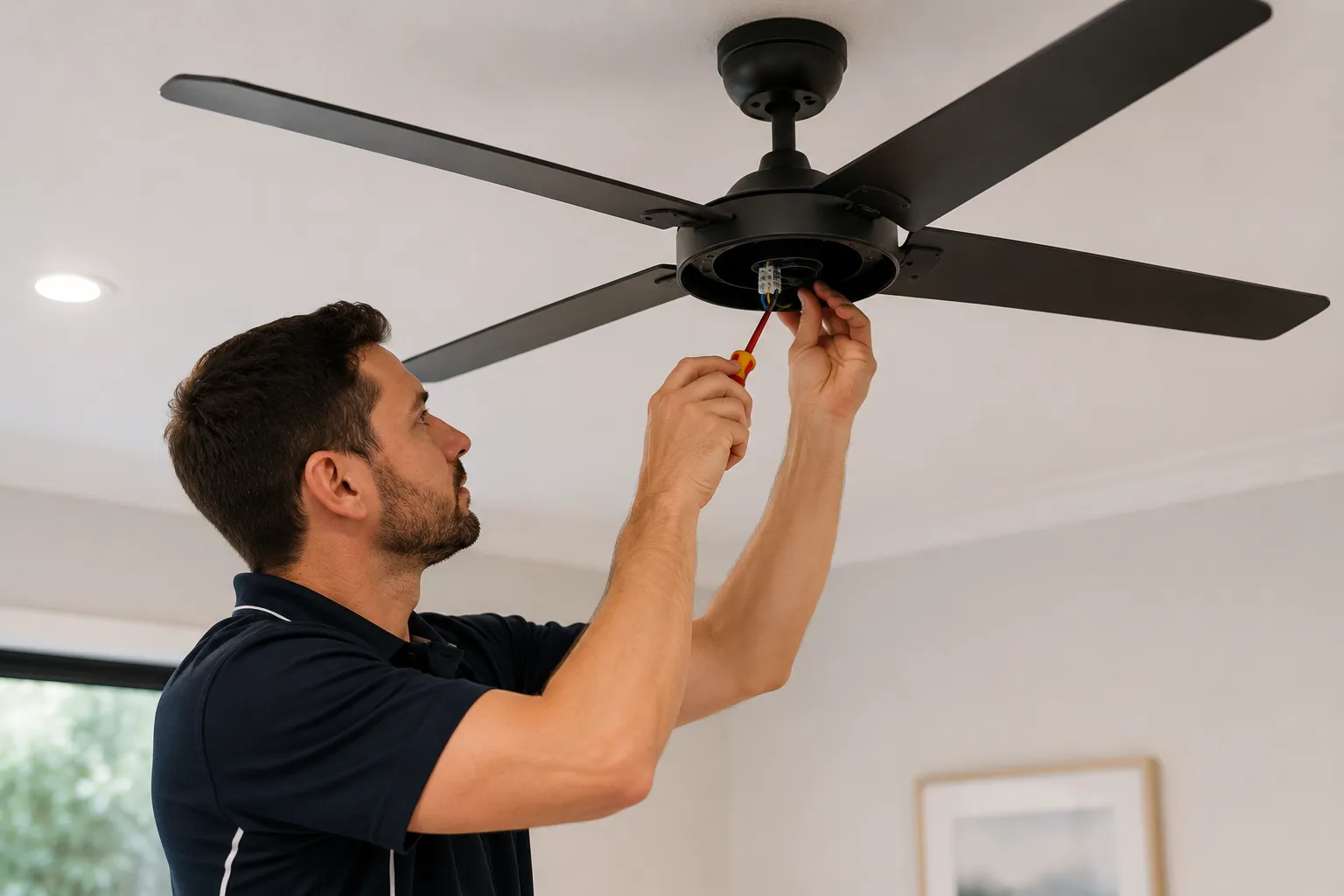
Ceiling fans are arguably the highest-value cooling investment a Brisbane home can make. They deliver a perceived temperature reduction of 2-4°C through air movement, let you raise your AC setpoint by 2-3°C for the same comfort (cutting AC running cost by roughly 20%), and run for $20-$50/year per fan even with constant use. Modern DC motor fans take this further — using 70-85% less electricity than older AC fans while running whisper-quiet with more speed settings. Aurora Electrical Solutions installs and replaces ceiling fans across Brisbane, the Gold Coast, Logan and SEQ — DC and AC motor fans, smart Wi-Fi models, outdoor IP-rated alfresco fans, bathroom exhaust+light+fan combos, and full like-for-like replacements. Every install uses fan-rated mounting (not standard lighting outlet boxes, which aren't designed for the dynamic load of a spinning fan), proper electrical scope, and Certificate of Test on completion. Aurora is a fully licensed Queensland electrical contractor (Licence EC91972), Master Electricians Australia members, fully insured.
What's included
- DC motor ceiling fan installation (Hunter Pacific, Ventair, Beacon Lighting Lucci, Brilliant, Mercator)
- AC motor ceiling fan installation (budget option for occasional-use rooms)
- Like-for-like ceiling fan replacement (existing fan dying, swap for modern equivalent)
- New ceiling fan into existing light fitting position (very common Brisbane retrofit)
- New ceiling fan into new position requiring wiring run
- Outdoor IP-rated ceiling fans for alfresco, patios, pergolas (IP44 covered, IP55+ exposed)
- Bathroom exhaust + light + heater combo fan installation
- Smart Wi-Fi ceiling fan setup (Hunter Pacific HomeKit/Alexa/Google, Mercator Ikuü, Brilliant Smart)
- Light kit installation and integration with fan
- Remote control pairing and wall switch reconfiguration
- Fan-rated outlet box installation (critical safety upgrade for fans on lighting-only boxes)
- Drop rod sizing for high ceilings, hugger/flush-mount for low ceilings
- Multi-fan whole-house installations (renovations, new builds)
- Repair of wobbling, clicking, slow or non-functioning fans where economically viable
- Removal of old fans for disposal
- All work to AS/NZS 3000:2018 with Certificate of Test on completion
When you need a ceiling fan installed (or replaced)
If any of these apply, a ceiling fan installation or upgrade is worth doing — and most pay back their cost within 2-3 summers on reduced AC running costs alone:
- Your home has no ceiling fans, or only in some rooms (Brisbane's climate makes them genuinely useful in every bedroom and living space)
- Your existing fans are old (15+ years), noisy, slow, or wobbling — replacement is overdue
- Your fans only have 3 speed settings and you'd benefit from finer speed control (DC fans typically have 6-9 speeds)
- Your fans are loud enough to be heard in the next room — modern DC fans are nearly silent
- You're spending heavily on AC because the rooms don't have proper air movement
- You're building, renovating or extending and want fans designed in from the start
- Your alfresco or pergola has no fan and Brisbane summer entertaining is uncomfortable
- You bought a fan from Bunnings/Beacon Lighting and need it installed properly
- Your bedroom needs a fan you can control from bed (remote, app or smart speaker)
- Your high-ceiling living room needs a fan with extended drop rod for proper airflow
- Your low-ceiling room (under 2.4m) needs a hugger/flush-mount fan
- Your bathroom needs proper exhaust + light + heat combo replacement
- Your fan has lost a blade balance and is wobbling dangerously
- An old fan is mounted to a standard light outlet box (genuine safety risk that should be fixed)
How much does ceiling fan installation cost in Brisbane?
Ceiling fan installation pricing depends mostly on whether an existing wiring point is available, the fan complexity, and how many fans are being installed in one visit. Volume installs (3+ fans in one visit) typically reduce per-fan cost 20-30%. Here are typical Brisbane ranges for 2026:
- Like-for-like ceiling fan replacement (existing wiring, similar fan): typically $200 – $400 labour
- New fan into existing light fitting position (replace light with fan): typically $250 – $500 including fan-rated box upgrade
- New fan into new position (no existing wiring): typically $400 – $800 depending on cable run length and ceiling access
- DC ceiling fan install (premium fan supplied by customer, existing wiring): typically $250 – $550 labour
- Outdoor IP-rated ceiling fan (covered alfresco, IP44): typically $350 – $650 installed
- Outdoor IP55+ rated fan (fully exposed location): typically $450 – $750 installed
- Bathroom exhaust + light + heater combo (3-in-1): typically $400 – $850 supplied and installed
- Smart Wi-Fi ceiling fan setup including app configuration: typically $300 – $650 labour
- Light kit added to existing fan: typically $150 – $300
- Multi-fan install discount: typically 20-30% off per additional fan in same visit
- High ceiling install (cathedral, raked, 3m+): typically $100 – $300 surcharge
- Fan removal only (no replacement): typically $120 – $250
- Fan-rated outlet box upgrade (when existing is lighting-only): typically $80 – $180 added to install cost
- Wall switch reconfiguration (changing from rotary speed controller to standard on/off for remote-control fan): typically $80 – $150
Aurora supplies and installs fans at trade pricing, or installs customer-supplied fans (from Bunnings, Beacon Lighting, Lighting Online) — your choice. Trade-supplied installations typically cost less overall because we get fan pricing 20-30% under retail and use it to bundle the supply+install. Free quotes, fixed-price, Certificate of Test on completion.
How long does ceiling fan installation take?
A like-for-like ceiling fan replacement takes 45-90 minutes. A new fan into an existing light fitting position (with fan-rated box upgrade) takes 90-120 minutes. A new fan requiring new wiring run typically takes 2-4 hours depending on ceiling access. Outdoor fan installations take 90 minutes to 3 hours depending on exposure rating and access. Bathroom combo units (exhaust+light+heater) typically take 2-3 hours including ducting. Multi-fan installations work room by room — a typical 4-fan whole-house install completes in a single day. Power is only off in the room being worked on; the rest of the house stays live.
AC vs DC ceiling fans — the decision that matters most
The AC vs DC motor decision is the single most important choice when buying a new ceiling fan. The difference affects upfront cost, running cost, noise level, speed control, and useful life. Here's the honest comparison:
- AC ceiling fans — cheaper upfront ($150-$400 unit), typical 75-90W power draw, louder operation (especially at higher speeds), fewer speed settings (typically 3, controlled by rotary wall switch), shorter motor life (8-12 years), some models not reversible. Best for: occasional-use rooms, budget-driven purchases, rental property owners who pay upfront and tenant pays running cost.
- DC ceiling fans — more expensive upfront ($350-$1,000+ unit), 15-35W power draw (70-85% less than equivalent AC), near-silent operation, 6-9 speed settings via remote, longer motor life (15-20+ years), reversible direction (summer cooling, winter warming distribution). Best for: bedrooms (silent operation), living areas (constant use), homeowners who pay their own running costs, premium fit-outs.
- Running cost comparison — typical AC fan running 8 hours/day costs $30-$50/year; equivalent DC fan running same hours costs $8-$15/year. Over 10-year useful life, DC saves $200-$350 in electricity. Combined with longer motor life, DC pays back its premium 2-3× over its service.
- Noise level comparison — modern DC fans run at 25-35 dB at lowest speed (whisper quiet, suits bedrooms and study areas). AC fans typically 40-55 dB at lowest speed (audible hum). For bedrooms specifically, DC is genuinely worth the premium.
- Speed range — DC fans typically have 6-9 speeds with fine control via remote. AC fans typically have 3 speeds via rotary wall switch. The fine speed control on DC matters most in shoulder seasons (autumn/spring) when low speeds are the most-used setting.
- Reverse function — DC fans are always reversible. In summer (anticlockwise from below) blades push air down for cooling effect. In winter (clockwise from below) blades pull air up to circulate warm air without breeze. Useful for the small number of cold Brisbane winter nights.
- Smart Wi-Fi integration — most modern DC fans support smart home integration (Apple HomeKit, Google Home, Alexa, Matter). AC fans rarely do. If you want voice control or app scheduling, DC is essentially required.
- The honest recommendation for Brisbane — DC for any room used regularly (bedrooms, living areas, alfresco, study). AC acceptable for occasional-use rooms (spare bedrooms, garages, workshops) where the running cost difference doesn't matter much. For most Brisbane homes, all-DC is the right answer.
How ceiling fan installation runs
Most ceiling fan installs are 1-3 hour single-visit jobs. Here's how Aurora delivers them:
- Free quote — usually remote — Tell us the room dimensions and ceiling height, send a photo of the existing fitting (or the position where the new fan goes), and confirm whether you've already chosen a fan or want our recommendation. For most jobs we quote remotely within 24 hours. Larger jobs (whole-house installs, complex outdoor) we visit briefly first.
- Fan selection and sizing — We recommend the right fan for your room — blade span sized to room area (1050mm for small bedrooms, 1220mm for standard bedrooms, 1320mm for living rooms, 1420mm+ for larger spaces), motor type matched to use pattern (DC for constant-use rooms, AC acceptable for occasional), and mounting style suiting your ceiling height (drop rod for standard ceilings, hugger for low ceilings, extended rod for cathedral or raked ceilings).
- Outlet and mounting check — Critical safety step often skipped by handymen: we verify whether the existing outlet box is fan-rated (capable of supporting the dynamic load of a spinning fan) or just a standard lighting box (designed only for static light fittings). Standard lighting boxes mounting a ceiling fan is one of the most common causes of fan failure and ceiling damage. If yours is lighting-only, we install a proper fan-rated box as part of the job.
- Install — fan up, wiring connected, balance check — Drop sheet down, ladder positioned, old fan removed if applicable. New fan mounted to fan-rated box with manufacturer-supplied hardware. Wiring connected to active/neutral/earth plus any separate light circuit. Blades attached and balanced (most modern fans come pre-balanced; if there's any wobble we adjust with the supplied weights).
- Remote pairing, wall switch reconfiguration — For remote-controlled fans (essentially all DC fans), we pair the remote to the fan receiver, configure any directional preference, and set the wall switch correctly. Often the existing rotary speed controller wall switch needs replacing with a simple on/off (since fan speed is now controlled by remote). For smart Wi-Fi fans, we connect the fan to your home network and configure voice assistant integration if you have one.
- Test, demonstrate, certify — Fan tested at every speed in both directions. Light tested if applicable. Remote walked through with you so you know how to use it. Certificate of Test and Compliance issued. Tidy up — drop sheet folded, vacuum if any plaster dust, all packaging taken away. Fan ready to use that night.
Why ceiling fans matter in Brisbane — the running cost math
Brisbane's climate genuinely justifies ceiling fans in every regularly-used room. Summer humidity and temperatures consistently push indoor comfort limits, and air movement is the cheapest tool for combating both. A ceiling fan moving air across your skin produces a perceived temperature reduction of 2-4°C through evaporative cooling, even when the actual air temperature is unchanged.
The economic implication is substantial when combined with air conditioning. A ceiling fan running at 25W (typical DC fan, low speed) lets you raise your AC setpoint from 22°C to 25°C for the same comfort level. For a typical Brisbane home running ducted AC, that 3°C setpoint change reduces AC running cost by approximately 18-24%, or roughly $200-$500/year depending on home size and usage. The fan itself costs $5-$25/year to run. Net annual saving: $180-$475 per fan-supported room.
Over the 15-20 year service life of a quality DC fan, total savings typically reach $3,000-$7,000 per fan from AC reduction alone. Compare to an installed cost of $400-$800 per fan and the ROI math is among the best in residential electrical work. Most fans pay back their installed cost within 2-3 summers and then deliver pure savings for 12-17 more years.
The other often-overlooked benefit is sleep quality. Brisbane summer nights frequently sit at 24-27°C indoor temperature. AC on overnight is expensive and can feel too cold for sleeping, but a ceiling fan running at low speed provides enough air movement for comfortable sleep at no meaningful electricity cost. Modern DC fans are quiet enough that they don't interfere with sleep — older AC fans often did.
Fan-rated outlet boxes — the critical safety detail most installs get wrong
The single most common ceiling fan installation mistake — and the cause of most fan failures, ceiling damage incidents, and the genuine safety risks associated with ceiling fans — is mounting a fan to a standard lighting outlet box. The two box types look superficially similar but have very different structural ratings:
Standard lighting outlet box — designed to support a static load of a light fitting (typically rated for 5-10kg). Plastic construction, mounted to a single ceiling joist with two screws. Adequate for any light fitting, totally inadequate for the dynamic load of a spinning ceiling fan.
Fan-rated outlet box — designed specifically for ceiling fans (rated to 30-50kg dynamic load). Metal construction, mounted across two ceiling joists with a structural brace or specifically rated single-joist mount. Handles the rotational forces and vibration of a fan motor without loosening over time.
The risk with a fan on a lighting box isn't always immediate — many fans run on inadequate mounts for months or years before something fails. The failure modes are: progressive loosening from vibration (resulting in fan wobble and eventual fall), torque damage to the plaster ceiling around the box (visible cracks spreading from the mount), and in worst cases, full mount failure where the fan crashes from the ceiling.
Aurora always verifies the existing outlet box rating before installing a fan. If you're replacing an existing fan, the old box is checked — many older Brisbane homes had fans installed on lighting boxes that have been progressively loosening for years. If you're converting a light fitting to a fan, the lighting box typically needs replacement with a fan-rated box (most are too small for the fan's mounting plate anyway). Cost of the upgrade: $80-$180 typically. Worth doing properly the first time.
Handymen and unlicensed installers frequently skip this step — "the box that's there will be fine" — because checking and upgrading the box takes 30 extra minutes per install. A licensed electrician shouldn't.
Sizing your fan — blade span for your room
Fan blade span is the most important sizing decision. An under-sized fan in a large room moves no usable air; an over-sized fan in a small room is overwhelming and wastes money. Use these proven sizing guidelines:
Up to 9m² rooms (small bedrooms, study nooks, walk-in robes) — 1050mm (42 inch) blade span. Sufficient for the small floor area, doesn't overwhelm the visual scale of the room.
9-16m² rooms (standard Brisbane bedrooms, smaller living rooms) — 1220mm (48 inch) blade span. The most common Brisbane residential ceiling fan size. Suits the 3.6×3.6m typical bedroom.
16-22m² rooms (larger bedrooms, standard living rooms, dining) — 1320mm (52 inch) blade span. The workhorse size for main living spaces in mid-size Brisbane homes.
22-30m² rooms (larger living rooms, open-plan kitchen/dining/living) — 1420mm (56 inch) blade span. Moves enough air for the larger volume.
30m²+ rooms (large open-plan, expansive living areas) — 1500mm+ (60 inch+) blade span, or consider multiple fans positioned in the room. A single large fan in a very large room often produces too much air movement in the centre and not enough at the edges; two medium fans are often better.
Ceiling height matters too. Standard 2.4-2.7m ceilings suit standard 200-300mm drop rods. Cathedral or raked ceilings (3m+) need extended drop rods (500-1500mm depending on ceiling height) — many fans come with rod kits or extended rods are sold separately. Low ceilings (under 2.4m) need hugger/flush-mount fans that sit against the ceiling rather than dropping below it (preserves head clearance). A hugger fan loses slightly in air movement efficiency but is essential where ceiling height is constrained.
Outdoor and bathroom fans — IP ratings, weatherproofing, special considerations
Standard indoor ceiling fans installed in outdoor or wet areas fail rapidly. Brisbane's humidity, storm season rain, salt air on coastal properties, and chlorine vapour in pool areas all attack standard motors and electronics within months to a couple of years. Proper outdoor and wet-area fans use sealed motors, corrosion-resistant blades, and appropriate IP ratings.
IP44-rated fans — splash-proof, suitable for covered outdoor areas (under eaves, covered alfresco, pergolas with solid roofing). Don't survive direct rain exposure long-term but handle the airborne moisture and occasional splash. The right choice for most Brisbane outdoor entertaining areas.
IP55 and IP66 rated fans — fully weatherproof, suitable for exposed outdoor areas (pergolas with louvre or slat roofing, beachfront properties, fully exposed verandahs). Higher cost but essential for genuinely exposed installations.
Marine-grade outdoor fans — additional corrosion resistance for coastal Brisbane properties (Burleigh Heads, Palm Beach, Jacobs Well, coastal Pinkenba). Standard outdoor fans typically last 5-7 years near the coast; marine-grade equivalents last 12-15+ years. Worth the modest premium for coastal homes.
Bathroom fans are subject to AS/NZS 3000:2018 zone classifications. Zone 1 (directly above bath/shower up to 2.25m): IPX4 minimum, specific safety requirements. Zone 2 (extending 0.6m from Zone 1): IPX4 minimum. Outside zones: standard fans acceptable but most installs use IP44+ for consistency. The most common bathroom fan install is a 3-in-1 combo (exhaust + light + heater) for full bathroom functionality in a single ceiling cutout.
Aurora installs both outdoor and bathroom fans to manufacturer specs and AS/NZS 3000:2018 zone requirements. We don't accept jobs to install indoor-rated fans in outdoor or wet locations — it's a safety issue and the fan will fail anyway. We'll recommend an appropriate weatherproof model and quote accordingly.
Smart ceiling fans — Wi-Fi, voice control, scheduling
Modern DC ceiling fans increasingly include smart Wi-Fi connectivity, allowing app and voice control alongside the included remote. The practical benefits go beyond novelty:
Voice control — "Hey Google, turn the bedroom fan to speed 3" or "Alexa, turn off the lounge fan" works with all major voice assistants when the fan supports the right ecosystem. Particularly useful in bedrooms (control without getting up) and where the remote has gone missing.
Scheduling — fans can be programmed to start automatically before you wake up (cool the bedroom for getting dressed), shut off after you leave for work (saves energy if you forgot), restart when you're due home. Integration with home automation routines ("Goodnight scene" turns on bedroom fan, turns off living room fan, dims lights) is increasingly common.
Multi-fan control — single app interface controls all fans across the home. Useful for whole-home cooling adjustments ("all fans on low for the night") without walking room to room.
Energy monitoring — premium smart fans report actual energy use over time, useful for confirming the DC fan running cost claims and validating the AC reduction strategy.
Major smart fan ecosystems: Hunter Pacific (HomeKit, Google Home, Alexa support, premium quality, $700-$1,500 range), Mercator Ikuü (Tuya-based, broad voice assistant support, mid-range pricing $400-$800), Brilliant Smart (own ecosystem plus Alexa/Google, budget-friendly), Ventair (premium with HomeKit support).
Setup typically involves connecting the fan to your home Wi-Fi via the manufacturer's app, then linking that app to your voice assistant ecosystem. Most smart fans only work on 2.4 GHz Wi-Fi (not 5 GHz), which is occasionally an issue on newer routers prioritising 5 GHz. We configure all of this as part of the install where needed.
Repair vs replace — when fixing an old fan makes sense
Brisbane homes accumulate ceiling fans over decades, and many existing fans are 10-25 years old. When an old fan develops problems, the question becomes whether to fix it or replace it. Honest answers:
Worth fixing: balance issues causing wobble (often just one blade slightly bent or weight slipped — adjustable), pull-cord broken (replaceable as a part), light bulb socket failed (replaceable), remote no longer pairing (often a replacement remote sorts it). Repair cost typically $80-$200, fan continues working for several more years.
Worth replacing instead of fixing: motor noise that's not loose mounting (motor bearings worn — fans aren't economical to motor-replace), capacitor failure on AC fans (replaceable but a sign of age — other components likely failing soon), broken blade arm or hub (parts often discontinued for older models), housing/canopy cracked (cosmetic but accelerating).
Definitely replace: any fan over 15 years old showing multiple symptoms simultaneously, any AC fan with new bedroom installation budget (the DC upgrade pays back fast), any outdoor fan showing rust or corrosion (compromises blade balance and ultimately fails dramatically).
The DC upgrade math: a 10-year-old AC fan with one or two issues might be "fixable" for $150-$250. The DC replacement costs $400-$700 installed but saves $200-$400/year in AC running cost. Replacement pays back the difference in 1-2 years and then continues delivering savings for 15-20 more years. Repairing an old AC fan is often the worse economic choice even when the fix itself is cheap.
Aurora assesses each fan on visit and gives an honest recommendation. We're happy to repair if it makes sense; we'll tell you when replacement is the better economic answer.