
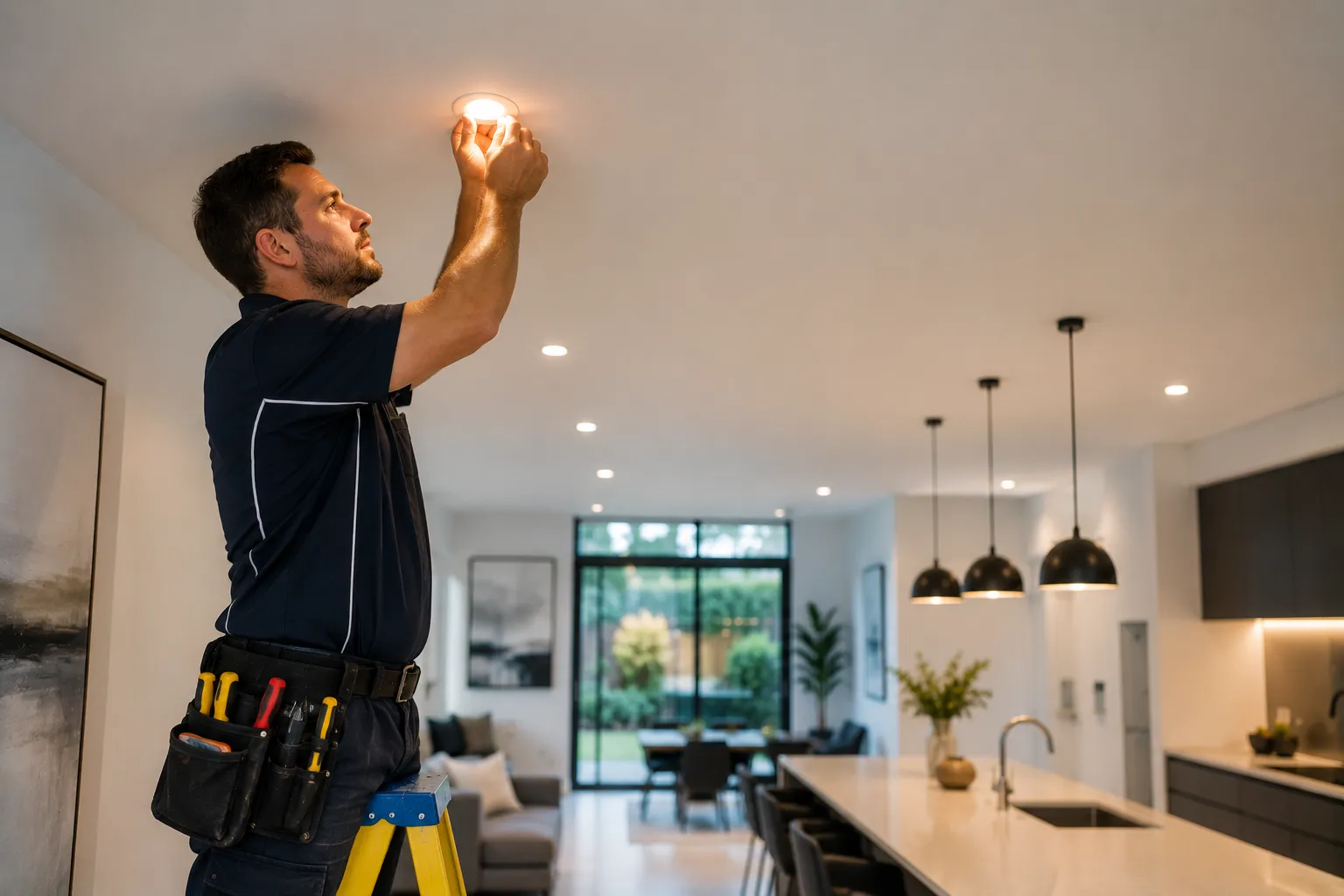
Lighting is the single most impactful and cost-effective electrical upgrade you can make to a Brisbane home. Done well, it makes a house feel larger, warmer, more inviting — and cuts your lighting electricity bill by 75-85% if you're still running halogen downlights. Done poorly, it leaves you with dark corners, glaring hotspots, flickering dimmers and lights that never quite suit the room. Aurora Electrical Solutions delivers residential lighting work across Brisbane, the Gold Coast, Logan and SEQ — LED downlight installation and halogen retrofits, pendant lights and feature fittings, outdoor and garden lighting, dimmable circuits with compatible LED-rated dimmers, bathroom and kitchen task lighting, smart lighting integration, and full lighting design for renovations and new builds. Aurora is a fully licensed Queensland electrical contractor (Licence EC91972), Master Electricians Australia members, fully insured, with a Certificate of Test issued on every install.
What's included
- LED downlight installation (new circuits, retrofits, halogen-to-LED conversions)
- Pendant light and statement fitting installation (kitchen islands, dining areas, stairwells, entries)
- Feature wall lights, sconces, picture lights
- LED strip lighting (under-cabinet, cove, stair, shelving, mirror, in-floor)
- Outdoor lighting — flood, spot, path, step, deck, garden, pool surrounds
- Motion-sensor security lighting with PIR and smart sensors
- Bathroom IP-rated lighting (mirror, vanity, downlight zones)
- Smart lighting (Philips Hue, LIFX, Nanoleaf, Aqara, Clipsal Wiser)
- LED-compatible dimmer installation (trailing-edge dimmers for flicker-free LED dimming)
- Multi-zone lighting circuits and scene control
- Tri-colour CCT-selectable downlights (warm/neutral/cool switchable)
- Fire-rated downlights for apartments and commercial-class spaces
- Full lighting design and layout for renovations, extensions and new builds
- Coordination with builders, designers and interior architects on construction projects
When to upgrade your home's lighting
If any of these apply, your home would benefit from a lighting upgrade — and most pay back their cost within 1-2 years on energy savings alone.
- Your home still has halogen downlights (those round 50W globes that get hot and burn out every 1-2 years)
- Your lighting electricity bill is high and you can't pin down which appliance is to blame
- Lights flicker or buzz when dimmed (incompatible LED-dimmer combination — fixable)
- Rooms have dark corners or uneven lighting (insufficient downlight density)
- Your kitchen has a single ceiling fixture rather than task lighting at the benches
- You're renovating, extending or doing a kitchen/bathroom refresh
- Building a new home — lighting design is significantly cheaper to plan during construction than retrofit
- Your outdoor lighting is dim or non-existent (security and aesthetic concern)
- You want pendant lights above your kitchen island or dining table but the wiring isn't there
- Bathroom mirror lighting is poor (shadow on the face when you look in the mirror)
- You want to add LED strip lighting under cabinets, in coves, or up stairs
- Light switches are inconveniently located (we can add new switch points or smart wireless switches)
- You want voice or app control over lighting (smart lighting integration)
- Outdoor entertaining area needs proper lighting design (most Brisbane backyards are under-lit)
How much does lighting installation cost in Brisbane?
Lighting pricing varies with fitting type, ceiling access, existing wiring, and total quantity. Per-fitting cost typically reduces with volume — installing 20 downlights is significantly cheaper per fitting than installing 4. Here are typical Brisbane ranges for 2026:
- LED downlight installation (new fitting, existing wiring): typically $80 – $150 per point
- Halogen-to-LED downlight conversion (replace existing halogens with LEDs): typically $55 – $95 per light
- New downlight circuit (no existing wiring, requires ceiling access): typically $120 – $220 per point
- Pendant light installation (existing ceiling rose, similar position): typically $120 – $250 per pendant
- New pendant point (no existing wiring): typically $250 – $500 per pendant
- LED-compatible dimmer switch installation: typically $120 – $220 per dimmer
- Smart dimmer installation (app/voice control): typically $180 – $300 per dimmer
- LED strip lighting (under-cabinet, cove): typically $200 – $600 per run depending on length
- Outdoor wall light (single fitting on existing wiring): typically $150 – $300
- Outdoor floodlight with PIR sensor: typically $200 – $450 installed
- Garden / path lighting (low-voltage, with transformer): typically $1,500 – $5,000 for a whole-garden design
- Bathroom IP44/IP65 lighting upgrade (3-4 fittings): typically $400 – $900
- Whole-home halogen-to-LED conversion (typical 20-downlight Brisbane home): typically $1,500 – $2,800 — pays back in under 2 years
- Full lighting design and install for a renovation (kitchen + living + bedrooms + outdoor): typically $4,000 – $12,000
- Smart lighting starter (10-15 smart switches/fittings + voice integration): typically $1,500 – $3,500
Every job is fixed-price quoted up-front, with the fittings, labour, and any extras shown line by line. No hidden fees, no callout charges on quoted work. Per-fitting cost drops sharply for larger jobs — we recommend grouping lighting work for renovations into one project to maximise value.
How long does lighting installation take?
A simple halogen-to-LED swap (10-20 lights) is typically a half-day job (3-4 hours). A whole-home LED retrofit with new dimmer switches takes a full day. New downlight circuits (no existing wiring) typically need 1-2 days depending on ceiling access and the number of new points. Pendant installations are usually 1-3 hours per pendant including any wiring adjustment. Outdoor lighting design and install runs 1-3 days depending on scope. Full lighting design and installation for a renovation typically spans 3-7 working days, coordinated with the broader build program. Power is only off in the areas being worked on — we work room-by-room so the rest of the home stays live.
Halogen vs LED — why the upgrade pays back fast
If your home still has halogen downlights, the LED upgrade is one of the highest-ROI electrical projects available. The numbers in detail:
- Energy use — a typical 50W halogen downlight uses 50W of electricity; an equivalent LED uses 7-12W producing the same or better light output (75-85% less energy)
- Brisbane home savings — a typical home with 20 halogen downlights running 5-6 hours a day saves $150-$300 per year on electricity by switching to LED
- Bulb replacement savings — halogens fail every 1-3 years on average; quality LEDs last 25,000-50,000 hours (11-22 years at 6 hours/day usage)
- Payback period — typical halogen-to-LED conversion in a Brisbane home pays back in under 2 years on energy savings alone, before counting the avoided replacement bulbs
- Heat reduction — halogens run at 100-200°C surface temperature, contributing to AC load and creating real fire risk near ceiling insulation; LEDs run at 40-60°C
- Light quality — modern LEDs match or exceed halogen colour rendering (CRI 80-95+) with no warm-up time and no buzz
- Dimming behaviour — quality LED-dimmer combinations dim smoothly from 10-100% with no flicker (older halogen-rated dimmers cause LED flickering and need replacement)
- Fire safety in older homes — Brisbane homes built before 2007 often have halogen fittings in close contact with ceiling insulation; LED retrofits eliminate this fire risk
- Insurance and resale — modern LED lighting is now a standard expectation in residential property; halogen-equipped homes are increasingly seen as needing immediate upgrade by buyers
- Compatibility caveat — most LED fittings need IC-4 rated bodies for safe contact with ceiling insulation, and need trailing-edge dimmers (not the older leading-edge dimmers used with halogens)
How lighting installation runs
Good lighting starts with design, not just product selection. Here's how a typical Aurora lighting project runs:
- Free consultation and lighting plan — We attend the home, look at how each room is used (work area, relaxation, entertaining), discuss your style preferences (warm or cool light, downlights vs pendants, visible fittings vs concealed), and identify what's currently underperforming. For renovations we coordinate with your builder, designer or interior architect.
- Layout design — density and placement — Downlight density follows a simple rule: 1 fitting per 1.5-2 m² of floor area for even general illumination. A 12 m² living room needs 6-8 downlights; a 4 m² bathroom needs 2-3. Kitchen benchtops and task areas get additional downlights for cooking light. We sketch the layout on the ceiling plan and check it with you before ordering anything.
- Fitting selection — quality and colour temperature — We specify quality LED fittings (HPM Legrand DLI, Martec Tradetec Ultra, Beacon LEDlux, Brilliant for budget jobs) rather than the cheapest imports that fail within 2-5 years. Colour temperature chosen per room: 2700-3000K warm white for living areas and bedrooms, 4000-5000K cool white for kitchens and bathrooms. CCT-selectable (tri-colour) downlights let you choose at install or via switch.
- Dimmer compatibility check — If you want dimmable lights, the dimmer and fitting must be matched. Standard halogen-era dimmers don't work with LEDs (cause flickering, buzzing, limited range). We specify LED-rated trailing-edge dimmers — typically Clipsal Iconic Rotary LED dimmers ($30-60 at trade), installed $120-220 each. Smart dimmers add app/voice control at modest additional cost.
- Install — clean and tidy — Drop sheets across furniture, vacuum each work area as we go, drilled-out plaster contained where possible. Most rooms take 30-60 minutes per round of fittings. Halogen-to-LED retrofits use the existing ceiling cutouts where possible — no new holes. New circuits require ceiling cavity access, which means careful work to avoid plaster damage.
- Testing, commissioning and walkthrough — Every fitting tested for correct operation, dimmers tested through their full range to confirm flicker-free dimming, scene controls (if applicable) commissioned. You receive the Certificate of Test and Compliance, manufacturer warranty information for the fittings (typically 3-7 years on quality LED downlights), and a walkthrough of the new lighting.
Lighting design — the part most installers skip
Most lighting installs in Brisbane are reactive — "replace what's there with the modern equivalent." That gets you working lights but misses the genuine improvement that thoughtful lighting design delivers. Good residential lighting uses three distinct layers working together:
Ambient lighting — the general illumination of the space. Recessed LED downlights are the standard solution for Brisbane homes, with the right density for even coverage (1 fitting per 1.5-2 m² of floor area) and the right colour temperature for the room's function.
Task lighting — focused light where you actually do things. Kitchen benchtops need additional downlights above the work surfaces. Bathroom vanities need light on the face, not above the head (which casts shadows under the eyes). Bedside reading lights need to be directional and easily switchable. Home offices need glare-free task lighting at the desk level.
Accent lighting — feature lighting that adds character and depth. Pendant lights over kitchen islands and dining tables. Wall sconces or picture lights highlighting art or architectural features. LED strip lighting in coves, under cabinets, or up stairs. Outdoor uplighting on trees or wall surfaces.
Most Brisbane homes have plenty of ambient lighting (the downlight retrofit boom of the 2010s ensured that), but lack task and accent layers. A lighting upgrade that adds these two layers can transform a room without changing the ambient downlights at all. We design with all three layers in mind — and we tell you when ambient lighting alone is enough.
Colour temperature — getting the warm/cool decision right
Colour temperature is measured in Kelvin (K) and ranges from very warm (2700K, almost orange) through neutral (4000K, like office lighting) to very cool (6500K, like daylight). The wrong colour temperature in a room makes the space feel uncomfortable even if the light level is fine.
2700K-3000K (warm white) — best for living areas, bedrooms, dining rooms, lounges. Creates a cosy, relaxing atmosphere. Mimics traditional incandescent light. Most premium Brisbane homes default to 3000K throughout the social and sleeping areas.
3500K-4000K (neutral white) — best for kitchens, bathrooms, laundries, hallways. Provides clearer task light without feeling cold. Good for spaces where colour accuracy matters (matching clothes, preparing food, applying makeup).
4500K-5000K (cool white) — best for garages, workshops, home offices, study areas, and outdoor security lighting. Provides crisp task light that keeps you alert. Avoid in bedrooms and lounges (feels harsh, can interfere with circadian rhythms).
CCT-selectable (tri-colour) downlights — modern fittings with a small switch on the fitting body let you choose 3000K, 4000K or 5000K at install time. Useful when you're not sure, or when the same fitting type is going in different rooms with different needs. Slightly more expensive than fixed-colour fittings but very flexible.
A common mistake we see in Brisbane retrofits: customers pick the cheapest cool-white LEDs for the whole house because they're slightly brighter per watt. The home then feels clinical and uncomfortable in the living areas. We always recommend matching colour temperature to room function — and the small price difference is worth it.
Dimming LEDs properly — why most LED dimming fails
LED dimming fails more often than any other home lighting setup, and the cause is almost always dimmer-fitting mismatch. The technical explanation: traditional halogen dimmers used "leading-edge" phase-cut dimming, which works fine with the heating-element load of a halogen but causes flickering, buzzing, and limited dimming range with the electronic driver of an LED.
Modern LED-compatible dimmers use "trailing-edge" dimming, which works correctly with LED drivers. The most commonly specified Brisbane residential LED dimmer is the Clipsal Iconic Rotary LED dimmer in 150W and 350W variants — clean dimming, broad LED compatibility, modern aesthetic. Other reliable options: HPM Legrand Excel dimmers, Schneider LED-rated dimmers, Lutron Caséta wireless dimmers (smart).
The other critical element is matched fittings. Not every dimmable LED dimms with every trailing-edge dimmer. Some combinations work perfectly; others flicker at the bottom of the dimming range. We specify the dimmer and fitting as a paired solution rather than buying them separately and hoping for the best.
Smart dimmers add app and voice control on top of the dimming function. The Clipsal Wiser dimmers integrate with Wiser smart switches and the wider Schneider smart home ecosystem; the Lutron Caséta system is excellent if you want premium smart dimming without committing to a full Clipsal or KNX ecosystem; LIFX and Philips Hue dimmer systems work with their respective smart bulb ecosystems. See our home automation page for more on smart lighting integration.
Halogen-to-LED upgrades — the highest-ROI lighting work
If your home still has halogen downlights, the LED conversion is genuinely the highest-ROI electrical project you can do. The numbers are emphatic: 75-85% less energy for the same or better light output, 10-20× longer service life, lower fire risk, and modern dimming behaviour.
A typical Brisbane home with 20 halogen downlights running 5-6 hours a day uses roughly 1,800-2,200 kWh/year on lighting alone, costing $500-$700/year at current rates. The LED equivalent uses 300-450 kWh/year, costing $90-$140/year. The annual saving of $400-$560 typically pays back the conversion cost ($1,500-$2,800 for whole-home) in 2-5 years on energy alone.
Beyond energy, the safety improvement matters. Halogen downlights run at 100-200°C surface temperature. In homes with ceiling insulation in direct contact with non-IC-rated halogen fittings, the heat creates genuine fire risk — there are documented house fires attributed to this exact scenario. LED downlights run at 40-60°C, with IC-4 rated bodies designed for safe contact with insulation. For older Brisbane homes (pre-2007) with original halogen installations and added roof insulation, the LED upgrade is genuinely a safety improvement, not just an energy efficiency one.
The conversion process is usually straightforward: existing halogen fittings removed (transformers also removed if separate), LED replacements installed in the same ceiling cutout, existing dimmer switches replaced with LED-compatible dimmers where needed. Most homes are converted in a single day. We test every fitting and dimmer combination before leaving.
Pendant lights and feature lighting — the design layer
Pendant lights and feature fittings are where lighting moves from utility to design. The most common Brisbane residential applications:
Kitchen island pendants — typically 2-3 pendants over a kitchen island bench, providing focused task light for food prep while becoming a visual focal point. Spacing: pendants typically 600-900mm apart on a 2.4-3.0m island, hung 750-900mm above the benchtop. Brand options span budget (Beacon Lighting, Bunnings) through mid-range (Mercator, Mr Ralph) to premium (Tom Dixon, Flos, Articolo). Aurora installs all — we recommend the right scale and hang height for your specific kitchen.
Dining table pendants — single statement pendant or 3-5 smaller pendants over the dining table. Hung typically 750-900mm above the table surface, scaled to roughly two-thirds the table width. Dimmable circuits are essential here — full brightness for cleaning up, dimmed for evening dining.
Stairwell and entry pendants — vertical feature lights for double-height spaces. Make a strong first impression in the entry and double as ambient lighting for the stairs. Hang height critical — too high looks lost, too low looks oppressive. We sight-check from multiple positions before final installation.
Wall sconces and picture lights — focused accent lighting on walls, art, or architectural features. Particularly effective in dining rooms, hallways, and along bedroom walls. Typically dimmable for atmosphere control.
LED strip lighting — concealed in coves, under cabinets, in shelving, up stairs, around mirrors, in toe-kicks. Adds depth and modern design language. Requires LED-rated driver, proper heat dissipation, and waterproof spec (IP65+) for bathroom and outdoor applications.
Pendant installation cost depends heavily on whether the wiring point already exists. Like-for-like replacement (existing ceiling rose, similar position): $120-$250 per pendant. New pendant point (no existing wiring): $250-$500 per pendant. We can usually quote remotely from a description of the existing situation.
Outdoor lighting — security, aesthetics, and Brisbane climate
Outdoor lighting is one of the most underused electrical investments in Brisbane homes. Done well, it extends the usable hours of outdoor entertaining areas, provides genuine security improvement, and dramatically enhances the visual quality of the property at night.
Functional outdoor lighting: entry path lights, deck and patio lights, BBQ area lighting, pool surround lighting, garage and carport lights. These need adequate brightness for safe movement and clear visibility, with appropriate IP65+ rating for Brisbane's storm season and humidity.
Security lighting: motion-sensor floodlights (PIR-triggered or smart-triggered) covering driveway, entry points, and vulnerable sides of the home. Modern smart sensors can distinguish between humans, animals and vehicles, reducing nuisance triggering. Smart security lights integrate with cameras and home automation for coordinated response — light comes on when motion detected, camera records, notification sent.
Accent and feature lighting: uplighting on trees, wall-washing on textured surfaces, path lighting through gardens, in-ground deck lights. This is where outdoor lighting design moves from utility to art. Low-voltage (12V or 24V) systems are typical here — safer in damp ground conditions, lower power for the typically lower light output needed.
Brisbane climate considerations: UV exposure, humidity, salt air (for coastal areas), and storm season demand proper weatherproofing on every outdoor fitting. We specify IP65 as a baseline for any outdoor application — fittings rated for direct rain exposure with sealed cable entries. For coastal areas (Burleigh, Palm Beach, Jacobs Well) we step up to marine-grade hardware (stainless mounting, IP66+ enclosures) for outdoor electrical components.
Cabling: all outdoor cable runs through weatherproof conduit, with proper UV-rated cable for above-ground runs and direct-buried cable rated for in-ground installation. Trenching coordinated with concrete and landscaping contractors when groundworks are involved.
Bathroom lighting — IP ratings and zones
Bathroom lighting is subject to specific IP rating requirements based on the zone of the bathroom the fitting is installed in. AS/NZS 3000:2018 defines Zone 0 (inside the bath/shower), Zone 1 (immediately above and around), Zone 2 (extending out from Zone 1), and outside zones (the rest of the room). Each zone has different IP rating and voltage requirements.
Zone 0 (inside the bath/shower) — no fittings except 12V SELV with IPX7 rating. Rare in residential — typically only for sunken spa baths or specialty shower features.
Zone 1 (directly above the bath/shower, up to 2.25m above floor) — fittings must be IPX4 minimum and SELV (12V) preferred. Most modern bathroom downlights specifically designed for this zone are IP44 or IP54 with 240V LED drivers in the fitting.
Zone 2 (extending 0.6m from Zone 1) — fittings must be IPX4 minimum. Most quality bathroom downlights and vanity lights meet this with IP44 rating as standard.
Outside zones (rest of the bathroom) — standard IP20 fittings acceptable, but most bathroom installs use IP44+ throughout for consistency and longevity.
Bathroom lighting design needs three components: ambient downlights for general light, vanity lighting at the mirror (positioned to light the face from front, not just above), and shower/bath area task lighting. The common mistake — a single ceiling downlight and a vanity light above the mirror — leaves heavy shadows on the face and doesn't suit applying makeup or shaving. Two vanity sconces or LED strip lighting around the mirror is the correct solution.
We specify proper IP-rated fittings for every bathroom zone and install to AS/NZS 3000:2018 standards. Certificate of Test issued on completion.