
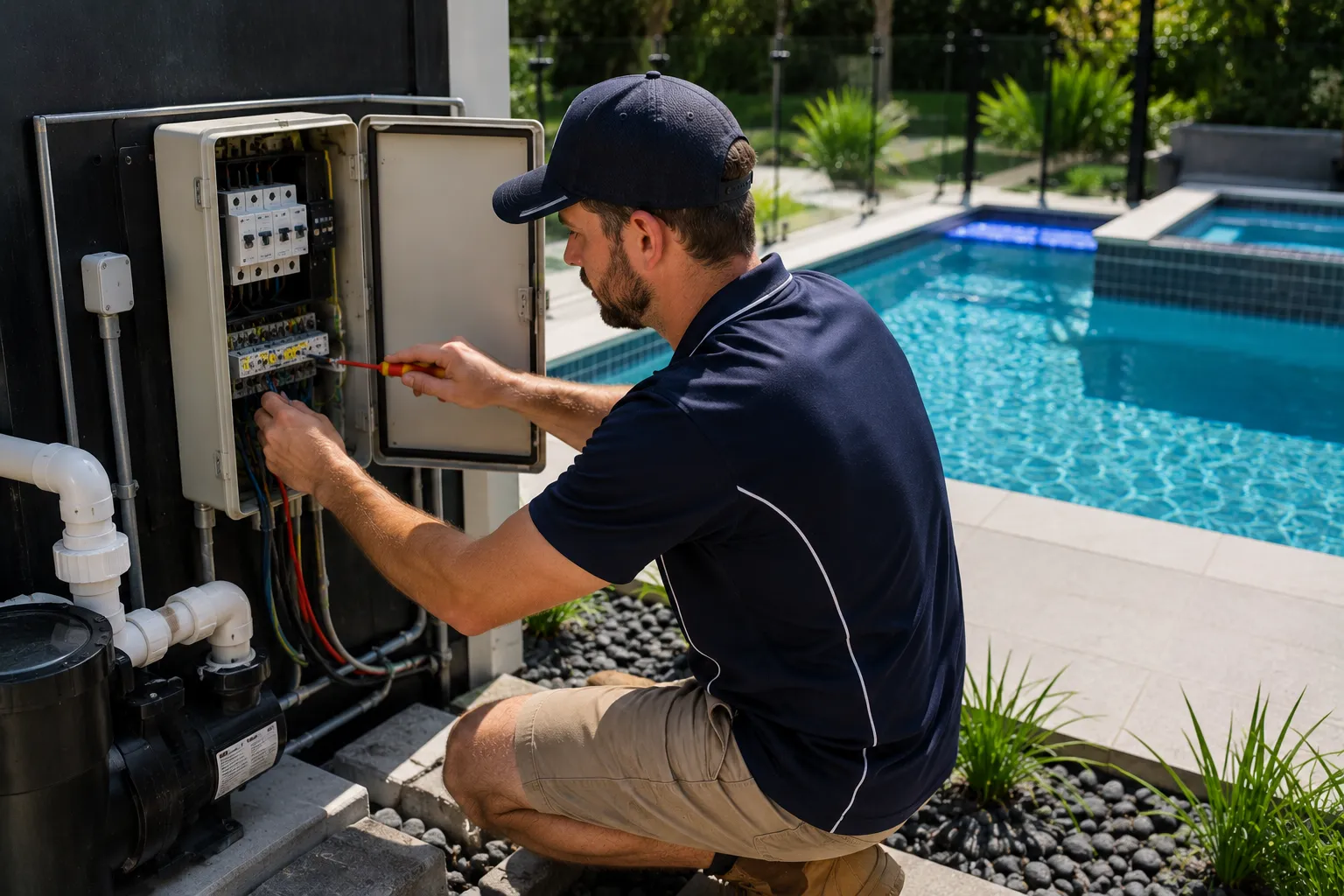
Pool and spa electrical work has the strictest safety rules in residential electrical — and for good reason. Water and electricity are the most dangerous combination in a home, and a single insulation fault on a pool circuit without proper bonding and RCD protection can produce voltages in the water that are quietly fatal. Aurora Electrical Solutions delivers pool and spa electrical work across Brisbane, the Gold Coast, Logan and SEQ to the strict requirements of AS/NZS 3000:2018 (Wiring Rules) and AS/NZS 3004 (caravan and marine, which covers some pool zones). Pool pump wiring, heat pump and gas heater electrical hookups, salt chlorinator circuits, underwater lighting, equipotential bonding to current standards, switchboard upgrades for pool equipment loads — full electrical scope under one licence. Aurora is a fully licensed Queensland electrical contractor (Licence EC91972), Master Electricians Australia members, fully insured, with Certificate of Test issued on every job.
What's included
- Pool pump electrical installation and replacement — single-phase and three-phase, including variable speed pumps (VSP)
- Salt water chlorinator electrical wiring and timer control
- Heat pump pool heater installation (electric heat pump and gas heater electrical hookup)
- Underwater LED pool light installation and replacement (12V SELV systems)
- Deck and garden lighting integrated with pool equipment area
- Equipotential bonding to AS/NZS 3000:2018 — pool shell reinforcing, fences, ladder rails, diving boards, all metal within 1.25m of pool edge
- Type A 30mA RCD protection on every pool and spa circuit
- Dedicated circuit installation from main switchboard to pool equipment enclosure
- Pool equipment sub-board installation for sites with multiple loads
- Smart pool controller integration (Wi-Fi pump control, automated scheduling, app monitoring)
- Spa electrical (in-ground spa, portable spa, swim spa) — hardwired or appliance-cord installation
- Pre-purchase pool electrical safety inspection and compliance reporting
- Switchboard upgrade where required (older boards may not have Type A RCDs needed for VSP pumps)
When you need a pool & spa electrician
Pool electrical isn't a job for handymen or pool builders without electrical licences. If any of these apply, get a licensed electrician on the job:
- Installing a new pool or spa (electrical needs to be planned during pool construction, not bolted on after)
- Replacing a pool pump (older pumps drew 5-6A; modern VSP pumps need different protection)
- Adding a salt water chlorinator (needs dedicated circuit with proper timer control)
- Adding a heat pump or gas heater (significant new electrical load needing dedicated circuit)
- Adding or replacing underwater lighting (12V SELV system, transformer required)
- Pool fence repairs or upgrades (metal fences within 1.25m of water need equipotential bonding)
- Existing pool failing pool safety inspection due to electrical compliance
- Pool circuit trips frequently when pump or heater runs (likely RCD or earth fault)
- Pool pump or heater showing visible corrosion on electrical connections (saltwater pools accelerate this)
- Pre-purchase inspection on a property with a pool — get electrical compliance verified
- Insurance review flagged pool electrical compliance
- DIY or unlicensed pool electrical work needs assessment and re-certification
How much does pool & spa electrical cost in Brisbane?
Pool electrical pricing varies with scope — from a single pump replacement through to full pool electrical fit-out for a new installation. Here's the typical range for Brisbane jobs in 2026:
- Pool pump replacement (like-for-like, single-phase): typically $400 – $900 including pump or pump-only labour
- Variable speed pump (VSP) installation with control wiring: typically $600 – $1,200
- Salt chlorinator electrical install (new): typically $300 – $700 for wiring + timer + dedicated circuit
- Heat pump pool heater electrical hookup: typically $600 – $1,500 dedicated circuit
- Gas heater electrical (ignition and controls): typically $400 – $900
- Underwater LED light replacement (existing wiring intact): typically $250 – $600 per light
- New underwater light installation (including transformer and bonding): typically $500 – $1,200 per light
- Equipotential bonding upgrade for existing pool (to current AS/NZS 3000:2018): typically $800 – $2,500
- Full pool electrical fit-out for new pool (pump + chlorinator + light + bonding + circuits): typically $2,500 – $6,000
- Pool equipment sub-board (consolidated location for multiple loads): typically $1,200 – $2,800
- Smart pool controller integration (Wi-Fi pump, scheduling, app): typically $400 – $900 wiring + commissioning
- Switchboard upgrade for older boards lacking Type A RCDs: typically $1,200 – $3,000 (see switchboard page)
Every job is fixed-price quoted after a site visit. Pool electrical isn't a quote-from-photos job — the bonding requirements depend on the specific pool layout, equipment locations and existing infrastructure. Site visits are free across Brisbane and SEQ. Certificate of Test and Compliance issued on every completed job.
How long does pool electrical work take?
A pool pump replacement is usually 2-3 hours. A salt chlorinator install (new circuit + chlorinator electrical) is typically 3-4 hours. A heat pump heater electrical hookup with new dedicated circuit is 4-6 hours. Equipotential bonding retrofit on an existing pool typically takes 4-8 hours depending on how many metal components need bonding and access to the pool shell reinforcing. A full pool electrical fit-out for a new pool runs 1-2 days, coordinated with the pool builder so the electrical work happens at the right point in the build (shell reinforcing bond before the concrete is poured, equipment area wired before the equipment is installed). Power is only off in the areas we're actively working on — pool circuits are typically isolated separately so house power stays live.
Pool & spa electrical — what the law actually requires
AS/NZS 3000:2018 (the Wiring Rules) and the 2018 update have specific requirements for pool and spa electrical that are stricter than any other residential context. Here's what the law actually requires:
- Equipotential bonding — all metal components within 1.25m (arm's reach) of the pool edge must be bonded together to a common earth point, eliminating dangerous voltage differences
- 30mA Type A RCD protection — every pool and spa circuit must have a Type A 30mA RCD (Type AC is insufficient for circuits with VSP pumps, LED drivers or heat pump compressors)
- Classified Zones — Zone 0 (the water itself), Zone 1 (above water and immediate surrounds), Zone 2 (extending out 1.5m from Zone 1) — each zone has specific equipment IP ratings and voltage limits permitted
- Accessible bond point (2018 requirement) — the pool reinforcing bond conductor must be terminated at an accessible point so future bonding additions can be connected
- Pool shell reinforcing bonding — for concrete and gunite pools, the steel reinforcing in the shell must be bonded before the concrete is poured (impossible to retrofit easily)
- Metal pool fence bonding — aluminium and steel fences within arm's reach must maintain continuity through the full length and connect to the equipotential bond
- Glass pool fence spigots — metal spigots holding glass panels are conductive and need bonding; non-conductive CFG spigots (rated to 1000V) are an alternative
- 12V SELV for underwater lighting — underwater lights must use Separated Extra-Low Voltage (12V) systems with isolating transformers, never direct mains voltage
- Separation from aerial cables — minimum clearances between pools and overhead electrical infrastructure
- Type B RCD for variable speed pumps in some configurations — VSP pumps can produce DC fault currents that Type A RCDs may not detect
How a pool electrical project runs
Pool electrical work needs careful staging — particularly for new pools where the bonding has to happen before the concrete is poured. Here's how a typical project runs:
- Site visit and assessment — We attend the site, assess the existing electrical infrastructure (switchboard capacity, RCD types, existing pool circuits if any), measure distances from pool edge to all metal components within arm's reach, and identify what bonding work is required. Free for all Brisbane and SEQ pool jobs.
- Quote and scope — Fixed-price quote covering the full electrical scope — pump and equipment circuits, bonding work, lighting, controls, switchboard work if required. For new pools we coordinate with the pool builder on staging. For existing pools we schedule around your use.
- Coordination — pool builder, plumber, fencer — Pool electrical isn't standalone work — it interfaces with the pool builder (shell reinforcing bonding before concrete pour), the pool plumber (pump and filter electrical), and the pool fencer (metal fence bonding continuity). We coordinate with each so the electrical staging fits the broader build program.
- Install — staged appropriately — For new pools: shell reinforcing bond conductor installed before concrete pour (this is the one task that's impossible to retrofit cleanly later — it has to happen at the right point). Equipment area circuits and sub-board installed during the pool equipment installation phase. Underwater lighting wiring run during shell construction. Fence bonding completed after the fence is installed.
- Testing, bonding verification, RCD trip testing — Continuity testing of the entire bonding system — every metal component within arm's reach verified to be bonded to the common earth point. RCD trip testing per AS/NZS 3760 (must trip within 300ms at rated current). Voltage testing in the water (should be 0V relative to earth — any reading indicates a bonding fault).
- Certification and handover — Certificate of Test and Compliance issued. For new pools we provide the documentation the pool certifier needs for pool fence and electrical compliance sign-off. We walk you through the smart controller setup (if applicable), explain what each circuit feeds, and provide operating instructions for the safety devices.
Equipotential bonding — why it's the most important thing about pool electrical
Equipotential bonding is the single most important safety feature in pool electrical, and the most commonly missing or substandard element on older pools and DIY-installed pools. The principle: if a fault on any circuit causes voltage to appear on a metallic part connected to the pool (a ladder, a fence, a light fitting, the pool shell reinforcing), bonding ensures that voltage appears equally on every other metallic part — so there's no voltage difference between, say, the metal ladder rail you're holding and the pool water you're in.
Without bonding, you can get a few volts between the pool water and the ladder rail. That voltage might not be enough to seriously hurt you on dry land, but in water — where your body conducts electricity far more readily — it can be enough to cause muscle paralysis, drowning, or in worst cases direct electrocution. The pool industry has well-documented cases of pool drownings caused by minor electrical faults on poorly-bonded pools.
AS/NZS 3000:2018 mandates equipotential bonding for every pool and spa in Australia. The bonding conductor (typically 4mm² green/yellow cable) must connect every metal component within 1.25m of the pool edge to a common earth point. This includes: pool shell reinforcing (for concrete pools, bonded before the pour), metal pool fences and gates, ladder rails and handrails, diving board mounts, metal light poles and shade structure supports, metal spigots on glass pool fences, pipework connections that bridge into the pool area, and aluminium window frames within arm's reach.
The 2018 update added a critical requirement: the pool reinforcing bond conductor must be terminated at an accessible point so future additions (a new fence, a new ladder, a new light pole) can be connected to the same bonding system. Older installations often have inaccessible bond points buried in concrete — meaning future bonding work has to fall back on a separate earthing scheme.
RCD protection — why Type A matters now
Every pool and spa circuit must have RCD protection rated at 30mA — the same trip threshold that protects bathroom outlets and outdoor circuits. RCDs detect imbalance between the active and neutral currents, indicating that current is flowing somewhere it shouldn't (typically through a person or through the water).
Until recently, Type AC RCDs were standard for most residential circuits. Type AC RCDs detect AC fault currents, which works for resistive loads (old-style heaters, basic pumps). But modern pool equipment increasingly produces DC fault currents during failure modes — variable speed pumps, LED light drivers, heat pump compressors, smart controllers. Type AC RCDs can be "blinded" by these DC currents and fail to trip on what would otherwise be a dangerous fault.
AS/NZS 3000:2018 now requires Type A RCDs (which detect both AC and pulsating DC) for circuits feeding modern pool equipment. Some configurations — particularly VSP pumps with variable-frequency drives — may require Type B RCDs which detect all fault current types including smooth DC. We assess your specific equipment and install the appropriate RCD type for the actual loads.
If your pool was installed before 2018 and still has its original Type AC RCDs, the protection may not be working as designed against modern equipment faults. An RCD upgrade to Type A is typically $200-$400 per circuit and is genuinely worthwhile from a safety standpoint, not just compliance.
Variable speed pumps (VSP) — the biggest running cost reduction
Single-speed pool pumps are the legacy standard — they run flat-out whenever they're on, drawing 1.5-2.5kW continuously. For a typical Brisbane pool running the pump 6-8 hours a day in summer, that's 9-20kWh/day of pool pump electricity alone, or roughly $1,000-$1,800/year on a typical tariff.
Variable speed pumps (VSP) run at lower speeds for most of the cycle (typically 30-50% of full speed), drawing 200-600W instead of 1.5-2.5kW. They still circulate the same total water volume per day (just over longer hours), maintain filtration and chemical distribution equally well, and use 60-80% less electricity. Annual running cost typically drops from $1,000-$1,800 down to $200-$500.
Payback on a VSP retrofit is usually 2-3 years on running cost savings alone. Most Brisbane pool owners with single-speed pumps would benefit from the upgrade — and the savings are even better if you pair the VSP with a smart controller running it primarily during solar-production hours.
Electrical implications: VSPs need Type A or Type B RCD protection (Type AC is insufficient), control wiring for the variable frequency drive, and often a smart timer or controller. We install all the major VSP brands — Pentair IntelliFlo, Hayward EcoStar, AstralPool Viron, Davey EcoMatic. Existing single-speed pump circuits usually need RCD verification or upgrade before a VSP can be installed safely.
Solar + pool — running the pump from sunshine
Pool pumps are the perfect load for solar. They draw substantial power (200W-2.5kW depending on type), they run during the day (when solar is producing), and they're easy to schedule. A typical Brisbane household with 6.6kW of solar and a pool pump can run the pump entirely off solar production during peak sunshine hours, with net pool running cost approaching zero.
The implementation is straightforward: smart timer or controller programmed to run the pump during peak solar hours (typically 9am-3pm). For VSP pumps, the controller can run the pump at low speed during marginal solar hours and at full speed during peak hours to maximise solar self-consumption. Smart controllers like the Pentair IntelliFlo3, Davey ChloroMatic Edge, and the Astral Connect 10 all support this pattern natively.
If you don't have solar yet but are considering it, the pool is a strong argument for sizing the solar system slightly larger — the additional production easily pays back when the pump can run during the day instead of overnight on grid power. See our solar page for more on sizing for pool + EV + heat pump combined loads.
Pool heating — heat pumps, gas, and the running cost gap
Brisbane's climate means most pool owners get 6-8 months of comfortable swimming per year without heating. The other 4 months — late autumn through early spring — are when pool heating earns its place. There are three common heating options:
Electric heat pump pool heaters — the dominant choice for new installations. Similar principle to a heat pump hot water system: 1kW of electricity input produces 4-6kW of pool heat output (COP 4-6). Running cost in Brisbane: roughly $500-$1,200 for the cooler months depending on pool size and target temperature. Premium brands: Madimack, Hydroheat, AstralPool BX. Mid-range: Evoheat, Aquatight.
Gas pool heaters — historically common, increasingly replaced by heat pumps. Gas heaters heat faster (useful for spas) but running cost is significantly higher (typically $1,500-$3,500 for the same heating season). Still appropriate where gas is already connected and the heating is occasional rather than continuous.
Solar pool heating — black tubes on the roof, water circulated through them, heated by sunshine. Very low running cost (just the pump) but only effective when the sun is shining and the roof tubes are warm. Not effective for pre-dawn winter swims; works well as a season-extender shoulder months.
Electrical requirements differ for each. Heat pumps need a dedicated 32A circuit, Type A RCD protection, and (for larger units) three-phase supply. Gas heaters need a lower-current electrical circuit for ignition and controls. Solar pool heating just needs a controller and the existing pump circuit. We install the electrical scope for all three.
Spa electrical — in-ground, portable, and swim spas
Spa electrical is a subset of pool electrical with some specific considerations. In-ground spas are treated almost identically to pools — same bonding requirements, same RCD protection, same zone classifications. Portable spas (the freestanding above-ground units) have their own considerations:
Portable spas connecting via appliance cord — these are technically appliances that plug into a 15A or 20A outlet. The outlet itself needs Type A 30mA RCD protection, must be installed within reach of the spa cord (typically 2.5m), and the spa location needs equipotential bonding to any metal components within arm's reach (pergola structures, balustrade rails, nearby metal fences).
Hardwired portable spas — larger spas (over 6kW heater draw, or with multiple pumps) often require hardwired installation rather than cord-connected. This means a dedicated circuit from the switchboard, an isolator within sight of the spa, and proper equipotential bonding.
Swim spas (large fitness spas) — these straddle the line between spa and pool. They're typically larger than 6m long, accept multiple users, and have substantial electrical loads (15-25kW total including heater, pumps, jets, lighting). They need pool-grade electrical: dedicated three-phase supply often, full equipotential bonding to all metal components, multiple Type A RCDs, and sometimes a dedicated sub-board for the spa equipment.
We install electrical for all spa types — assessing the specific spa model's requirements against the existing supply and recommending the right approach. Many spa retailers don't include the electrical scope in their price; we quote it separately and clearly.
Salt air, chemicals, and pool equipment corrosion
Pool equipment lives in a harsh environment. Salt-water pools (which most Brisbane pools now are) produce salt-laden mist around the equipment area. Chlorine chemistry — even on salt-chlorinated pools — accelerates corrosion on electrical connections. Standard residential electrical equipment near a pool typically deteriorates faster than equivalent equipment elsewhere in the home.
What this means for the electrical: we specify IP55+ enclosures for pool equipment sub-boards (most pool equipment areas need IP-rated equipment because of the airborne moisture and chemical exposure). Stainless or marine-grade mounting hardware for any outdoor or exposed components. Corrosion-resistant cable glands and entries. Regular inspection of terminations during maintenance visits to catch deterioration before it causes faults.
Pool circuits also tend to develop earth-leakage faults over time as moisture penetrates ageing components — pumps, lights, heaters all gradually deteriorate. RCD nuisance trips on pool circuits are usually a sign that the equipment itself is approaching end-of-life, not a fault in the RCD. We diagnose, replace deteriorated components, and re-test.
For pools we deliver new electrical for, we recommend annual or biennial RCD trip testing and bonding continuity verification as part of pool maintenance. Typically a 1-hour service, covers all the critical safety verifications, catches developing issues before they become dangerous.