
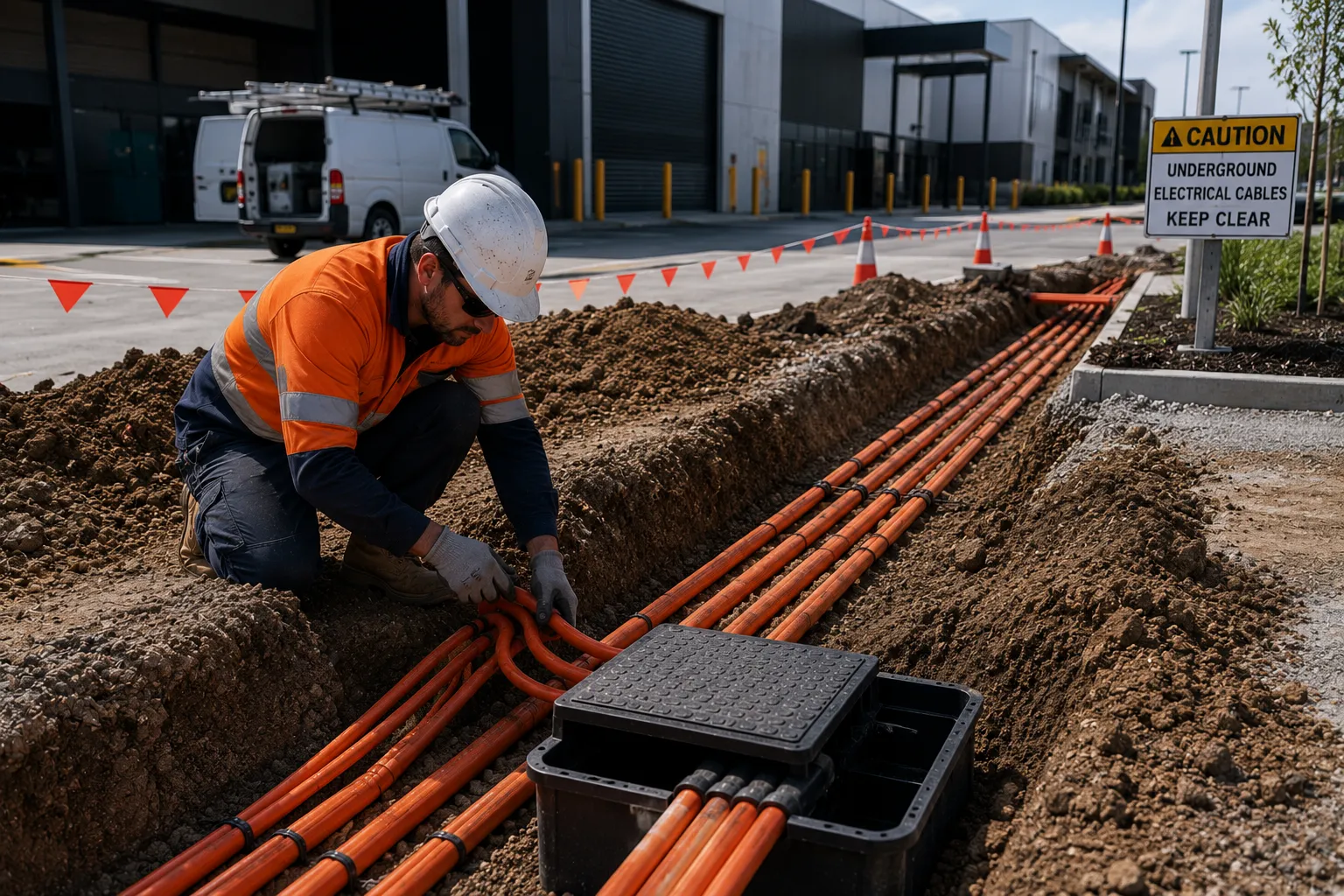
Underground electrical work is where shortcuts cause the most expensive failures. A cable buried too shallow gets damaged by garden tools or fence posts a year later. A cable without proper conduit is destroyed by tree roots within a decade. A trench dug without BYDA coordination hits a gas main or NBN cable, costing tens of thousands in repair plus the safety incident risk. The pits installed at the wrong intervals make future cable replacement impossible. None of these failures are visible on day one — they emerge months or years later, expensive and disruptive to fix. Aurora Electrical Solutions delivers underground electrical across Brisbane, the Gold Coast, Logan and SEQ — commercial site sub-mains, body corporate underground EV charger feeds, car park lighting circuits, lifestyle property house-to-shed runs, granny flat feeds, pool and pump electrical, external signage power, and full civil-works coordination. AS/NZS 3000:2018 compliant burial depths, AS/NZS 2053.2 orange conduit, BYDA coordination before every dig, traffic management where required, sand bedding and warning tape, properly-spaced pits for future access, and full as-built documentation. Aurora is a fully licensed Queensland electrical contractor (Licence EC91972), Master Electricians Australia members, fully insured with $20M public liability.
What's included
- BYDA (Before You Dig Australia) coordination — mandatory utility locate before any excavation, included in every project
- Trenching to AS/NZS 3000:2018 minimum depths (500mm landscaped/lawn, 600mm under driveways/trafficable, 750mm+ heavy duty)
- Heavy-duty orange PVC conduit installation per AS/NZS 2053.2 (the only acceptable conduit standard for direct burial)
- Sand bedding (75mm minimum) below cable and over cable before backfill
- Yellow warning tape installation 150mm above cable in the trench (alerts future excavators)
- Conduit pit installation at changes of direction, splice points, and major junctions
- Concrete pits with traffic-rated lids for vehicle-accessible areas
- Polymer pits for landscaped areas
- Sub-main runs between buildings on commercial sites
- House-to-shed underground runs for residential and acreage properties
- House-to-granny-flat sub-mains with sub-board termination
- EV charger sub-mains for body corporate and commercial car parks (multi-charger sites)
- Car park lighting circuits with proper pit access for future maintenance
- External signage power and control
- Pool, pump and equipment shed electrical
- Festoon lighting and outdoor entertaining area power
- Concrete saw cut and reinstatement (driveway crossings)
- Bitumen reinstatement (commercial car park crossings)
- Directional boring (HDD) for no-dig crossings under driveways and gardens
- Traffic management coordination for works on shared roadways or commercial entries
- Full as-built drawings showing cable routes, depths, conduit sizes, pit locations
- Certificate of Compliance on every installation
When you need underground electrical work
Underground electrical is rarely an optional choice — it's the right answer (often the only answer) when these scenarios apply:
- You're building or developing a commercial site with new electrical infrastructure
- You're connecting a new building to existing site supply (warehouse complex, body corporate site, mixed-use development)
- You're installing EV chargers in a body corporate or commercial car park requiring sub-mains across the car park
- Your acreage or lifestyle property needs power to a detached shed, workshop, granny flat, or outbuilding
- You're installing pool, pump or pool-equipment electrical with proper underground supply
- You're upgrading car park lighting and need new underground circuits to light poles
- You're installing external signage requiring power supply across landscape areas
- Your existing underground supply is undersized for current loads (frequent trips, voltage drop complaints)
- Your existing underground cable has failed (cable fault detected by megger testing or by progressive nuisance trips)
- You're a body corporate with ageing common-area underground electrical infrastructure
- You're installing solar at scale and need underground DC or AC cabling between arrays and inverters
- You're a builder needing an underground electrical subcontractor for a commercial or premium residential project
- You're a property developer planning new estate or commercial development with electrical infrastructure scope
- You need festoon lighting or outdoor entertaining power without unsightly overhead runs
How much does underground electrical cost in Brisbane?
Underground electrical pricing is dominated by cable run distance, cable/conduit size, soil conditions, surface reinstatement requirements, and the number of pits required. Here are typical Brisbane ranges for 2026:
- Standard underground run (single circuit, 10m, soft soil, conduit): typically $800 – $1,800
- Standard underground run (single circuit, 30m): typically $2,500 – $4,500
- Acreage long run (50-100m, single circuit): typically $4,500 – $12,000
- Sub-main install (large conduit, large cable, 30m run, 100A): typically $4,000 – $8,000
- Heavy commercial sub-main (multiple conduits, 50-100m, 200A+): typically $12,000 – $35,000+
- EV charger sub-main across car park (single charger position): typically $3,500 – $8,500
- Multi-EV-charger car park sub-mains (4-8 chargers with load management): typically $15,000 – $45,000+
- Concrete pit (small, polymer, landscaped area): typically $400 – $900 supplied and installed
- Concrete pit (medium, traffic-rated lid for car parks): typically $1,200 – $3,500
- Concrete saw cut + reinstatement (driveway crossing, per metre): typically $80 – $200
- Bitumen cut + reinstatement (commercial car park crossing, per metre): typically $50 – $150
- Trenching only (machine, soft soil, per metre): typically $40 – $100
- Trenching only (rocky ground, rock saw required, per metre): typically $80 – $180
- Directional boring / HDD (no-dig crossings, per metre): typically $250 – $600+
- BYDA scan and locate coordination: included in all our quotes (free)
- Traffic management for road crossings: typically $400 – $1,500+ per shift depending on requirements
- As-built drawings and documentation: included in all our quotes
Every underground project is custom-quoted after a site visit and route survey. We provide fixed-price quotes with itemised civil works, conduit sizing, pit specifications, surface reinstatement scope, and BYDA coordination. Customer-dug trenches accepted for residential projects (we provide specifications, inspect before cable laying — typical saving $40-$80 per metre). Commercial projects typically include trenching as part of the integrated civil scope.
How long does underground electrical work take?
Short residential underground runs (10-30m, single circuit): 1-2 days including trenching, conduit, cable, and reinstatement. Acreage long runs (50-100m): 3-5 days including trenching and reinstatement. Commercial sub-main projects: 1-3 weeks depending on civil scope, number of pits, traffic management requirements, and any directional boring. EV charger car park sub-mains: 1-2 weeks per charger array depending on complexity. The critical lead time is usually BYDA coordination (24-48 hours before any dig start) and any required traffic management or council permit approval (1-4 weeks lead time for shared roadway works). We coordinate all of this as part of the project program.
AS/NZS 3000:2018 underground burial requirements — the rules that matter
AS/NZS 3000:2018 Clause 3.11 sets out the legally-required minimum depths and protection methods for underground cables in Australia. These aren't guidelines — they're what makes the installation legal and what makes the cable survive long-term. Here are the requirements every Brisbane underground job must meet:
- Minimum 500mm depth — for cables in heavy-duty conduit under landscaped areas, lawns, gardens, footpaths. The default minimum for residential underground work.
- Minimum 600mm depth — for direct-buried (no conduit) cables under landscaped areas, OR for cables in conduit under driveways and trafficable areas. The standard for vehicle-crossing zones.
- Minimum 750mm depth or greater — for cables under commercial vehicle paths, heavy trafficked areas, or where additional mechanical protection is warranted. The standard for commercial car parks and industrial sites.
- Heavy-duty orange PVC conduit per AS/NZS 2053.2 — the only acceptable conduit grade for direct burial. Medium-duty grey conduit is for surface-mounted use, NOT underground. Using grey conduit underground is non-compliant work.
- Sand bedding — minimum 75mm of clean sand below the cable before the cable is laid, protecting from sharp rocks and providing a stable base. Sand cover above the cable (another 75mm) before earth backfill.
- Yellow warning tape — durable yellow plastic tape laid in the trench approximately 150mm above the cable, with text identifying "DANGER ELECTRICAL CABLE BELOW." Alerts future excavators (gas, water, NBN, drainage works) to the presence of electrical infrastructure.
- Pit access at changes of direction — generally required where the cumulative bend exceeds 180° between draw points. Without pits, future cable replacement becomes impossible.
- No buried splices — cable joints must be made in pits or above ground, never directly buried. Direct-buried splices are a guaranteed future fault.
- RCD protection at the load end — every underground circuit must be RCD-protected at the receiving switchboard per AS/NZS 3000:2018.
- BYDA (Before You Dig Australia) consultation — every excavation must be preceded by a BYDA scan identifying existing underground services. Free service via 1100 or byda.com.au. Failure to scan is both legally negligent and dangerous — hitting a gas main or HV cable can kill.
How an underground electrical project runs
Underground electrical work follows a tight sequence — civil works can't be paused mid-trench, and reinstatement must follow promptly to keep sites safe. Here's how Aurora delivers:
- Site survey and route planning — We visit the site, measure the proposed route, identify natural cable pathways (along fence lines, parallel to existing services, avoiding tree roots and irrigation), confirm pit locations, identify any surface reinstatement requirements (concrete cuts, bitumen patches), and assess soil conditions (soft soil, rocky ground, clay). For commercial sites we coordinate with the lead contractor and certifier.
- BYDA scan and design — We lodge a BYDA enquiry (Before You Dig Australia) for the site, receiving plans of all existing underground services within 48 hours. We adjust the proposed route to maintain safe separation from existing services (gas, water, NBN, drainage, existing electrical). Detailed design produced: cable size per AS/NZS 3008 voltage drop calculation, conduit size, pit locations, surface reinstatement scope, traffic management if required.
- Permits, traffic management, fixed-price quote — Council permits arranged for any work crossing public land or shared roadways. Traffic management plan developed if works will affect vehicle access. Fixed-price quote provided with itemised civil and electrical scope, clear inclusions, BYDA reference, as-built documentation in scope.
- Site setup, trenching, conduit laying — Site setup: safety signage, traffic cones, barricades around all work zones. Trenching commences along the planned route with proper depth control (laser or string line for long runs). Sand bedding placed in the trench bottom. Orange conduit laid with draw cord pre-installed inside. Pits installed at planned positions with proper bedding.
- Cable pull, terminations, testing — Cable pulled through conduit using mechanical pulling equipment for longer runs (preserves cable performance — over-tensioned cables develop faults). Terminations made at both ends in proper enclosures. Megger testing (insulation resistance) on every circuit before backfill. Identifying any installation faults before the trench is closed is critical — finding them after backfill costs many times more.
- Warning tape, backfill, reinstatement — Sand cover placed over the cable in the conduit. Yellow warning tape laid 150mm above. Trench backfilled in compacted layers (uncompacted backfill settles and creates trip hazards). Surface reinstatement: turf for lawn areas, concrete patching for driveway crossings, bitumen patching for commercial car parks. Site cleanup — all spoil removed, no construction debris left behind.
- Final testing, as-built documentation, certification — Final testing under load. Circuits energised and operational. As-built drawings prepared: cable route survey, depth at each point, conduit sizes, pit locations and reference numbers, surface reinstatement records. Certificate of Compliance issued. Documentation pack handed over to customer, builder and certifier. Critical for future site works — the next contractor knows exactly where the cables are.
BYDA — the free service that prevents catastrophic dig incidents
Before You Dig Australia (BYDA, formerly Dial Before You Dig) is a free national service that provides plans of all underground services on a given property — gas, water, telecommunications, electrical, sewer, stormwater, NBN. Every excavation in Australia should start with a BYDA enquiry. Yet a substantial proportion of "general handyman" trench digging proceeds without one, and the incidents that result are entirely preventable.
The risks of digging without BYDA: hitting a gas main causes immediate evacuation, infrastructure repair costs of $5,000-$50,000+, potential fire/explosion risk, and the digger may be prosecuted under WHS legislation. Hitting an HV electrical cable can kill — the energy contained in even a 11kV distribution cable is enough to cause fatal injuries to the excavator operator. Hitting NBN or water mains causes significant disruption and repair costs but is generally non-fatal.
The BYDA process is straightforward and free: lodge an enquiry online at byda.com.au or call 1100, specify the location and intended dig area, receive plans within 48 hours from each utility operator with services in the area. The plans show approximate positions of underground assets — accurate to typically 1-2 metres, sometimes better. Excavators are then expected to hand-pothole (dig carefully with a shovel) within 1m of any indicated service to confirm exact position before machine excavation.
BYDA validity: plans are valid for 28 days from issue. Any work starting outside that window requires a new lodgement. We lodge BYDA enquiries as part of every underground electrical project — the customer doesn't need to do this themselves. We also handle the hand-potholing where required to confirm asset positions before machine trenching commences.
The cost-benefit math is overwhelming: BYDA is free, costs 48 hours of lead time, and prevents potentially fatal incidents and substantial repair liabilities. A reputable underground contractor never skips it. If you're getting quotes for underground electrical work and the contractor doesn't mention BYDA, that's a red flag.
Orange conduit (AS/NZS 2053.2) — why standard conduit isn't enough
PVC conduit comes in several grades, identified by colour and thickness rating. Underground electrical work has specific conduit requirements that aren't optional:
Heavy-duty orange PVC conduit (AS/NZS 2053.2 compliant) — the required grade for direct underground burial. Thicker wall section, UV-stable, and rated for the mechanical loads expected when buried under landscape or vehicle traffic. Always orange so excavators can immediately identify it as electrical infrastructure during future digging.
Medium-duty grey PVC conduit (AS/NZS 2053.5) — for surface mounting, in-wall use, and protected applications. NOT rated for direct burial. Using grey conduit underground is non-compliant work and fails inspection — yet it's a common shortcut by handymen and unlicensed installers because grey conduit costs slightly less.
Communications conduit (white) — for data and telecommunications cabling only, not electrical. Different mechanical and electrical requirements.
HDPE conduit — increasingly used for major commercial underground work (long pulls, directional boring applications). More flexible than rigid PVC, allows longer pulls without intermediate pits, but premium cost and specialist installation.
Conduit sizing matters as much as material — the conduit needs to accommodate the cable without exceeding the cable manufacturer's bend radius requirements. For a typical 16mm² sub-main cable, 50mm conduit is the practical minimum; for larger cables, 65mm or 80mm. Undersized conduit prevents future cable replacement and may damage cables during initial pulling. We size conduit to allow at least 40% spare capacity for future works.
Conduit jointing — solvent-cement joints (proper PVC primer + cement applied to socket and spigot) make permanent watertight joints. Push-fit joints are NOT acceptable for underground use. We use the slow-cure solvent process for joints subject to mechanical stress during cable pulling.
Draw cord — every conduit run includes a draw cord pre-installed for the full length, with 1m coiled at each end. This is what allows future cables to be pulled through without digging up the conduit. Conduits without draw cords are essentially single-use installations.
The conduit pit — why properly-spaced pits are essential, not optional
Conduit pits (also called draw pits or junction boxes) are the access points along an underground cable run that allow future cable pulling, maintenance, and inspection. The pit specification on an underground project is often the difference between an installation that survives 20 years with normal maintenance and one that needs to be entirely excavated and re-laid after 5-10 years.
Where pits are required: at changes of direction (the general rule is no more than 180° cumulative bend between pits), at major intersections or branch points, where cable splices are needed (no buried splices allowed under AS/NZS 3000:2018), and at major distance intervals on long runs (typically every 50-100m for sub-mains).
Pit sizing: small polymer pits (typically 450 × 450 × 600mm) for residential and light commercial use, with single-cable access. Medium concrete pits (600 × 600 × 750mm) for multi-cable junctions and commercial sub-mains. Large concrete pits (1.0m+ × 1.0m+) for heavy commercial works with multiple sub-mains converging.
Pit lids: this is where many installations cut corners. Polymer lids for landscaped areas are fine. Traffic-rated cast iron or composite lids are required for any area where vehicles may drive (car parks, driveways, commercial yards). Non-traffic-rated lids in vehicle areas crack within months and need replacement — modest upfront saving turns into substantial repair cost.
Pit drainage: pits collect water (rainfall through the lid gap, groundwater seepage). Modern pits include drainage holes or sump positions to prevent standing water around cable terminations. Older pits without drainage are common sources of cable corrosion and termination failure.
Pit labelling: every pit gets a permanent identifier (engraved tag or paint) so as-built drawings can reference specific pits. Critical for future maintenance and troubleshooting — "the fault is at pit 7" is meaningful only if pit 7 is identifiable on site.
The economic case for adequate pits: each pit adds $400-$3,500 to project cost depending on size and lid type. The cost of subsequently needing to excavate to add a pit (because none was installed where now needed) is typically 5-10× the cost of installing the pit during the initial project. Aurora's approach: design pit locations for the realistic 20-year evolution of the cable, not just the day-one installation.
Trenching vs directional boring — choosing the excavation method
Two main methods deliver cable from point A to point B underground: open-cut trenching (digging a trench, laying conduit, backfilling) and directional boring / horizontal directional drilling (HDD) (drilling horizontally underground from a launch pit to a receive pit without surface disturbance between them). Each has appropriate applications:
Trenching applies when: the route runs through landscape that can tolerate disturbance (lawn, garden, paddock), the surface is unsealed (no concrete or bitumen to break up), the distance is short to moderate (typically up to 100m), and the trench can be dug without affecting traffic flow. Trenching is the cheaper method by a factor of 3-10× for suitable applications. Most residential and light commercial underground work is trenched.
Directional boring applies when: the route crosses an existing surface that can't be disturbed (sealed driveway, concrete car park, established gardens with substantial planting, road crossings), the route is long enough to justify the setup cost (typically 30m+), or the route needs to maintain vehicle access during works (commercial sites operating during construction). HDD costs 5-10× more per metre than trenching but is sometimes the only practical option.
Directional boring how it works: a drill rig launches a steerable drill head from a launch pit. The drill bores horizontally underground following the operator's guided path (monitored by surface tracking equipment). At the receive pit, the drill exits the ground. The drill is then pulled back, drawing a conduit or cable behind it. The process takes hours rather than days and leaves the surface between the pits completely undisturbed.
Brisbane-specific HDD considerations: many Brisbane commercial sites have sealed surfaces (asphalt car parks, concrete driveways) that make directional boring the practical choice for any new cable runs. Established residential streets with mature trees benefit from HDD to avoid disturbing root systems. Older Brisbane suburbs with mixed underground services benefit from HDD because the bore can be planned to stay clear of mapped existing services.
Cost comparison example: a 40m run under a commercial car park. Open-cut trench: $2,000-$5,000 for the civil works including saw-cut and bitumen reinstatement, but disrupts car park access for several days. Directional boring: $10,000-$24,000 but completed in a single day with no surface disruption. The HDD premium often pays back through reduced business interruption.
Commercial EV charger sub-mains — the underground work behind workplace charging
Commercial EV charging installations almost always involve substantial underground electrical work — sub-mains running from the building's main switchboard out across the car park to individual charger positions. The underground scope is often the largest line item in the EV charging project budget, larger than the chargers themselves.
Why underground: chargers are typically positioned at parking bays distributed across the car park, often 20-100m from the main switchboard. Overhead cabling across a car park isn't practical (interferes with vehicle access, looks terrible, needs poles and supports). Surface-mounted cabling fails rapidly under vehicle traffic. Underground is the only durable approach.
Sub-main sizing: depends on the number of chargers and the load management approach. A workplace with 8 × 22kW chargers, fully concurrent draw would need ~250A — far more than typical commercial sub-mains. With load management, peak draw is capped at 60-100A — much smaller sub-main needed. The cable sizing decision happens at design stage based on the load management strategy.
Multiple conduits common: rather than one large cable, we often install multiple parallel conduits — one carrying the power sub-main, another for OCPP networking (Ethernet to chargers), a third spare for future expansion. The marginal cost of an additional conduit during the same trenching operation is small; the value of having spare capacity ready for future EV expansion is substantial.
Pit specification for EV: pits at each charger cluster, plus major intersections on the run. Pits sized to accommodate cable bending radius for the larger cable typical of EV sub-mains. Traffic-rated lids essential — pits sit in car park traffic zones by definition.
Future-proofing: EV charger numbers will grow at most commercial sites over the next 5-10 years. Installing conduit-only spare capacity during the initial dig (additional conduit alongside the cable being installed) costs typically $30-$60 per metre but saves $200-$500 per metre if cable needs to be pulled through later. Strong economic case for over-specifying conduit on any EV underground project.
Aurora delivers commercial EV underground sub-mains as a complete scope including all civil works, conduit, cable, pits, and integration with the broader EV charger installation. See the Commercial EV Chargers page for the full charger-side scope.
Acreage and lifestyle properties — long runs done properly
Acreage and lifestyle properties around Brisbane (Park Ridge, Ormeau, Heathwood, Jimboomba, Mount Cotton, parts of Pinkenba) frequently need long underground electrical runs — house-to-shed, house-to-granny-flat, house-to-pool-shed, paddock lighting, bore pumps. These long-run installations have specific design considerations distinct from short suburban runs:
Voltage drop dominates cable sizing: AS/NZS 3008 limits voltage drop to 5% from main switchboard to point of use. On a 50m run for a 40A workshop sub-board, voltage drop calculation typically requires 16mm² cable. A 100m run might require 25mm² or 35mm². Cable cost rises non-linearly with size — long runs cost much more per metre than the distance alone suggests. Worth calculating accurately at design stage rather than discovering mid-install.
Customer-dug trenches common: most acreage owners have access to mini excavators or have hire arrangements. Digging your own trench saves typically $40-$80 per metre depending on soil and route. We provide trench specifications (depth, width, route, conduit installation method, no-go zones around mature trees), inspect the trench before cable goes in, and handle all the electrical work.
Rocky ground: parts of SEQ acreage have rocky substrate that defeats standard mini-excavator trenching. Options: rock saw attachment (specialist hire, $30-$60 per metre cost premium), directional boring through the rocky section (more expensive but works), or route adjustment to find softer ground (cheapest if the route can move).
Cable type selection: long acreage runs benefit from armoured cable (steel wire armour around the cable) for additional mechanical protection — particularly where the trench will pass through paddocks or under future garden development. Armoured cable costs ~30% more than equivalent unarmoured but reduces conduit requirements and improves long-term reliability.
Multiple sub-mains in one trench: if you're trenching anyway, running multiple cables in the one trench is economically smart — one cable to the shed sub-board, another to the granny flat, a third spare or for future pool/paddock works. Marginal cost is small; future flexibility is substantial.
Generator integration: many acreage properties have backup generators (storm season power outages are real). Underground installations can include a generator changeover switch at the relevant sub-board (typically the shed or main house). $1,200-$2,800 for the changeover switch, integrated into the broader installation.