
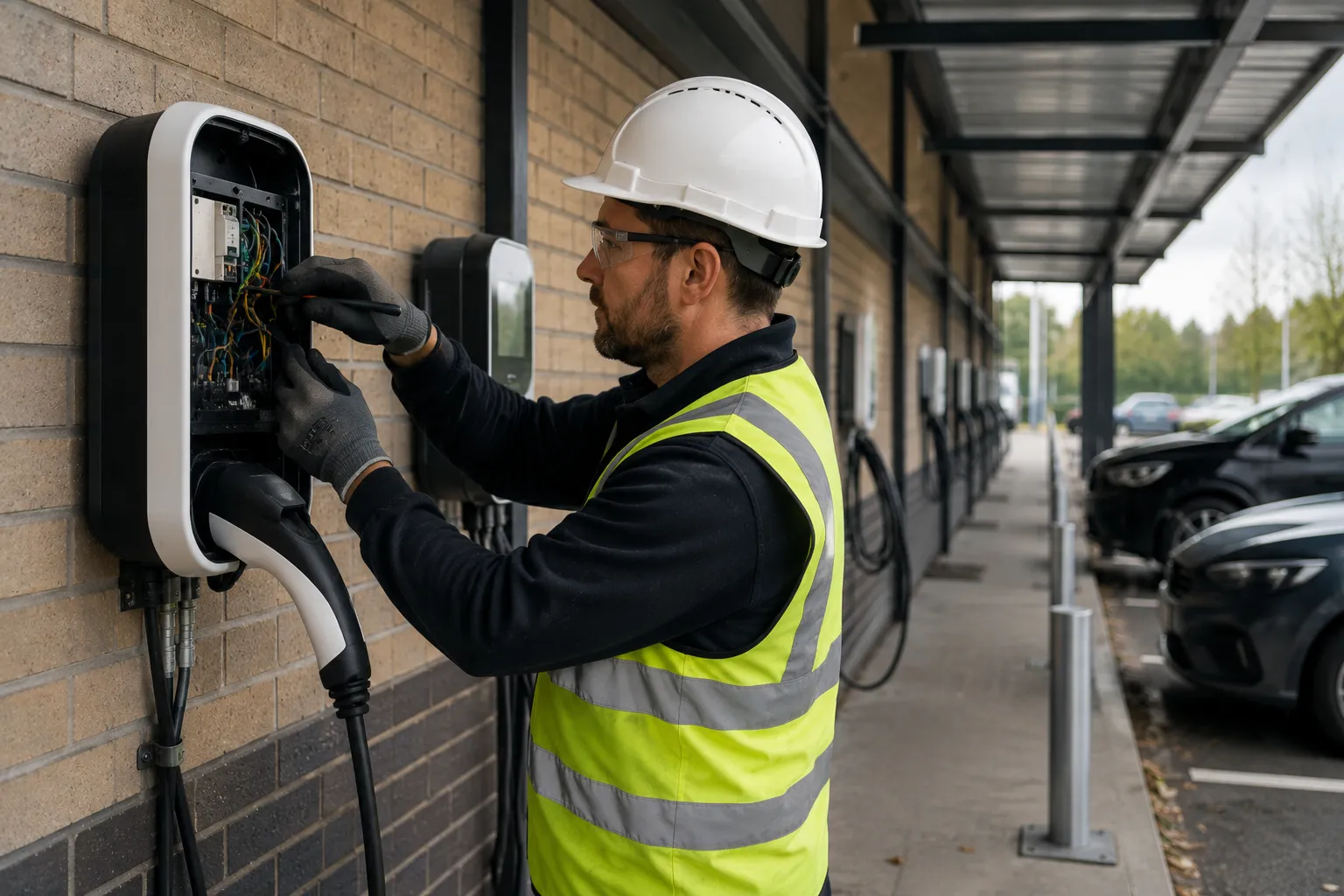
Commercial EV charging is fundamentally different from residential. A home installation is one charger, one circuit, one user. A commercial installation might be four, eight or twenty chargers sharing a single building supply, billing multiple users (employees, tenants, customers, fleet vehicles), coordinating with Energex on network capacity, and requiring load management hardware to prevent the total draw exceeding what the site can deliver. Done right, commercial EV charging becomes infrastructure your business depends on for decades. Done wrong, it trips breakers, fails audits, and produces ongoing billing disputes. Aurora Electrical Solutions delivers commercial EV charging across Brisbane, the Gold Coast, Logan and SEQ — workplace charging for staff and salary-sacrifice programs, fleet depot infrastructure, destination charging for hotels and retail, body corporate solutions for strata-managed apartments, and the underlying electrical scope (switchboard upgrades, sub-main runs, load management, Energex network coordination) that commercial deployments need. Aurora is a fully licensed Queensland electrical contractor (Licence EC91972), Master Electricians Australia members, fully insured with $20M public liability.
What's included
- AC Level 2 charger installation (7kW single-phase and 22kW three-phase) — Ocular, JET Charge, EVSE, Wallbox, Schneider EVlink Pro, ABB Terra AC, Delta AC Max
- DC fast charger installation (20kW – 150kW+) — Tritium (Brisbane-based), ABB Terra DC, Kempower, Delta UFC, Wallbox Supernova
- OCPP 1.6 and 2.0 compliant charger setup with management platform integration (AmpUp, ChargePoint, EV Connect, Driivz, EVPass, Charge Star)
- Load management hardware and software — prevents multiple chargers exceeding building supply capacity
- Three-phase supply provision and switchboard upgrades for multi-charger sites
- Sub-main runs to charger locations — including underground trenching across car parks
- Energex network notification, load assessment coordination and connection approval
- Workplace charging programs — staff allocation, salary-sacrifice integration, employee billing
- Fleet depot infrastructure — overnight charging design matched to fleet size and shift patterns
- Destination charging for hotels, restaurants, shopping centres and retail
- Body corporate / strata EV charging with individual sub-metering and resident billing
- Public charging infrastructure including DC fast charging hubs
- Solar PV and battery integration for charger load offset
- Future-proofing — sizing electrical infrastructure for planned charger expansion
- Maintenance and ongoing support contracts (see commercial maintenance page)
When you need commercial EV charging
If any of these apply to your business, commercial EV charging infrastructure is either already overdue or will be within 12-24 months as EV adoption accelerates.
- Your staff are increasingly driving EVs and need workplace charging access
- You're implementing a salary sacrifice EV program (FBT-exempt for EVs under the LCT threshold since 2022) and need supporting infrastructure
- You're transitioning your company fleet to EVs and need depot charging
- You operate a hotel, restaurant, shopping centre or gym where customers expect charging as an amenity
- You're a body corporate or strata manager with EV-owning residents asking about charging infrastructure
- You're a motor dealer selling EVs and need showroom and service department charging
- You're applying for federal DRIVEN program funding (up to $20,000 per site for eligible operators)
- Your existing single-residential EV charger is being shared by multiple vehicles and needs commercial-grade replacement
- You're planning a new commercial building or major renovation and want EV charging designed in from the start
- Your tenancy fitout has electric vehicle charging as a base building requirement
- Multiple stakeholders (employees, tenants, visitors) need billing/access control on the same chargers
- You're a property developer with EV charging in your project brief
- Your competitors are advertising EV charging and you're being left behind on customer/staff appeal
How much does commercial EV charger installation cost in Brisbane?
Commercial EV pricing varies enormously based on charger type, quantity, distance from switchboard, trenching requirements, and whether switchboard upgrades or sub-main runs are needed. Here's the typical Brisbane range for 2026:
- Single 22kW AC charger commercial install (3-phase, OCPP-compliant): typically $3,500 – $7,500 installed
- Multi-charger AC installation (4 × 22kW with load management): typically $18,000 – $35,000 installed
- Workplace charging package (8 × 22kW with billing platform): typically $35,000 – $70,000 installed
- Fleet depot infrastructure (12-20 × AC chargers with smart load management): typically $60,000 – $150,000+ installed
- Single DC fast charger (25-50kW): typically $25,000 – $55,000 installed
- DC fast charger (75-150kW): typically $60,000 – $150,000+ installed
- DC fast charging hub (4 × 150kW DC): typically $400,000 – $900,000+ installed (often requires HV connection)
- Load management hardware and commissioning: typically $2,000 – $8,000 depending on scope
- OCPP platform subscription (monthly): typically $20 – $60 per charger per month
- Energex network notification and load study: typically $500 – $3,000
- Switchboard upgrade for multi-charger site: typically $5,000 – $30,000+ depending on capacity required
- Sub-main run with car park trenching: typically $80 – $200 per linear metre depending on surface type
- Body corporate / strata EV charging with individual sub-metering: typically $4,500 – $9,000 per resident position
Every commercial EV project is custom-scoped after a site visit. Free initial consultation and load assessment. We coordinate Energex notification, prepare network load studies where required, and provide all documentation for grant applications (Federal DRIVEN, ARENA, Instant Asset Write-Off). Hardware-agnostic — we install the right charger for your use case rather than pushing one brand.
How long does commercial EV charging take to install?
Single AC charger commercial installs typically take 1-2 days. Multi-charger AC sites (4-8 chargers with load management) usually run 3-7 days depending on switchboard work and trenching scope. Fleet depot installations (12-20 chargers) typically take 2-4 weeks of on-site work plus the lead time for Energex network notification (4-12 weeks from application). DC fast charging projects involve longer Energex coordination — typically 8-20 weeks from application to energisation for new HV connections. We coordinate scheduling around your operating hours where the work permits, with most disruptive activities (switchboard work, supply isolations) scheduled for off-hours, weekends or scheduled shutdowns.
Choosing the right charger type for your commercial site
Commercial EV charging hardware splits into two fundamentally different categories. The right choice depends entirely on what your site is trying to achieve:
- AC Level 2 charging (7kW single-phase) — typical home-style installation; suits workplace amenity charging where vehicles are parked all day; ~50km of range per hour of charging; lowest installation cost; one charger per parking bay
- AC Level 2 charging (22kW three-phase) — the workhorse of commercial workplace charging; ~150km of range per hour; suits workplaces, hotels, destinations where vehicles park 1-4 hours; needs three-phase supply (most commercial sites have this)
- DC fast charging (25-50kW) — "medium-fast" charging; ~200-300km in 30-60 minutes; suits destination sites where customers stop for an hour (restaurants, larger retail, gyms); significant electrical infrastructure required
- DC fast charging (75-150kW) — "fast" charging; ~250-400km in 15-30 minutes; suits service stations, highway sites, fleet depots with quick turnaround; requires substantial HV infrastructure
- DC ultra-fast charging (150-350kW+) — "ultra-fast" charging; close to ICE refuelling speeds for vehicles that support 800V architecture; primarily for highway corridors, dedicated charging hubs, and high-volume fleet operations
- Hybrid AC/DC sites — increasingly common; AC chargers for staff and longer-stay customers, DC for quick-turnaround visitors; the right answer for many shopping centres and mixed-use sites
- Battery-buffered charging — battery storage paired with chargers for sites where grid capacity is the constraint; allows higher peak charging speeds than the grid connection alone would support
- Solar-integrated charging — chargers coordinated with on-site solar production; maximises self-consumption and lowest-cost charging during daylight hours; common for fleet depots with large roof areas
How a commercial EV project runs
Commercial EV charging projects involve more stakeholders and longer lead times than residential — Energex network coordination is often the critical path. Here's how a typical project runs:
- Free consultation and site assessment — We meet on site, understand the use case (workplace, fleet, destination, body corporate, public), assess the existing electrical infrastructure (incoming supply capacity, switchboard headroom, distance to proposed charger locations), and identify any obvious constraints. Free initial assessment, no commitment.
- Load study and Energex coordination — For multi-charger sites we conduct a load study calculating the diversified peak demand against site capacity. If new chargers exceed available capacity, we coordinate with Energex on network notification or connection upgrade. Energex lead times: 4-12 weeks for LV upgrades, 16+ weeks for HV connections. We initiate this early in the project so it doesn't block the install.
- Charger selection and OCPP platform setup — Recommend the appropriate hardware (AC vs DC, brand, port count) based on use case and budget. We're hardware-agnostic — we install the major brands and pick what suits your project, not what we have margin on. OCPP platform selected for billing, access control and monitoring (AmpUp, ChargePoint, EV Connect, Driivz, EVPass, Charge Star).
- Detailed design and fixed-price quote — Single-line diagram showing chargers, sub-mains, load management interconnections, switchboard work, Energex coordination. Fixed-price quote covering all electrical scope plus hardware. Documentation included for grant applications (Federal DRIVEN, Instant Asset Write-Off) where applicable.
- Installation — staged to minimise disruption — Switchboard work and supply isolations scheduled for after-hours, weekends, or planned shutdowns. Sub-main runs and trenching scheduled to minimise car park disruption (often one charging zone at a time). Charger mounting and connection per manufacturer specifications and AS/NZS 3000:2018. All cable runs through proper conduit with appropriate IP ratings for outdoor and exposed locations.
- Commissioning, OCPP setup, testing and handover — Every charger commissioned per manufacturer procedure, OCPP backend configured for billing and access control, load management commissioned and tested under fault conditions. Site documentation pack provided: as-built drawings, charger settings, OCPP credentials, Certificate of Test, Energex documentation, hardware warranties. Staff training on the management platform included.
Workplace charging — staff EVs, salary sacrifice, FBT exemption
Workplace EV charging is one of the highest-growth segments in commercial EV infrastructure right now, driven by the FBT exemption introduced in mid-2022 for electric vehicles under the Luxury Car Tax (LCT) fuel-efficient threshold. The exemption makes salary-sacrifice EV programs dramatically more attractive than internal combustion equivalents — many employees are saving $4,000-$10,000+ per year in pre-tax salary cost. As salary sacrifice EV uptake grows, workplaces need supporting infrastructure.
A typical Brisbane workplace charging installation: 4-12 × 22kW AC chargers in the staff car park, OCPP-managed for individual user identification and energy reporting, load-managed to share the building's available three-phase capacity, with employee billing or fixed-rate subsidisation handled through the OCPP backend. Total installation typically $35,000-$70,000 for an 8-charger workplace setup.
The economics work for the employer in several ways: it's a recruiting and retention benefit at moderate cost, it qualifies as part of the company's ESG and Scope 3 emissions reduction reporting, it supports the salary-sacrifice program (which is itself a tax-efficient compensation tool), and in some cases the workplace charging infrastructure itself qualifies for federal DRIVEN program funding (up to $2,500 per charger).
Three implementation models are common: free workplace charging (employer covers the electricity cost as a staff benefit), employee billing (each user pays per-kWh through the OCPP platform), fixed monthly contribution (employees pay a fixed amount regardless of usage). Aurora installs the infrastructure for all three; the model choice depends on your culture, HR policy and tax accountant's input.
Fleet depot charging — overnight scheduling, shift patterns, the math
Fleet depot charging is fundamentally a scheduling problem with electrical infrastructure attached. The principle: most fleet vehicles drive during the day and return to the depot overnight, so you have 10-14 hours of charging window per vehicle. With proper load management, that window is usually enough to charge a full fleet using AC infrastructure (significantly cheaper per port than DC).
The math for a typical Brisbane delivery or service fleet: a 50kWh EV battery, depleted to 20% during the day's work, needs 35kWh of charge overnight. At 22kW AC charging, that's 1.6 hours of actual charging. With load management staggering charging start times across the fleet, a 20-vehicle fleet can be fully charged overnight on a load-managed AC array drawing as little as 100-150kW peak — far less than the 440kW (20 × 22kW) you'd need if every charger ran simultaneously.
DC fast charging in fleet depots is usually only necessary for shift-overlap fleets (where vehicles need to charge during quick driver swaps) or for fleets with shorter dwell times (taxis, ride-share, food delivery). For most commercial fleets, AC charging with smart scheduling is cheaper, simpler, and operates equally well.
Aurora designs fleet depot infrastructure based on actual fleet operations: vehicle count, daily kilometres, dwell time patterns, future fleet growth plans. The design always builds in 50-100% more port capacity than current need, because retrofitting additional capacity later costs far more than installing it during the initial fit-out.
Destination charging — hotels, retail, hospitality, gyms
Destination charging is rapidly transitioning from "nice to have" to "expected amenity" for any business where customers stay 30 minutes to several hours. EV-driving customers explicitly choose destinations with charging available, and competitor sites that offer charging often win the business — particularly for higher-value customers and longer-stay visits.
Brisbane destinations now installing EV charging at scale: hotels (Marriott, Hilton, Accor properties all mandating EV charging at major sites), shopping centres (Westfield, Stockland, Mirvac all rolling out charging across portfolios), restaurants and pubs (particularly those with substantial car parks), gyms and fitness centres (Anytime Fitness, Plus Fitness, F45 destinations), medical centres and hospitals (staff and patient amenity), airports (already deploying at Brisbane and Gold Coast).
The sweet-spot configuration for most destinations: 2-6 × 22kW AC chargers (cover the typical 1-3 hour visit duration), OCPP-managed for individual billing, branded charging signage that doubles as wayfinding for EV-driving customers. Total installation typically $15,000-$45,000 for a mid-size destination site, often qualifying for partial federal DRIVEN funding.
Higher-end destinations and those near highways increasingly include DC fast charging too — typically 1-2 × 50-150kW DC stations alongside the AC array, giving "top-up" capability to passing customers who need 100-200km of range added during a meal or shopping visit. We design and install both AC and DC infrastructure to integrate cleanly under a single OCPP backend.
Body corporate / strata charging — the apartment problem solved
Body corporate and strata EV charging is one of the most-asked but least-well-implemented areas of commercial EV charging in 2026. The challenge: apartment residents own electric vehicles but the building's electrical infrastructure was designed before EV charging was contemplated. Just running 22kW circuits to 50 residents' parking bays would multiply the building's demand by 5-10×, far beyond what the existing connection can support.
The solution Aurora delivers for Brisbane body corporates and strata: smart load-managed shared infrastructure with individual sub-metering. Instead of every resident having a dedicated charger drawing 7-22kW continuously, all chargers share the building's available capacity (typically 50-150kW depending on building size), with load management throttling individual chargers as needed to stay within budget. Each resident's usage is metered separately and billed back via the OCPP platform.
Practical implementation: chargers installed at parking bays as residents adopt EVs (incremental rollout rather than upfront full deployment), shared OCPP backend manages access control (only the bay owner can use their charger), individual metering allocates exact kWh to each resident's billing, body corp owns the infrastructure but residents pay for their own usage at cost-recovery rates. Typical install cost: $4,500-$9,000 per resident position depending on cable distance and infrastructure shared.
Body corp governance considerations are real but solvable: the by-laws need to permit the installation, the building manager needs to support the OCPP platform administratively, and dispute resolution processes need to address billing edge cases. We work with body corp managers on the technical scope; the legal and governance work typically sits with the body corp's strata lawyer.
OCPP and load management — why "dumb" chargers don't work commercially
A residential EV charger can be a "dumb" hardware unit — install it, plug in your car, charge. A commercial charger cannot. Three capabilities are non-negotiable for commercial deployment:
OCPP (Open Charge Point Protocol) — the universal protocol that lets chargers communicate with a central management platform. OCPP enables individual user identification (via RFID card, app, or licence plate), per-session energy metering, billing integration, remote diagnostics, firmware updates, and access control. OCPP 1.6 is the current widespread standard; OCPP 2.0 adds features like ISO 15118 plug-and-charge support. Without OCPP, you can't accurately bill users or restrict access — fatal for commercial deployment.
Load management — the system that prevents multiple chargers exceeding the site's available capacity. Without load management, an 8-charger site at 22kW each would attempt to draw 176kW whenever all chargers are active — overloading building supplies that typically have 50-150kW available. Load management throttles individual chargers dynamically, prioritising vehicles with the lowest charge state, and shedding load when other building demand spikes (AC, lifts, manufacturing equipment). It's the difference between a system that works and one that constantly trips the main breaker.
Solar and battery integration — increasingly expected for ESG and operating cost reasons. Smart chargers coordinate with on-site solar production to charge primarily during daylight hours, drawing only minimal grid power. Battery storage can buffer peak demand, allowing higher charger speeds than the grid connection alone would support. Both integrate with the OCPP platform for unified management and reporting.
Aurora's commercial EV approach centres on these three capabilities by default — we don't quote "dumb hardware" installs because they create more problems than they solve for any multi-charger commercial deployment.
Energex coordination — network notification, load studies, connection upgrades
Commercial EV charger installations in Brisbane require coordination with Energex (the local Distributed Network Service Provider). For installations exceeding a certain load threshold or for multi-charger sites, network notification is mandatory before energisation. Energex may require a load study confirming the existing connection can support the new load, and may require connection upgrades for sites where capacity is insufficient.
Typical Energex coordination workflow: load assessment (we calculate the diversified peak demand of the proposed installation against existing site demand and connection capacity), network notification or connection alteration application (lodged with Energex with the load study and single-line diagram), Energex review and approval (typically 4-12 weeks for LV upgrades, 16+ weeks for HV connections involving new transformers or feeders), energisation (Energex sign-off allowing the new installation to be connected and operated).
The critical path for most multi-charger commercial projects is the Energex lead time, not the on-site electrical work. We initiate Energex coordination early in the project so it doesn't delay the schedule. For larger installations involving substantial connection upgrades, the lead time can be 6+ months from application — worth planning for at the project's outset.
Aurora handles all the Energex coordination on the customer's behalf — load assessments, network notifications, connection alteration applications, technical liaison through review and approval. The customer sees a clean single point of contact rather than navigating Energex requirements directly.
Federal grants and funding — DRIVEN, Instant Asset Write-Off, ARENA
Several federal funding mechanisms support commercial EV charging investment in 2026. Aurora prepares the technical documentation for grant applications as part of our commercial EV scope.
Federal DRIVEN Program — up to $2,500 per charger and $20,000 per site for eligible motor dealers and EV service providers. Workplace and destination installations may qualify depending on specific eligibility criteria. Application requires detailed scope of works, equipment specifications, and installation timelines — all of which we provide as part of our project documentation.
Federal Instant Asset Write-Off — the $20,000 threshold may apply to qualifying EV charging equipment installed by eligible small businesses. Worth discussing with your accountant — for a business buying multiple chargers, the deductibility of individual units under the threshold can make a meaningful difference to first-year tax position.
ARENA grants — Australian Renewable Energy Agency periodically opens funding rounds for larger EV charging projects, particularly DC fast charging hubs and commercial fleet electrification programs. Eligibility varies by round; not generally available for small workplace charging installations but can be substantial for large destination or public charging projects.
Queensland-specific note — unlike NSW (Kick-Start Fund) and Victoria (various commercial EV charging programs), Queensland does not currently operate a major state-level commercial EV charger rebate program. Federal funding is the primary support channel for QLD-based projects in 2026. ARENA-funded projects sometimes prioritise QLD locations to balance the federal investment portfolio.